
Key Takeaways
- Product engineering services help enterprises turn digital transformation into a scalable, long-term business capability rather than isolated technology projects.
- A product-centric engineering model improves time-to-market, scalability, customer experience, and continuous innovation across the product lifecycle.
- Modern product engineering combines cloud-native architecture, AI readiness, DevOps, security, APIs, and automation into a unified delivery framework.
- Reducing technical debt and improving architecture readiness enables faster releases, lower operational costs, and stronger business agility.
- Enterprises that integrate product engineering with modernization and governance are better positioned to scale digital products securely and sustainably.
Enterprises are increasingly judged by the digital products they put in front of customers, employees, partners, and operations teams. A banking app, commerce platform, patient portal, SaaS dashboard, or AI-powered workflow isn’t just a technology asset anymore. It’s how the business acquires revenue, protects margin, scales operations, and differentiates itself from competitors.
That shift shows up clearly in global investments. Enterprise investment in digital transformation is projected to approach $4 trillion by 2028. But spending at that scale doesn’t automatically produce returns. Effectiveness usually depends on one difference: whether technology becomes a repeatable product capability or stays a series of disconnected projects.
Product engineering services exist to close that gap, bringing product strategy, architecture, UX, cloud, AI readiness, DevOps, security, and continuous improvement into a single, coherent lifecycle rather than stitching them together after the fact.
This article highlights how leaders can use product engineering to continuously deliver and maintain improved products to market and use digital transformation to enhance brand reputation and scalability.
What Are Product Engineering Services?
Product engineering services cover the full product lifecycle, from design and development through modernization, deployment, and ongoing improvement. A third-party provider handles it end-to-end, so internal teams aren’t stretched across every layer of the stack.
In an enterprise context, the scope goes well beyond shipping code. The focus shifts to strategy, architecture, UX, cloud, DevOps, AI, analytics, security, and the kind of long-term thinking that keeps products performant as the business evolves. Here, product engineering differs from traditional project-based development. The strategy changes from product-centric engineering to project-centric development:
| Dimension | Project-Centric Development | Product-Centric Engineering |
| Primary focus | Scope completion | Business value and product outcomes |
| Delivery horizon | Launch or release date | Full product lifecycle |
| Ownership model | Team-based handoffs | End-to-end accountability |
| Optimization | Often post-launch and reactive | Continuous and data-led |
| Architecture thinking | Built for current requirements | Built for scale, change, and integration |
| Enterprise value | Delivery output | Long-term digital capability |
A mature product engineering strategy helps enterprises decide which platforms need modernization, which capabilities should move to cloud-native architecture, where AI can improve workflows, and how digital products should evolve with business priorities.
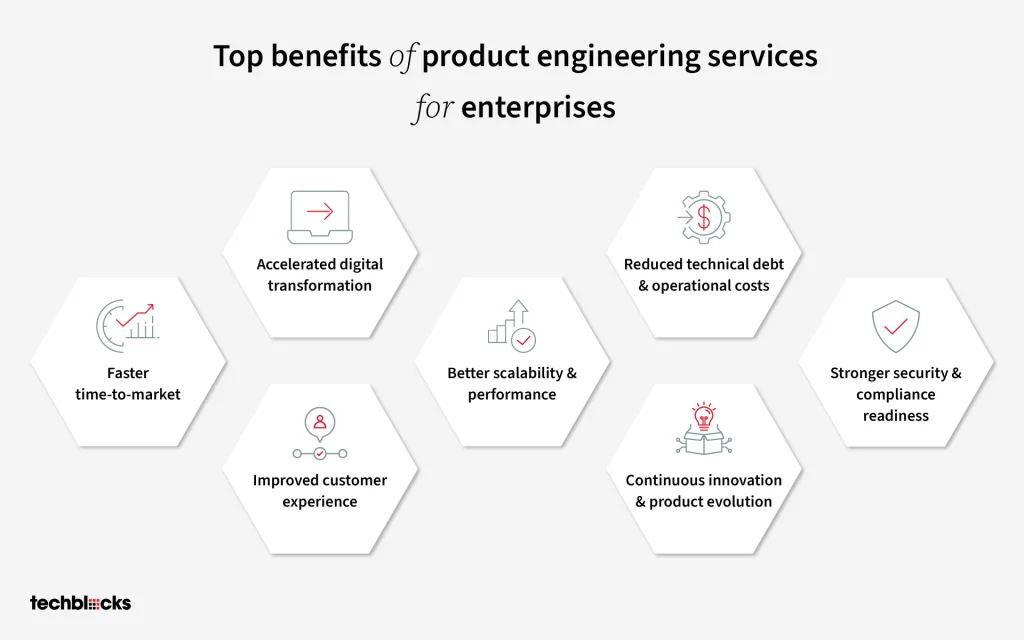
Top Benefits of Product Engineering Services for Enterprises
The real value of product engineering shows up when enterprises stop treating speed, modernization, scalability, customer experience, cost control, security, and innovation as separate problems to be solved sequentially. These are interdependent priorities:
- Faster releases only matter if the platform scales reliably behind them.
- AI adoption only delivers if the data, workflows, and governance are ready to support it.
- Customer experience improves only if the underlying architecture can handle performance, personalization, integration, and continuous change simultaneously.
Product engineering brings those priorities into a single operating model, enabling enterprises to build digital products that launch faster, adapt more easily, and withstand business pressure.
Faster Time-to-Market
Market windows close fast and are unpredictable. That makes speed a priority for executives. Product launches, feature releases, AI pilots, and workflow automation initiatives all lose value when delivery stretches across quarters without visible progress.
Agile product engineering shortens time-to-market by reducing friction across discovery, design, development, testing, deployment, and release. But the goal isn’t reckless acceleration. It is for enterprise teams to achieve faster delivery with stronger control, clearer prioritization, automated quality gates, and scalable release discipline.
The bottlenecks that slow most enterprises down are familiar:
- MVP scopes that keep growing until validation gets pushed out indefinitely
- Manual testing and deployment processes
- Legacy dependencies that make every release harder than the last
- Product, engineering, security, and operations teams working in sequence rather than in parallel
- Architecture decisions made for short-term convenience rather than long-term adaptability
A stronger product engineering process shifts enterprises away from large, delayed releases toward smaller, validated increments. MVPs reach the market faster. Feedback comes earlier. Priorities can be adjusted before budgets get locked into work that isn’t delivering value.
For senior leaders, time-to-market is worth measuring by learning velocity as much as launch velocity. How fast a team ships a feature matters, but how quickly the business can test, refine, scale, or retire a product decision based on real evidence matters more.
Accelerated Digital Transformation
Digital transformation often slows when modernization, cloud adoption, AI integration, and workflow redesign are managed as separate initiatives. One team may modernize applications, another may build automation, another may pursue analytics, and another may evaluate AI. Without a unified product model, transformation becomes fragmented.
Product engineering services give enterprises a structured way to connect these priorities:
| Transformation priority | Product engineering response | Business impact |
| Legacy application constraints | Refactor, re-platform, or modernize core components | Lower risk and better agility |
| Cloud migration | Build cloud-native or hybrid architecture based on workload needs | Better scalability and resilience |
| AI integration | Prepare data flows, APIs, workflows, and governance | Higher AI readiness |
| Workflow inefficiency | Automate repetitive or rules-based processes | Lower operating burden |
| Fragmented systems | Build integration layers and reusable services | Better enterprise connectivity |
Legacy systems can be assessed by business criticality, technical debt, integration risk, customer impact, and modernization value. Not every system needs a full rebuild. Some need API enablement. Others need refactoring, re-platforming, cloud migration, data integration, or selective replacement.
Improved Customer Experience
An aesthetic interface can’t save a product that’s slow, unreliable, or forgetful about who the customer is. When experiences break across channels, personalization feels generic, or data is inconsistent, no amount of visual polish makes up for it.
Engineering is what holds CX together. When UX, analytics, architecture, APIs, and performance work as one system rather than separate concerns, teams finally get visibility into what’s actually happening, where people give up, what creates friction, what’s driving adoption, and what’s silently frustrating customers who never complain.
The CX improvements that matter most at enterprise scale are fundamentally engineering problems:
- Personalization lives or dies on clean data and solid decision logic.
- Seamless omnichannel needs consistent APIs and a shared view of the customer.
- Shipping faster requires modular architecture and automated pipelines.
- Self-service only works when access is secure, and backends hold up.
- Mobile experiences need real performance investment, not afterthought optimization.
Retention, engagement, conversion, and differentiation move when the product works well. The leaders who get the most out of CX investments are the ones who’ve stopped treating it as a design metric and started treating it as a product performance metric.
A better digital experience directly supports retention, engagement, conversion, and competitive differentiation. For C-suite leaders, the most useful shift is to evaluate customer experience as a product performance metric, not only a brand or design metric.
Better Scalability and Performance
Scalability separates a product that grows with the business from one that has to be rebuilt every time it does. Modern enterprises are absorbing heavier transaction loads, expanding data sets, more integrations, rising AI demands, and tighter uptime expectations all at once. Modern product engineering handles this through cloud-native architecture, microservices, API-first development, containers, and resilient system design, paired with the observability and performance testing needed to catch problems before they become outages.
The cloud-native shift is already mainstream, with 82% of container users running Kubernetes in production. This validates Kubernetes as a common operating layer for cloud-native applications and AI workloads.
Also, scalability decisions should not be postponed until systems fail under pressure. They should be prioritized as per requirements and implemented as per engineering capabilities:
| Scalability need | Engineering implication |
| Higher traffic | Elastic infrastructure and load-aware design |
| More integrations | API-first architecture and integration governance |
| Faster feature growth | Modular services and reusable components |
| AI workloads | Compute-aware architecture and data pipeline readiness |
| Global expansion | Resilient infrastructure, localization support, and observability |
| Reliability expectations | Monitoring, automated recovery, and performance engineering |
A scalable product foundation helps enterprises support growth without turning every new requirement into a major technology program.
Reduced Technical Debt and Operational Costs
Technical debt gets expensive fast, and not just in maintenance costs. It slows decision-making, increases security exposure, and makes every release harder than the last. Legacy code gets most of the attention, but debt accumulates in plenty of other places, too. For example, outdated infrastructure, duplicated systems, brittle integrations, manual operations, poor documentation, weak test coverage, and unmanaged cloud spend.
Product engineering services take that weight off your team. They improve architecture, refactor what’s brittle, automate the tedious stuff, and cut the processes that no longer earn their keep. When technical debt stops quietly draining your capacity, something shifts. Engineers stop playing defense with fragile systems and start doing the work that actually matters: improving customer experience, bringing AI into the product, opening new markets, and building things worth the effort.
Leaders gain more traction by prioritizing debt reduction through a business-impact lens rather than a technical one. The right questions are:
- Which systems slow revenue-critical product changes?
- Which platforms create compliance or security exposure?
- Which workflows still depend on excessive manual effort?
- Which applications absorb maintenance budget without supporting growth?
- Which architecture constraints are blocking AI, analytics, or cloud scalability?
Approached that way, debt reduction stops being a cleanup initiative and starts being a growth enabler.
Continuous Innovation and Product Evolution
Digital transformation stalls when products are treated as finished the moment they launch. Markets shift with customers, regulations, and technology, which is why products need a lifecycle model built for continuous change rather than one designed for one product launch only.
A strong product engineering lifecycle weaves together experimentation, analytics, user feedback, backlog governance, performance optimization, security, and emerging technology. AI adds its own demands on top of that with model evaluation, data quality, workflow integration, governance, monitoring, and ongoing refinement.
The enterprises that get this right don’t bolt AI or automation onto the side. They find where intelligence can move the needle on outcomes that actually matter: faster service resolution, sharper recommendations, fraud reduction, underwriting accuracy, inventory visibility, better patient engagement, and higher workflow productivity.
A practical product engineering roadmap should connect inputs with executive questions:
| Roadmap input | Executive question |
| Customer behavior data | Where is friction affecting revenue or retention? |
| Operational performance | Which workflows create cost or delay? |
| Architecture health | Where does the technical debt block change? |
| AI feasibility | Which use cases have usable data and measurable value? |
| Security and compliance | Which risks need to be addressed before scale? |
| Market priorities | Which capabilities protect or expand competitive position? |
Continuous innovation becomes more predictable when product investment decisions are tied to evidence, architecture readiness, and business outcomes.
Stronger Security and Compliance Readiness
Security and compliance can’t be left to the final stretch. Enterprise products now sit on a web of APIs, cloud services, third-party integrations, AI models, and distributed infrastructure. The later controls get added, the more expensive and fragile they become.
A secure product engineering strategy means building protection into every stage, from architecture and design through development, testing, deployment, and monitoring. DevSecOps helps teams catch vulnerabilities earlier, automate checks, manage identity and access, protect data, and cut the cost of fixing problems after the fact.
In regulated industries, compliance can’t be retrofitted. It has to be in the foundation. That means controlled access, encryption, traceability, logging, and governance models that can actually keep pace with release cycles.
Security is also what makes a product resilient. Something that can’t be monitored, patched, recovered, or audited is a technical and a business liability. Enterprise leaders need to treat secure engineering as part of what makes a product good, not a separate risk function that shows up after the work is done.
Technologies Enabling Modern Product Engineering
Modern enterprise teams use complex tech stacks that grant products the scale, intelligence, interoperability, resilience, automation, and continuous delivery they require. That purpose needs leaders to choose technologies that have active roles in enterprise-grade product engineering:
| Technology area | Role in enterprise product engineering |
| Cloud-native architecture | Supports elasticity, resilience, global availability, and faster provisioning |
| DevOps and CI/CD | Automates testing, deployment, release governance, and environment consistency |
| AI and machine learning | Enables personalization, prediction, intelligent automation, and decision support |
| Kubernetes and containers | Improves workload portability, scaling, and deployment consistency |
| APIs and integrations | Connects products with enterprise systems, partner ecosystems, and data platforms |
| Microservices | Allows modular development, independent scaling, and faster product change |
| Automation frameworks | Reduces manual effort across testing, operations, and workflows |
| Data analytics platforms | Converts product usage and operational signals into roadmap insight |
However, technology only delivers value when it’s properly architected, governed, and integrated. Microservices without ownership discipline add complexity. Cloud without cost governance bleeds budget. AI without data readiness never leaves the pilot stage. APIs without lifecycle management just become another layer of dependency.
Digital product engineering helps here. It works when technology decisions are grounded in product economics, customer outcomes, operating risk, and scalability. This way, you have accountable, reliable tech to deliver maximum value with minimal risk.
Enterprise Use Cases of Product Engineering Services
Enterprise use cases demonstrate where product engineering delivers measurable value. Each sector has different constraints, but the underlying need is similar: scalable, secure, intelligent products that improve customer experience and operational performance.
Retail and E-Commerce Platforms
Retail and e-commerce leaders need platforms that can handle personalized commerce, omnichannel journeys, mobile-first experiences, real-time inventory, loyalty integration, and checkout at scale. And all while absorbing seasonal spikes and shifting customer behavior.
Product engineering helps retailers build storefronts that handle higher traffic, enable faster merchandising changes, deliver smarter recommendations, and drive stronger post-purchase engagement. Better architecture also makes it easier to connect ERP, CRM, inventory, payments, logistics, and customer data without the usual friction.
The payoff is a cleaner shopping experience with other benefits. Retailers see stronger conversion, lower abandonment, higher retention, and clearer visibility across the entire commerce operation.
FinTech and Banking Platforms
Financial services organizations need to move fast without eroding trust. Digital banking apps, payment platforms, onboarding journeys, fraud monitoring, and compliance workflows must all be secure, reliable, and scalable.
Product engineering helps financial institutions through secure architecture, API ecosystems, automation, identity management, compliance traceability, and real-time monitoring. AI can sharpen fraud detection, customer service, risk analysis, and personalization, but only when the underlying data, governance, and workflows are actually engineered to support it.
Healthcare and HealthTech Platforms
Healthcare products have to get several things right at once, including usability, privacy, interoperability, and reliability. Telemedicine systems, patient engagement platforms, scheduling workflows, access to records, and care coordination tools all depend on an architecture that leaves little room for error.
Product engineering helps healthcare organizations improve data exchange, access controls, patient-facing workflows, system performance, and integration with existing infrastructure, without disrupting the operations that teams and patients already depend on.
SaaS and Enterprise Applications
SaaS and enterprise applications live or die by their ability to scale. Cloud-native architecture, multi-tenant design, role-based access, subscription workflows, usage analytics, and reliable integrations let a product grow without cracking under pressure.
Consulting with product engineers helps SaaS leaders take an honest look at architecture maturity, platform scalability, onboarding friction, roadmap feasibility, and release reliability. The goal is a foundation that supports more customers, more features, and more complex enterprise demands without constant rework as the business grows.
Conclusion: Product Engineering as a Driver of Digital Transformation
Digital transformation delivers when enterprises can build products that launch faster, scale reliably, reduce technical debt, support AI adoption, and keep improving after release. Product engineering services make that possible by bringing strategy, architecture, UX, cloud, DevOps, security, analytics, and continuous optimization into a single connected lifecycle.
For most enterprises, the problem is connecting modernization priorities to execution without disrupting the business. At TechBlocks, we help organizations design, build, modernize, and scale digital products using engineering models tied to measurable outcomes. Our services include MVP delivery, cloud-native architecture, AI-ready ecosystems, DevOps automation, UX-led design, application modernization, and performance optimization. Our goal, beyond faster development, is to build products that remain adaptable, secure, scalable, and commercially relevant as the business evolves.
With the right product engineering strategy, digital transformation stops being a series of disconnected initiatives and becomes a sustained growth capability.
Make product engineering a long-term business capability that grows with your enterprise.
Book a 15-minute discovery call today!
FAQs on Benefits of Product Engineering Services
Traditional software development usually focuses on delivering a defined application or feature set. Product engineering covers the full lifecycle, including strategy, UX, architecture, development, deployment, modernization, analytics, scalability, security, and continuous improvement. The focus is broader because the product continues to evolve after launch.
They help enterprises integrate modernization, cloud adoption, AI integration, customer experience, faster delivery, and continuous optimization into a single execution model. Digital transformation fails when initiatives remain disconnected. Product engineering creates the structure needed to build scalable, secure, and adaptable digital products.
They improve scalability through cloud-native architecture, microservices, API-first engineering, containers, observability, infrastructure optimization, and performance testing. These capabilities help products handle more users, transactions, data, integrations, and AI workloads without requiring repeated re-architecture.
Common technologies include cloud platforms, DevOps tools, CI/CD pipelines, APIs, microservices, containers, Kubernetes, automation frameworks, AI and machine learning systems, analytics platforms, monitoring tools, and security solutions. The right stack depends on workload complexity, scale, compliance needs, and business goals.
It reduces technical debt by modernizing legacy systems, refactoring fragile components, automating testing and deployment, improving architecture, strengthening documentation, optimizing infrastructure, and removing redundant processes. Lower debt improves maintainability, release speed, operational efficiency, and long-term product agility.