The enterprise AI Center of Excellence was a reasonable organizational response to a real problem. When AI pilots started multiplying in 2022 and 2023, someone needed to review them for security, establish tooling standards, and prevent every business unit from independently contracting with five different AI vendors. Centralizing that function made sense.
Three years later, that same CoE is the primary bottleneck in most enterprise AI programs. Not because the people in it are the wrong people. Because the structure that made sense for governing ten AI pilots cannot govern the distributed, production-grade AI capability that enterprise competitive strategy now requires.
This article is not an argument against Centers of Excellence. It is a precise diagnosis of what CoEs can and cannot do, and an explanation of what must exist alongside them, the AI Operating Model, if enterprise AI is going to move from centrally managed asset to distributed enterprise capability.

AI Center of Excellence vs. AI Operating Model: How They Differ
| Dimension | AI Center of Excellence | AI Operating Model |
| Primary function | Standards, expertise, governance policy | Capability infrastructure + embedded governance |
| How it scales | Headcount growth in central team | Tooling and infrastructure — independent of headcount |
| Governance | Review processes and policy docs | Automated controls in development and deployment tooling |
| AI ownership | CoE owns AI systems; BUs are users | Business units own outcomes; CoE provides infrastructure |
| Success metric | AI use cases reviewed and approved | Business outcomes delivered through AI enterprise-wide |
| Bottleneck risk | High — becomes queue as demand grows | Low — standards enforced by tooling not approvals |
Key Insight
The CoE establishes standards. The Operating Model enforces them through tooling. Both are required — in the right structural relationship.
Three Signs the CoE Has Become the Ceiling
Most enterprise AI Centers of Excellence (AI CoE) do not fail suddenly. The transition happens gradually, often while the organization still believes the governance model is working. AI pilots continue shipping. New tools continue entering the environment. Business units continue requesting support. On the surface, the enterprise appears to be scaling AI adoption successfully.
The structural problem emerges underneath that activity. As AI demand spreads across departments, workflows, and operational systems, the centralized review model begins struggling to keep pace with the velocity it was originally designed to govern. The same CoE that once accelerated AI standardization slowly becomes the dependency every deployment must wait on.
This transition from governance asset to structural bottleneck follows a highly consistent pattern across enterprise AI programs. The signs usually appear long before leadership formally recognizes that the operating model itself has become the limiting factor.
Here are the three indicators that the CoE has become the ceiling rather than the enabler of enterprise AI scale.
Sign One: The Review Queue Is Longer Than the Delivery Cycle
When a business unit’s AI initiative needs to wait six to eight weeks for a CoE security and architecture review, and the AI initiative itself can be prototyped in three weeks, the governance function has inverted. The team that is supposed to enable faster, safer AI deployment is slowing deployment below the speed of an ungoverned alternative.
The response is usually to hire more CoE staff. This delays the ceiling but does not eliminate it. A CoE that scales by headcount will always lag behind a business that scales AI demand through technology. The structural fix is to move governance from a review process into the tooling itself.
Sign Two: Shadow AI Programs Are Multiplying
When business units begin contracting directly with AI vendors, deploying point solutions that bypass the CoE review process, and building team-level AI capabilities without central visibility, the CoE has lost practical authority. The units are not trying to circumvent governance. They are responding to a queue that makes the alternative more attractive than the official path.
Shadow AI programs are not just a governance risk. They are a compounding cost. Each team building its own AI data access layer, its own model integration, and its own governance workaround is paying a tax that the Operating Model would eliminate. TechBlocks estimates the shadow AI tax at 20 to 35 percent of total AI program spending in organizations that have reached this stage.
Sign Three: AI Lives in Dashboards, Not Decisions
When the CoE builds AI systems for business units rather than equipping business units to build AI capability themselves, the outputs are typically dashboards, reports, and tools that sit adjacent to decisions rather than inside them. The business unit receives an AI-generated insight. The process by which that insight becomes a decision remains unchanged.
This is the most insidious form of the CoE ceiling because it produces real AI activity with minimal AI impact. Hours are spent. Budgets are consumed. Presentations show impressive model performance. Operating metrics remain static.
The question is not whether the CoE is doing its job well. The question is whether the job the CoE was designed to do is the job the enterprise AI program actually needs done.
The Operating Model Is Not a Replacement. It Is a Different Layer.
Enterprises that move past the CoE ceiling do not eliminate their CoE. They redefine its function. The CoE becomes the standards body and expertise resource. The Operating Model becomes the infrastructure layer that enforces those standards at scale, without the CoE needing to review every deployment.
The AI Operating Model, as TechBlocks designs it, is the enterprise-wide system that makes AI capability consistent, governed, and scalable across every business function. It has three structural components that correspond directly to TechBlocks’ three delivery engines.
Shared Data Infrastructure (The Context Engine)
The Enterprise Data Organization (EDO) is the data layer of the AI Operating Model. It defines who owns each data domain, enforces quality standards through automated contracts, maintains lineage from source to AI consumer, and delivers governed data products that every AI system in the enterprise can consume without rebuilding the data access layer from scratch.
In a CoE-only model, each AI initiative builds its own data access. The EDO eliminates that redundancy. It also eliminates the category of AI failure that comes from agents and models reasoning over ungoverned data: the hallucinations, the inconsistent outputs, the decisions that look right but are grounded in stale or incomplete information.
A large utility enterprise used the EDO framework to centralize grid telemetry, asset performance, and weather data into governed data products that multiple AI systems could consume simultaneously. Before the EDO, each operational AI initiative was building its own SCADA integration independently. After the transition, new AI deployments consumed shared governed data products that already existed, significantly reducing integration overhead while improving consistency, lineage, and governance across operational AI systems.
AI Development Infrastructure (The Delivery Engine)
The AI-Accelerated Software Factory is the engineering layer that embeds governance into the development toolchain rather than the review process. It establishes reference architectures for AI, data, and cloud delivery, automates testing and security gates across the SDLC, and ensures that every AI system built by any team in the enterprise meets defined quality and safety standards without requiring CoE review of every pull request.
This is the structural solution to the review queue problem. Standards are not enforced by a person reviewing a proposal. They are enforced by the tooling that every team uses to build and deploy AI systems. A team can deploy an AI feature in three weeks and meet every CoE standard because the standard is built into the pipeline, not waiting at the end of it.
Orchestration Infrastructure (The Precision Engine)
The Enterprise Orchestration Layer is the runtime coordination mechanism that makes AI capability consistent across the enterprise. It routes tasks to the right model at the right cost, enforces policies at inference time rather than at review time, logs every AI-driven decision with full context for audit, and provides the human-in-the-loop controls that regulated enterprises require without those controls becoming manual bottlenecks.
This layer is what makes each successful AI workflow pattern reusable. In a CoE-only model, a successful AI implementation in one business unit is not automatically available to another. In an Operating Model, the orchestration layer captures the successful pattern, and the next business unit builds on existing infrastructure rather than rebuilding from scratch.
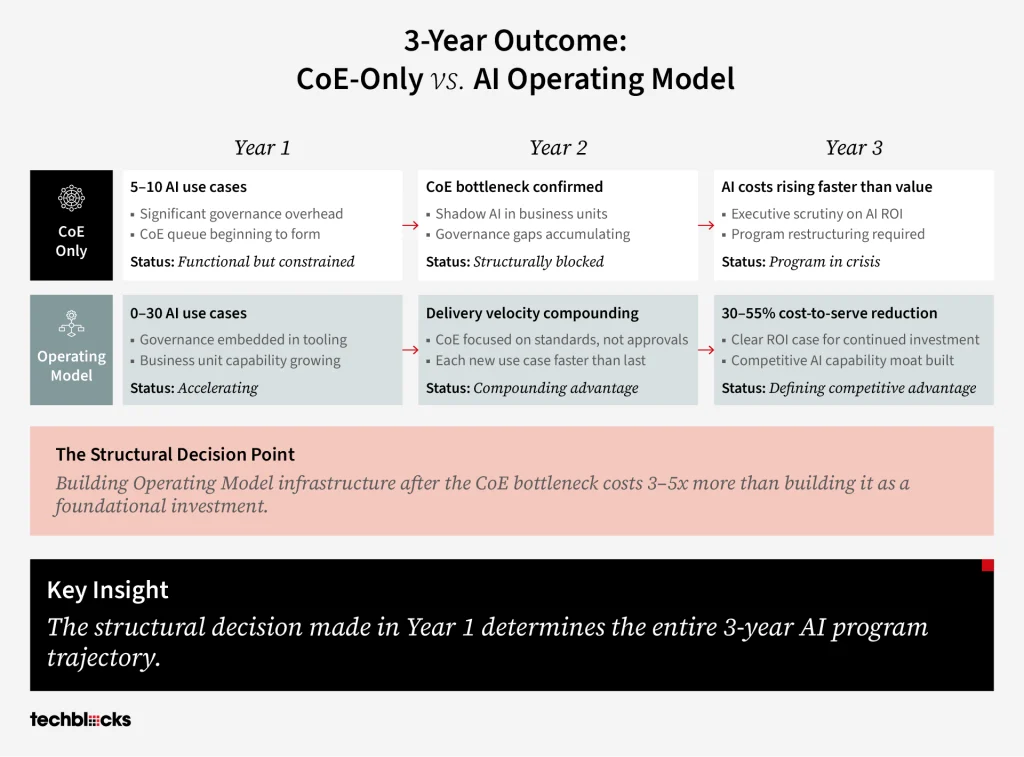
What the Transition From CoE to Operating Model Looks Like
The transition is not a reorganization. It is an infrastructure build. The CoE keeps its function. The three engines are built underneath it so the CoE can enforce standards through tooling rather than through reviews.
TechBlocks structures this transition through the same three-stage model that applies to enterprise AI broadly:
- Stage 1 establishes the infrastructure: the EDO data layer, the AI-Accelerated Software Factory reference architectures, and the Orchestration Layer control plane. This is the work that most organizations are missing when they ask why their CoE is not scaling. It takes three to six months and produces a foundation that every subsequent AI deployment builds on.
- Stage 2 activates the infrastructure: AI is embedded in production workflows using the shared data products, the governed delivery toolchain, and the orchestration layer. Each successful workflow improvement is captured as a pattern that the next deployment inherits. The CoE is no longer reviewing deployments; it is curating patterns.
- Stage 3 extends the infrastructure to the operating model: AI orchestrates work across the enterprise, not just within defined workflows. The CoE has become an enterprise AI architecture function, not a deployment review function. Business units build AI capability at their own velocity within a governed framework they did not have to build themselves.
| CoE Function (stays) | Operating Model Function (added) |
| AI standards and policy definition | Standards enforcement through tooling, not reviews |
| Vendor and tooling governance | Shared infrastructure available to all business units |
| AI risk and compliance oversight | Runtime governance at inference — not post-deployment audit |
| Center of expertise and enablement | Distributed AI capability built on shared foundation |
| AI strategy and roadmap input | Outcome accountability at business unit level |
The Commercial Model That Changes the Risk Equation
TechBlocks delivers enterprise AI transformation through what it calls the ELEVATE commercial model: outcome-based engagement where TechBlocks’ commercial terms are aligned to the business outcomes the program is supposed to deliver.
For the AI Operating Model build specifically, this means TechBlocks’ engagement success is measured against the metrics that the Operating Model is supposed to move: cost-to-serve, delivery velocity, operational overhead reduction, and AI adoption across the enterprise. The numbers TechBlocks commits to from Stage 1 through Stage 3:

These are not projected benefits from a market research report. They are benchmarks observed across TechBlocks enterprise AI transformation engagements delivered in regulated industries, retail, utilities, healthcare, and other large-scale operational environments. The range reflects variation in organizational starting conditions, particularly the maturity of the existing data foundation, engineering discipline, and governance infrastructure. Enterprises with stronger operational foundations typically realize value faster and move toward AI Operating Model maturity with significantly less friction.
The Practical Starting Point
For most organizations reading this, the starting point is an honest assessment of where the CoE model has reached its limits. Is the review queue longer than the delivery cycle? Are shadow AI initiatives emerging across business units? Is AI generating insights without materially changing how decisions are made?
If the answer to any of these questions is yes, it may be time to evaluate an AI Operating Model. TechBlocks’ AI Transformation Architects conduct a 90-day assessment that maps current CoE capabilities against operating model requirements, identifies critical infrastructure and governance gaps, and develops a sequenced roadmap aligned to measurable business outcomes.
The decisions made during this phase can shape how effectively AI scales across the enterprise for years to come. Organizations that establish the right operating foundations today are better positioned to move beyond isolated pilots and create repeatable, enterprise-wide value from AI investments.
Speak with an AI Transformation Architect about building your AI Operating Model.
FAQs on AI Center of Excellence vs. AI Operating Model
Most organizations do not recognize the CoE bottleneck until AI adoption begins slowing despite growing business demand. Common indicators include review queues that are longer than delivery cycles, business units deploying AI solutions outside approved governance channels, and AI initiatives producing reports and insights without changing operational outcomes. At this stage, the issue is no longer governance quality. The issue is that centralized review processes cannot scale at the same pace as enterprise-wide AI demand.
A Center of Excellence is effective for establishing standards, governance policies, and technical expertise. However, enterprise AI eventually requires infrastructure that enables those standards to scale across hundreds of deployments. Organizations moving beyond a CoE-only model are building AI Operating Models that embed governance into tooling, provide shared data foundations, automate policy enforcement, and allow business units to build AI capabilities without creating new governance bottlenecks for every deployment.
Three structural ceilings emerge as CoE-centric AI programs scale. First, the CoE becomes the review and approval bottleneck as business unit demand grows, forcing organizations to choose between slowing AI deployment or deploying without adequate review. Second, AI stays in the CoE rather than embedding in the business, producing systems that inform decisions through dashboards rather than changing how decisions are made. Third, governance cannot keep pace with deployment velocity, converting the CoE into a compliance function without enforcement authority.
Yes. The most effective enterprise AI programs use both in combination with clearly defined roles. The CoE establishes the standards and policies that the Operating Model enforces through tooling. The CoE provides the expertise that enables business units to build AI capability. The Operating Model provides the shared infrastructure that makes that capability consistent, governed, and scalable. The mistake is relying on one without the other: a CoE without an Operating Model creates bottlenecks; an Operating Model without a CoE creates ungoverned standards drift.
The Operating Model investment should begin before the CoE bottleneck emerges, not after. Most organizations discover the need for an Operating Model when their CoE review queue has grown to multiple months and shadow AI programs are appearing in business units. At that point, building the Operating Model under pressure is three to five times more expensive than building it as a foundational investment. The practical trigger is when the AI program has more than 10 to 15 production systems or when AI deployment demand from business units consistently exceeds CoE review capacity.