
Software has become one of the largest investments on the enterprise balance sheet, influencing revenue growth, customer experience, operational resilience, and increasingly, AI strategy. Every release carries business implications beyond engineering, affecting regulatory exposure, technology spend, and competitive advantage. While software has evolved into a strategic business capability, the operating models used to govern its delivery have struggled to keep pace with the scale, complexity, and speed modern enterprises now demand.
For CIOs, CTOs, Chief Digital Officers, and engineering leaders, the symptoms are familiar. Delivery commitments become harder to predict despite growing engineering investments. Technical debt accumulates faster than modernization efforts can reduce it. AI accelerates software creation while governance, security, and compliance struggle to keep pace. Engineering teams optimize delivery metrics, while executive teams seek answers about business outcomes, technology risk, and return on investment. Application Lifecycle Management sits at the center of these challenges because it governs how software moves from strategy to production, and how technology investments translate into measurable business value.
In this guide, we cover:
- Why Application Lifecycle Management has become a strategic priority, driven by AI, evolving regulatory expectations, software supply chain security, and the economics of modern engineering.
- What enterprise-grade ALM actually means, and why it extends beyond DevOps, CI/CD, and engineering toolchains into an enterprise governance model.
- The capabilities that distinguish modern ALM, including Value Stream Management, Platform Engineering, technical debt governance, AI-ready software delivery, and software supply chain security.
- How leading enterprises are rethinking software delivery to improve engineering effectiveness, strengthen governance, reduce technology risk, and establish the foundation for AI at scale.
What Application Lifecycle Management Actually Is
Application Lifecycle Management is one of the most misunderstood terms in enterprise technology.
Mention ALM in an engineering meeting and the conversation quickly turns to Azure DevOps, Jira, GitHub, CI/CD pipelines, testing frameworks, or release automation. None of those answers are wrong. They’re simply answering a different question.
The real question isn’t “What tools do we use to build software?”
It’s “How does the enterprise govern the software that runs its business?”
That distinction matters more today than it did five years ago.
Take almost any large enterprise. Every product team has improved its own way of working. Development is faster. Testing is increasingly automated. Releases happen more frequently. New AI coding assistants generate thousands of lines of code in minutes.
Now walk into the CIO’s office. The questions are completely different.
- Why are delivery dates becoming harder to predict?
- Why is technical debt growing despite continuous modernization?
- Which products are creating business value, and which are simply consuming engineering capacity?
- Can we prove software supply chain security to a regulator tomorrow?
- Is AI improving engineering productivity—or just producing more code that nobody has time to govern?
Notice what isn’t being questioned.
Nobody is asking whether Git is working.
Nobody is asking whether the CI/CD pipeline deployed successfully.
The concern is governance. That’s where traditional definitions of ALM begin to fall short.
Enterprise ALM isn’t another engineering platform. It’s the operating model that connects strategy, funding, architecture, engineering, security, compliance, operations, and business outcomes into a single governed system. The tools matter, but they are only implementation choices. What differentiates high-performing engineering organizations is not the sophistication of their toolchain. It’s the governance model sitting above it.
Organizations with nearly identical engineering stacks often achieve very different business outcomes. One consistently delivers predictable releases, manages technical debt as a strategic investment, meets regulatory expectations with confidence, and scales AI responsibly. The other operates with the same technologies but continues to wrestle with fragmented delivery, increasing operational complexity, and modernization programs that never fully deliver on their promise.
Technology provides the foundation. Governance determines the outcome.
Why Application Lifecycle Management Became a C-Suite Priority
Application Lifecycle Management didn’t move into the boardroom because software engineering suddenly became more complex. Software has always been complex. What changed was the role software began to play inside the enterprise.
Every major business initiative now depends on software. Launching a new product, modernizing customer experience, integrating an acquisition, expanding into new markets, strengthening cyber resilience, meeting regulatory obligations, or operationalizing AI—each ultimately becomes a software delivery initiative. Engineering is no longer supporting business strategy; it is executing it. As software became central to enterprise growth, governing how software is planned, funded, built, secured, and evolved became an executive responsibility rather than an engineering concern.
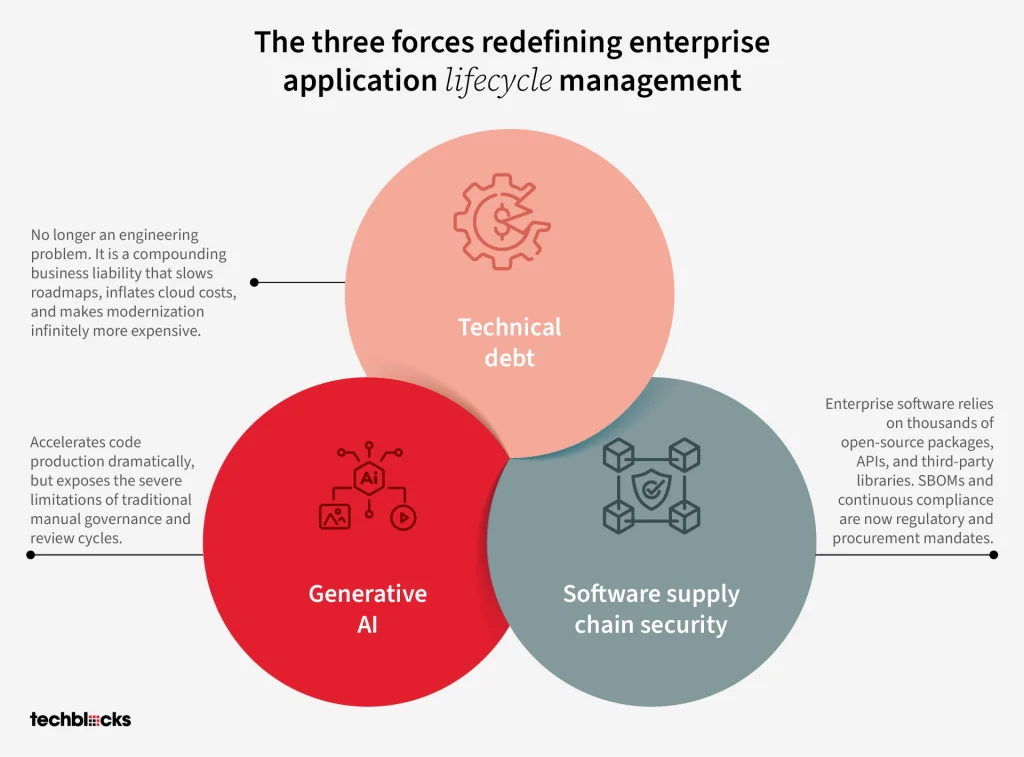
The transition has been gradual, but three structural shifts have fundamentally changed what leadership expects from Application Lifecycle Management.
| Capability | Why It Matters |
| Strategy & Operating Model | Establishes governance, funding, decision rights, and accountability so software investments align with business strategy. |
| Value Stream Management | Connects engineering execution with business outcomes by providing visibility into flow, delivery performance, and value creation. |
| Platform Engineering & DevSecOps | Standardizes software delivery through reusable engineering platforms, automation, security, and developer experience. |
| Technical Debt Governance | Makes technical debt measurable, prioritized, and managed as an enterprise investment rather than an engineering backlog. |
| AI-Ready Software Lifecycle | Introduces governance, policies, and lifecycle controls for AI-assisted software development and AI-native engineering. |
| Software Supply Chain Security & Compliance | Embeds traceability, SBOM management, policy enforcement, and continuous compliance throughout software delivery. |
| Managed Operations & Continuous Improvement | Ensures the operating model evolves continuously through platform optimization, governance refinement, engineering insights, and executive reviews. |
It is important to note that any of these capabilities operate in isolation. The delivery visibility depends on standardized engineering practices, while AI governance relies on secure delivery pipelines. Compliance requires end-to-end lifecycle traceability. Technical debt cannot be reduced without portfolio governance and modernization priorities. The value of Enterprise ALM comes from treating these capabilities as parts of a single operating model rather than independent transformation initiatives.
The sections that follow examine each capability in detail, explaining the business problem it addresses, the organizational maturity it enables, and the role it plays in building a governed, AI-ready software delivery organization.
1. ALM Strategy & Operating Model
Software delivery rarely breaks because engineering teams can’t build software. It breaks when investment priorities, governance, architecture, security, and delivery teams operate toward different objectives. Releases become less predictable, modernization efforts lose momentum, and leadership struggles to understand whether engineering capacity is creating strategic value or simply sustaining operational complexity.
An effective ALM strategy establishes the governance model that brings those moving parts together. It defines how software investments are prioritized, where decisions are made, how accountability is shared across business and technology leaders, and which measures determine success. The outcome isn’t tighter control over delivery teams; it’s greater alignment between engineering execution and business strategy.
What changes with a mature ALM operating model
| Focus Area | Executive Impact |
| Investment governance | Technology investments are prioritized against business outcomes, strategic value, and enterprise risk—not competing project requests. |
| Decision rights | Clear accountability across product, engineering, architecture, security, and business leadership reduces ambiguity and accelerates decision-making. |
| Engineering governance | Common standards improve delivery consistency while allowing teams the flexibility to execute independently. |
| Performance measurement | Business and engineering leaders evaluate success using shared delivery, quality, risk, and value metrics. |
| Portfolio visibility | Leadership gains a real-time view of delivery performance, technology risk, modernization progress, and engineering ROI. |
2. Value Stream Management & Delivery Visibility
Engineering organizations generate enormous amounts of delivery data, but very little of it helps executive teams answer fundamental business questions.
- Which products create the greatest value?
- Where do initiatives slow down?
- Which dependencies delay customer outcomes?
- How much engineering capacity is spent on innovation versus maintenance?
Without that visibility, portfolio decisions rely more on assumptions than evidence. Value Stream Management connects software delivery to business performance by measuring how ideas move from strategy to production. Instead of reporting isolated engineering metrics, it provides a shared view of flow, bottlenecks, delivery health, and value realization across the lifecycle. Leadership gains the insight needed to prioritize investments, remove constraints, and improve delivery predictability with confidence.
What changes with Value Stream Management
| Focus Area | Executive Impact |
| End-to-end delivery visibility | Tracks work from business request to production, exposing delays and delivery bottlenecks. |
| Flow-based decision making | Identifies where work slows, waits, or accumulates, enabling targeted operational improvements. |
| Business-aligned metrics | Connects engineering performance with customer outcomes, strategic initiatives, and business value. |
| Investment transparency | Reveals where engineering capacity is allocated across innovation, maintenance, technical debt, and operational work. |
| Executive reporting | Replaces fragmented project reporting with a consistent view of delivery performance across products and value streams. |
3. Platform Engineering, DevSecOps & ALM Modernization
As software portfolios grow, consistency becomes harder to maintain. Engineering teams adopt different development practices, deployment pipelines, security controls, and operational processes to solve local problems. Over time, those variations create delivery bottlenecks, inconsistent governance, duplicated effort, and increasing operational risk across the enterprise.
Platform Engineering establishes a common engineering foundation that standardizes how software is built, tested, deployed, and operated. DevSecOps complements that foundation by integrating security, compliance, policy enforcement, and software supply chain protection into every stage of the delivery lifecycle. Instead of treating governance as a separate function, security and engineering operate as a single, continuous system.
Combined, these capabilities enable organizations to modernize their ALM operating model without sacrificing delivery speed or engineering autonomy. Teams spend less time managing infrastructure and delivery processes, while leadership gains greater confidence that every application is developed using consistent standards, embedded security, and governed delivery practices.
What changes with Platform Engineering & DevSecOps
| Focus Area | Executive Impact |
| Standardized engineering platform | Reduces delivery variability by providing consistent development, testing, deployment, and operational practices across teams. |
| Built-in security & compliance | Integrates security, policy enforcement, and software supply chain controls throughout the delivery lifecycle rather than treating them as downstream activities. |
| Developer self-service | Enables engineering teams to provision environments, infrastructure, and delivery services quickly through governed, reusable platforms. |
| Delivery automation | Improves release quality and deployment consistency by automating testing, infrastructure provisioning, policy validation, and release workflows. |
| Engineering scalability | Supports growth across products, business units, and geographies without increasing operational complexity or governance overhead. |
4. Technical Debt & Legacy Modernization Management
Technical debt rarely appears on a balance sheet, yet it quietly influences some of the largest technology investment decisions an enterprise makes. Modernization programs become more expensive, product roadmaps slow down, infrastructure costs continue to rise, and engineering capacity is increasingly consumed by maintaining yesterday’s systems instead of building tomorrow’s capabilities. Left unmanaged, technical debt becomes a compounding business liability rather than an engineering challenge.
Enterprise ALM brings structure and discipline to technical debt management by making it measurable, visible, and governed. Instead of relying on anecdotal assessments or periodic modernization initiatives, organizations establish a clear understanding of where technical debt exists, the business risk it creates, and the investment required to address it. Modernization decisions become strategic portfolio decisions—prioritized by business value, operational risk, customer impact, and long-term technology sustainability rather than technical preference alone.
What changes with Technical Debt Governance
| Focus Area | Executive Impact |
| Enterprise-wide visibility | Creates a clear view of technical debt across applications, platforms, and business units. |
| Business-led prioritization | Modernization investments are driven by business value, operational risk, customer impact, and regulatory exposure. |
| Continuous debt governance | Technical debt becomes an ongoing portfolio management discipline rather than a one-time modernization initiative. |
| AI-assisted assessment | Accelerates code analysis, application discovery, dependency mapping, and modernization planning across complex estates. |
| Investment transparency | Enables leadership to balance innovation, modernization, and operational spending using measurable technology insights. |
5. AI-Ready Software Lifecycle
AI is reshaping every stage of software delivery. Requirements are generated faster, code is written in minutes, test cases are automated, documentation is produced alongside development, and operational issues can be analyzed long before they impact production. Engineering productivity is improving rapidly, but every gain in speed introduces a corresponding need for governance. Questions around code quality, intellectual property, model provenance, data privacy, security, and regulatory accountability can no longer be treated as isolated review activities, they must become part of the software delivery lifecycle itself.
An AI-ready Application Lifecycle Management model establishes the governance required to scale AI confidently across engineering. It defines where AI can be applied, where human oversight remains essential, how AI-generated artifacts are reviewed and validated, and how every decision remains traceable throughout the lifecycle. The objective isn’t to slow AI adoption with additional controls; it’s to create the confidence needed for AI to become a trusted part of enterprise software delivery.
What changes with an AI-ready software lifecycle
| Focus Area | Executive Impact |
| AI governance policies | Establishes clear guidelines for the responsible use of AI across software planning, development, testing, and operations. |
| Human oversight & accountability | Defines review and approval mechanisms for AI-generated code, documentation, and engineering decisions. |
| Traceability & audit readiness | Maintains visibility into AI-generated artifacts, approvals, and lifecycle decisions to support governance and compliance. |
| Risk & IP protection | Reduces exposure related to data privacy, intellectual property, model usage, and regulatory obligations. |
| Responsible AI adoption | Enables engineering teams to increase productivity while maintaining quality, security, and organizational trust. |
6. Compliance, SBOM & Software Supply Chain Security
Every software release carries more than new features. It carries dependencies, third-party components, open-source libraries, APIs, cloud services, and increasingly, AI-generated artifacts. Understanding where those components originate, how they are maintained, and whether they comply with organizational and regulatory requirements has become fundamental to enterprise software delivery. Security and compliance can no longer be validated at the end of a release cycle; they must be embedded throughout the lifecycle.
Enterprise ALM integrates software supply chain security into the delivery process through continuous governance rather than periodic audits. Software Bills of Materials (SBOMs), policy enforcement, vulnerability management, provenance validation, and end-to-end traceability become part of everyday engineering practices. Compliance shifts from a reactive reporting exercise to an operational capability, enabling organizations to respond to regulatory requirements, customer expectations, and emerging security risks with confidence.
What changes with integrated software supply chain governance
| Focus Area | Executive Impact |
| Continuous compliance | Security and regulatory requirements are validated throughout the delivery lifecycle instead of during audit cycles. |
| Software supply chain visibility | Provides complete visibility into software components, dependencies, and their associated risks. |
| Automated policy enforcement | Applies governance consistently across development, testing, deployment, and production environments. |
| End-to-end traceability | Creates a verifiable record from business requirement to production release, simplifying audits and regulatory reporting. |
| SBOM management | Generates and maintains accurate Software Bills of Materials to strengthen cyber resilience and support customer and regulatory requirements. |
7. Managed ALM Operations & Continuous Improvement
Designing an effective Application Lifecycle Management operating model is only the beginning. Maintaining its effectiveness as the organization grows is often the greater challenge. New products, acquisitions, delivery teams, cloud platforms, engineering practices, regulatory requirements, and AI capabilities continuously reshape the software landscape. Without ongoing governance, even well-designed operating models gradually lose consistency, creating fragmented delivery practices, inconsistent engineering standards, and reduced visibility across the software lifecycle.
Managed ALM Operations ensures the operating model evolves with the business rather than falling behind it. Governance, engineering platforms, delivery processes, automation, performance metrics, and lifecycle policies are continuously reviewed and refined to reflect changing business priorities and technology demands. Instead of treating modernization as a series of large transformation programs, organizations build a culture of continuous improvement where software delivery becomes progressively more resilient, efficient, and predictable over time.
What changes with Managed ALM Operations
| Focus Area | Executive Impact |
| Operating model governance | Maintains consistent engineering standards and delivery practices as teams, products, and technologies evolve. |
| Platform optimization | Keeps engineering platforms, automation, and delivery pipelines aligned with changing business and technology needs. |
| Lifecycle performance | Continuously improves delivery predictability, operational efficiency, and engineering effectiveness through measurable insights. |
| Governance reviews | Provides leadership with regular visibility into delivery performance, technology risk, and modernization progress. |
| Continuous organizational maturity | Strengthens software delivery capabilities incrementally, reducing the need for disruptive transformation programs. |
Why ALM Modernization Often Starts in the Wrong Place
Enterprise ALM initiatives rarely fail because the organization selected the wrong platform. They struggle because technology decisions are expected to solve governance challenges.
The first conversation is often about consolidating tools, modernizing DevOps, replacing legacy platforms, or introducing new engineering capabilities. Those investments certainly improve software delivery, but they don’t answer the questions executives are ultimately trying to solve. How should engineering investment be governed? Which products deserve continued funding? Where does accountability sit? How is technology risk measured? What defines success beyond release velocity?
Without clear answers, new platforms simply automate existing ways of working. Delivery may become faster, but governance remains fragmented. Teams continue measuring success differently, business priorities compete for engineering capacity, and leadership gains little additional visibility into how technology investments contribute to enterprise outcomes.
Modernization becomes significantly more effective when the sequence is reversed. The operating model establishes the destination. Platforms, engineering practices, automation, and delivery methodologies are then selected because they reinforce that model—not because they introduce new capabilities. Technology enables the operating model. It should never define it.
Common modernization approaches
| Tool-first modernization | Operating model-first modernization |
| Begins with platform selection and tooling consolidation. | Begins with business priorities, governance, and operating principles. |
| Optimizes engineering activities. | Aligns engineering execution with enterprise strategy. |
| Measures success through adoption, automation, and delivery metrics. | Measures success through business outcomes, technology risk, and investment performance. |
| Governance adapts to platform capabilities. | Platforms are selected to support governance objectives. |
| Creates localized improvements across delivery teams. | Establishes a consistent enterprise-wide software delivery model. |
Successful ALM modernization isn’t defined by the sophistication of the toolchain. It’s defined by the organization’s ability to create a governance model that remains consistent as technologies, engineering practices, and business priorities continue to evolve.
Engineering Enterprise ALM as an Operating Model
Application Lifecycle Management is often discussed as a technology transformation. Years of working with complex enterprise environments have led us to a different conclusion. Sustainable transformation rarely comes from introducing another platform, another methodology, or another automation initiative. It comes from establishing an operating model capable of bringing every engineering capability together under a common governance framework.
Platform Engineering, DevSecOps, Value Stream Management, AI-native engineering, software supply chain security, and modernization all solve important problems. Running them as independent programs, however, rarely produces enterprise-wide transformation. Separate governance models, competing investment priorities, and disconnected success measures gradually create the same fragmentation organizations were trying to eliminate.
Our approach at TechBlocks begins with a different set of questions.
- What should software delivery look like three years from now?
- Which governance model will support that vision?
- Where does the current operating model create friction?
- Which capabilities will create the greatest business impact when they work together—not independently?
Those questions shape every Enterprise ALM engagement we lead.
Rather than introducing technology first, we establish the operating model, define governance, align business outcomes, and then engineer the platforms, practices, and automation needed to support it. Software Factory, Platform Engineering, Value Stream Management, DevSecOps, and AI-native delivery through AiDE, become parts of one enterprise system, designed to evolve continuously as business priorities, technologies, and regulatory expectations change.
Organizations rarely achieve lasting transformation by optimizing individual engineering functions. Lasting transformation comes from engineering a software delivery system where governance, engineering, security, compliance, and AI continuously reinforce one another. Helping enterprises build that operating model is the role TechBlocks plays.
Ready to evaluate your software delivery operating model?
Every enterprise has an Application Lifecycle Management operating model. The real question is whether it was intentionally designed to support future business priorities, or gradually assembled through years of independent technology decisions.
Schedule an ALM Strategy Assessment with TechBlocks to evaluate your current operating model, identify capability gaps, and define a practical roadmap toward a governed, AI-ready Software Factory.
→ Schedule an ALM Strategy Assessment
FAQs on Application Lifecycle Management
DevOps focuses on improving how software is built, tested, and deployed through automation, collaboration, and continuous delivery. Enterprise Application Lifecycle Management encompasses the entire software delivery lifecycle—from investment planning and governance to engineering, security, operations, modernization, and retirement. DevOps is a critical capability within Enterprise ALM, but it doesn’t provide the governance framework needed to manage software as a strategic business asset.
ALM modernization becomes a strategic priority when software delivery is no longer keeping pace with business expectations. Common indicators include inconsistent delivery across teams, growing technical debt, fragmented engineering toolchains, limited visibility into engineering investments, increasing compliance requirements, or challenges scaling AI initiatives. These issues often point to operating model gaps rather than technology limitations.
AI accelerates every stage of software delivery, from requirements analysis and development to testing, documentation, and operations. Enterprise ALM provides the governance needed to scale AI responsibly by establishing policies for AI-assisted development, maintaining traceability across the software lifecycle, embedding security and compliance into delivery pipelines, and ensuring human oversight where it matters most. The goal is to enable faster innovation without increasing operational or regulatory risk.
Not necessarily. Most organizations already have mature investments in planning tools, source control platforms, CI/CD pipelines, testing frameworks, and observability solutions. Enterprise ALM focuses on governing how these capabilities work together rather than replacing them. In many cases, modernization involves integrating and standardizing existing platforms within a common operating model before introducing new technologies.
A well-designed Enterprise ALM operating model improves far more than software delivery speed. Organizations typically gain greater visibility into engineering investments, stronger governance across the software lifecycle, improved delivery predictability, reduced technology risk, enhanced regulatory readiness, and a scalable foundation for AI-driven software engineering. Most importantly, Enterprise ALM creates a direct connection between engineering execution and measurable business outcomes, enabling technology to operate as a strategic business capability rather than a supporting function.