
Key Takeaways
- Unmanaged platform maintenance drains engineering payroll into manual firefighting, stalling new business capabilities.
- DataOps eliminates expensive compute reprocessing by catching schema mutations directly at the ingestion boundary.
- Superficial uptime metrics conceal platform waste unless leadership actively tracks reprocessing volume and remediation hours.
- Merging DataOps with FinOps pairs pipeline reliability with cost governance to eliminate runaway cloud and AI spend.
- Modernizing a single mission-critical workload proves early financial return and creates a scalable enterprise blueprint.
Enterprise data estates continue to expand as organizations deploy more pipelines, analytics models, and artificial intelligence workloads.
What the data says:
94.7% of global organizations have experienced rapid data volume expansions owing to AI workflows in the last year. Among them, 60.9% claim a growth of more than 25%. Also, 85.4% of enterprises report an overall data lake volume growth in the past 12 months, with 85.8% expecting it to grow further in the next 3-5 years.
This expansion creates a difficult economic problem. Enterprises must invest in infrastructure, platform engineering, and governance while ensuring that data teams continue to deliver new products and AI capabilities. Yet a growing share of engineering capacity often goes toward maintaining existing workloads rather than creating new business value.
The resulting cost is not limited to cloud invoices or software licenses. It also includes failed pipeline runs, repeated data processing, emergency remediation, and the opportunity cost of keeping senior engineers focused on operational maintenance.
DataOps addresses this problem as an operating model. By introducing repeatable testing, controlled deployment, observability, and operational governance into data workflows, it helps organizations make data engineering more reliable and economically transparent.
What Is DataOps and Why Does It Matter at Enterprise Scale?
DataOps, or data operations, is a collaborative data management practice. It replaces manual, error-prone tasks in data ingestion, testing, and deployment with repeatable workflows. It integrates version control, continuous integration, automated testing, and active monitoring directly into enterprise data workflows.
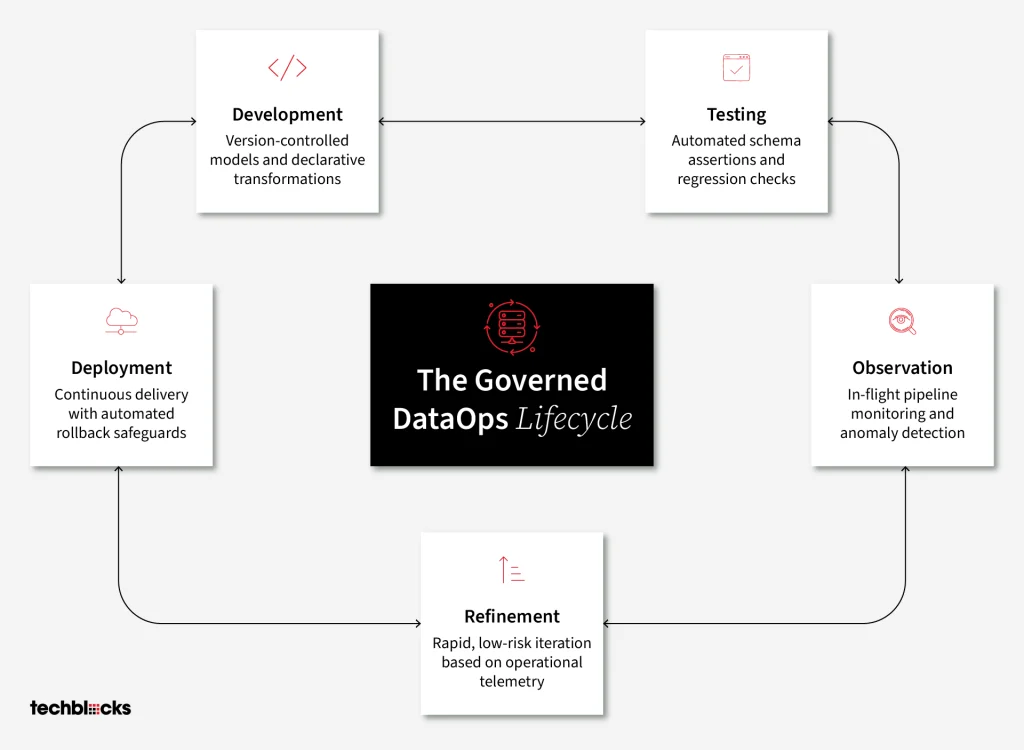
A typically governed DataOps lifecycle covers five critical steps:
- Development: Build version-controlled models and declarative transformations so pipeline changes remain repeatable and auditable.
- Testing: Run automated schema assertions, data-quality checks, and regression tests before changes reach production.
- Deployment: Promote validated pipelines through controlled delivery workflows with rollback safeguards.
- Observation: Monitor pipeline execution, schema changes, data volumes, freshness, and anomalies across live workloads.
- Refinement: Use operational and cost telemetry to improve workflows, remove recurring failure points, and make controlled architecture changes.
Building an individual data pipeline is relatively straightforward. Operating a large estate is more difficult because pipelines depend on changing source systems, shared infrastructure, downstream consumers, and business-specific data-quality rules.
Without appropriate controls, small changes can trigger production failures, silent data degradation, and expensive reprocessing. DataOps introduces the testing, deployment, and monitoring practices required to manage those dependencies systematically.
Its economic value therefore comes from more than automation. DataOps reduces the effort required to detect, diagnose, and resolve recurring operational problems.
The Hidden Cost of Enterprise Data Engineering
Executives often evaluate data engineering costs through visible categories such as cloud infrastructure, software licenses, and employee compensation. These figures are important, but they do not capture the full cost of operating an unreliable data platform.
For example, enterprises spend an average of $29.3 million every year on data programs. But $2.2 million of that budget gets lost in pipeline upkeep, and doesn’t show up as a line item charge. Similarly, 53% of enterprise data engineering capacity is spent on maintaining and troubleshooting existing pipelines instead of building new data products or AI capabilities.
To understand how capital is consumed, teams need to examine three distinct cost categories across their platform operations:
| Direct platform costs | Operational drag costs | Hidden opportunity costs |
| These are visible expenses such as:Engineering salaries.Cloud compute, storage, and networking.Data platform licenses.Monitoring and governance tools. | These arise when unstable workflows consume additional resources through:Failed jobs and repeated processing.Manual root-cause investigations.Emergency data-quality remediation.Inefficient queries and over-provisioned compute.Incident response and production support. | These reflect the business value lost when engineers maintain existing workloads instead of developing:New data products.Predictive models.AI capabilities.Faster reporting and decision-support systems.Reusable platform capabilities. |
Understanding this distinction is important because expanding the data engineering budget does not necessarily increase usable data capability. If additional spending primarily funds maintenance, the organization may be paying more without improving delivery capacity.
Effective data platform cost optimization therefore requires leaders to examine both infrastructure consumption and the engineering effort required to keep workloads operational.
How DataOps Reduces the Cost of Running Data Pipelines?
Data engineering economics deteriorate rapidly when platform stability depends on manual firefighting rather than automated operational guardrails. To understand this financial dynamic, consider how an enterprise handles an unannounced schema change from an upstream transactional system.
Without DataOps: The Reactive Drag
Consider an e-commerce company whose billing application changes an account identifier from text to integer.
Without automated controls, the change may enter an ingestion pipeline during an overnight processing window. Transformation jobs fail later in the workflow, and engineers discover the problem only when dashboards and billing reports fail to refresh.
The response typically involves:
- Reviewing execution logs.
- Identifying the source of the schema change.
- Writing and testing an emergency fix.
- Reprocessing historical data.
- Checking downstream reports and models.
- Communicating the impact to business stakeholders.
The direct cost includes wasted compute and delayed reporting. The larger cost comes from diverting senior engineers from planned delivery work.
With DataOps: Controlled Intervention
In a governed DataOps environment, contract tests and schema assertions detect the incompatible change at the ingestion boundary. The workflow can then reject or quarantine the affected records before they enter shared storage and downstream transformations.
Version control provides an auditable record of the change. Observability identifies the affected pipeline and its dependencies. Automated quality checks prevent invalid records from contaminating analytics products or machine learning datasets.
The response becomes contained rather than reactive:
- The incompatible change is detected early.
- Affected records are isolated.
- Downstream workflows continue where possible.
- Engineers can inspect the configuration difference.
- The pipeline can be rolled back or corrected without rerunning the entire data estate.
The main economic mechanisms behind DataOps:
- Automated testing: Detects schema changes and logical regressions before they become production incidents.
- Version control: Provides traceability and supports low-risk rollback.
- Automated deployment: Replaces inconsistent manual releases with controlled delivery workflows.
- Continuous monitoring: Reduces the time required to detect and resolve anomalies.
- Data-quality controls: Prevent invalid or incomplete records from propagating through downstream systems.
The primary economic benefit of DataOps does not stem from tooling adoption or superficial automation checklists. Instead, the financial return comes from radically reducing the human effort required to detect, diagnose, fix, and maintain data workflows.
When fewer workflows require emergency attention, engineering teams can redirect capacity toward new business capabilities.
What Should a DataOps Platform Measure?
A DataOps platform should measure more than pipeline availability. A workflow can complete successfully while delivering stale, incomplete, or commercially unusable data. It can also run reliably while consuming excessive compute because of poor query design or repeated processing.
| Platform Metric | What It Reveals |
| Pipeline Failures | Underlying reliability bottlenecks and structural instability across ingestion and transformation workflows. |
| Reprocessing Volume | Wasted cloud compute spend and engineering capacity lost to repetitive job reruns. |
| Remediation Time | The hidden engineering payroll cost required to triage, patch, and deploy emergency fixes. |
| Data Freshness | Concrete delivery performance measured against executive decision cycles and operational business SLAs. |
| Infrastructure Spend | The true cloud compute, storage, and networking costs required to operate active workloads. |
| Cost per Data Product | The aggregate engineering and infrastructure investment required relative to delivered commercial output. |
These metrics become useful when evaluated together. For example, a reduction in pipeline failures has greater significance when it also reduces remediation hours and reprocessing volume.
Note: The primary goal is not constructing another technical monitoring dashboard for developers to track operational tasks. Instead, it provides tech teams with an objective view of operational costs and high-impact improvement areas. The continuous telemetry enables sustainable data platform cost optimization by connecting engineering effort directly to business capability.
Data Platform Engineering Explained
Learn how data platform engineering enables reliable, governed enterprise data. Explore architecture, use cases, & the role of AI in modern analytics platforms.
DataOps and FinOps: Connecting Data Engineering With Cost
A reliable data platform is not necessarily an economical one. Workloads can complete without triggering alerts while still consuming more cloud resources than necessary.
DataOps exposes operational performance and system reliability, whereas FinOps uncovers what those underlying pipelines actually cost to run. Without uniting these two disciplines, technology leaders operate with a split screen that conceals compounding financial waste.
Platform expenditure rarely escalates from a single catastrophic failure, but rather through compounding, unchecked architectural habits:
- Brute-Force Compute Allocation: Inefficient SQL transformations meet aggressive delivery windows simply by over-provisioning compute warehouses, masking flawed queries with expensive hardware.
- Redundant Workload Processing: Disconnected business units often build parallel pipelines to extract identical source data, repeatedly paying compute fees for duplicated transformations.
- AI Infrastructure Sprawl: Machine learning and generative workloads routinely recompute feature sets and vector embeddings without caching, running high-cost GPU clusters around the clock.
- Unpruned Storage Expansion: Accumulating intermediate tables, abandoned sandbox environments, and unpartitioned data lakes quietly inflate storage invoices without delivering usable analytics.
Consider a production feature pipeline that updates an enterprise recommendation model every morning with flawless 100% reliability. Because performance metrics remain decoupled from cloud billing, nobody notices the job continuously re-scans raw historical partitions at premium rates. The engineering dashboard registers green availability, yet the workload burns tens of thousands of dollars in unnecessary compute each month.
A combined DataOps and FinOps model can expose this pattern by linking:
- Pipeline execution to cloud consumption.
- Reprocessing to avoidable expenditure.
- Data products to unit economics.
- Engineering activity to labor cost.
- Workload ownership to financial accountability.
This gives business leaders a clearer basis for data platform cost optimization.
Building a More Economical Enterprise Data Engineering Model
Large-scale platform programs often struggle when they attempt to modernize every workload at once. A more practical approach is to begin with one mission-critical data product, measure the economic impact, and use the results to establish reusable standards.
A disciplined operational roadmap advances across five focused stages:
- Baseline Operating Economics: Measure current cloud compute expenses, recurring failure frequencies, and engineering hours lost to manual maintenance across the target workload.
- Isolate Expensive Friction: Identify the exact ingestion boundaries, schema vulnerabilities, and reprocessing compute loops that drive avoidable platform expenditure.
- Automate Quality Safeguards: Embed automated contract tests, version-controlled CI/CD pipelines, and runtime observability where operational drag is most severe.
- Track Value Telemetry: Quantify shifts in incident recovery times, wasted compute reruns, and engineering capacity returned to active feature development.
- Standardize Reusable Templates: Package the validated testing harnesses and deployment guardrails into reusable golden paths for adjacent data teams.
Implementing DataOps principles should not become an isolated tooling exercise or a superficial automation checklist. The objective is to establish a governed delivery model that makes enterprise data engineering predictable, scalable, and economically transparent. For organizations with significant production support demands, achieving that model may require specialized expertise to establish the underlying standards without disrupting active workloads.
TechBlocks helps enterprise teams modernize legacy pipelines into cloud-native data foundations for analytics and production AI, combining platform engineering, DataOps, and operational governance across the data estate:
- Modern Platform Engineering: Rebuild brittle pipelines and tool sprawl into scalable lakehouse, warehouse, or mesh architectures supporting batch, streaming, and AI workloads.
- DataOps & FinOps Integration: Codify Git-based workflows, automated testing, and active cost guardrails to secure sustainable data platform cost optimization.
- SRE-Style Managed Operations: Deploy automated monitoring and AI-augmented anomaly detection to eliminate manual triage, protecting platform reliability and engineering bandwidth.
Reducing Operational Drag Through Governed Data Operations
A leading North American clean power generator operated a fragmented data estate spanning SAP, non-SAP, and operational technology systems. This architectural disconnect forced engineering teams into recurring manual reconciliation cycles that delayed critical reporting across 20+ plants.
TechBlocks engineered a unified data foundation featuring centralized governance models, standardized data schemas, and automated quality validation at ingestion. This modernized operating model eliminated systemic operational drag and returned vital engineering capacity to predictive analytics and commercial decision-making:
- 80% Reduction in Manual Reconciliation: Automated validation eliminated manual spreadsheet auditing, significantly lowering operational overhead across distributed plant teams.
- 42% Faster Reporting Turnaround: Modernized data pipelines accelerated analytics delivery cycles, providing executive leadership with timely operational visibility across generating facilities.
- 96% Quicker Approval Cycles: Version-controlled workflows and automated governance guardrails eliminated administrative latency from technical maintenance and schema updates.
Read the complete case study here.
Make Data Engineering Economics Visible
Adding engineers, expanding compute clusters, or purchasing more tools does not resolve the underlying economics of an unreliable data platform. Leaders must identify where engineering capacity disappears, which workloads drive infrastructure expenditure, and which operational failures create recurring cost.
DataOps provides the operating controls required to answer those questions. FinOps adds the financial context. Together, they help organizations connect pipeline behavior, engineering effort, infrastructure consumption, and business output.
The most effective modernization programs begin with a defined workload, establish a measurable baseline, and apply reusable controls across the wider data estate. This turns DataOps from a technical initiative into an operating model for reliable and economically accountable data engineering.
Data & Analytics Solutions
Governed DataOps Powering Enterprise AI
Modernize fragile platforms and complex estates into governed foundations for analytics and production AI

Modernize fragile platforms and complex estates into governed foundations for analytics and production AI with TechBlocks.
Book a 15-minute discovery call today.
Frequently Asked Questions
Calculating true cost requires combining direct infrastructure bills and engineering payroll with the operational waste of continuous pipeline triage. Technology executives must also factor in hidden opportunity costs, including stalled artificial intelligence initiatives and delayed commercial delivery.
Platform expenditures are justified when compute and engineering growth directly produce measurable business capabilities, faster decision cycles, and commercial revenue. Conversely, expanding cloud invoices driven by repetitive reprocessing, unoptimized queries, and continuous operational firefighting signal systemic platform inefficiency.
Automated schema validation and contract testing at ingestion boundaries consistently yield the fastest operational and financial returns for enterprises. Catching upstream mutations early prevents downstream pipeline breakage, drastically eliminating emergency developer triage and expensive historical compute reprocessing.
Organizations measure DataOps return on investment through reduced incident remediation hours, lowered compute reprocessing expenses, and accelerated feature velocity. Tracking unit costs per data product alongside platform stability confirms that engineering capacity is actively shifting from maintenance toward innovation.
Enterprises require specialized DataOps services when increasing developer headcount fails to improve release velocity or eliminate persistent operational firefighting. External partners establish standardized testing frameworks, automated CI/CD guardrails, and FinOps controls that internal delivery squads can consume repeatedly.