
Key Takeaways
- Modernization budgets collapse by underestimating transitional data migration, integration adapters, and dual-run coexistence costs.
- Prioritize application candidates using business criticality and release velocity rather than chronological software age.
- Lingering legacy coexistence drains projected savings through duplicate hosting, overlapping licenses, and split support payroll.
- Modernization ROI depends on maintenance reduction and developer throughput rather than completed workload migrations.
- Upgrading code without modernizing operating models preserves legacy engineering inefficiencies on expensive cloud runtimes.
When enterprises approve an application overhaul, they usually expect clear outcomes: lower technical debt, stronger security, improved scalability, and simpler maintenance across core operations. Budgets and timelines are often built around the planned architecture, migration approach, and expected cloud operating costs.
Yet, the true scale of the work often becomes visible only after implementation begins. Delivery teams uncover undocumented software dependencies, poorly mapped data structures, custom integrations, and business rules embedded in decades-old code. Each discovery can require additional engineering, data validation, integration changes, and regression testing across connected applications.
As a result, application modernization challenges rarely come from software development alone. Unplanned application modernization costs arise when financial estimates focus on the target architecture but overlook the complexity of moving applications, data, integrations, and business processes from the existing environment. Effective enterprise application modernization therefore depends on understanding the entire transition path before budgets, scope, and timelines are finalised.
The legacy app modernization market is valued at $27.6 billion in 2026 and is projected to hit almost $68 billion by 2031. Yet, as per reports, 70% of legacy overhaul projects fail, and the reason is not a lack of capable technology. They fail because most organizations work with an incorrect sequence and face application modernization challenges too late into the project.
When modernization estimates account only for the future-state architecture, hidden complexity can increase engineering effort and weaken project margins with every sprint. Enterprises must therefore assess seven critical cost traps before approving the modernization budget, implementation scope, and delivery timeline.
Starting Without a Clear Application Modernization Strategy
Enterprises frequently waste engineering budgets by prioritizing platforms based on system age, developer frustration, or executive visibility. Old software code creates technical debt among enterprises, causing a massive backlog of outdated applications that incur costs, leaving little room for innovation.
In fact, as per a 2025 report, US Federal Agencies spend about 80% of their $100 billion IT budget on maintaining existing legacy applications and mitigating technical debt. That leaves engineering teams with about 20 Cents per Dollar to spend on innovation.
A disciplined application modernization strategy must begin with determining which enterprise systems justify capital allocation based on measurable operational returns.
Enterprises should evaluate each application against core technical characteristics and business requirements, and then decide on the appropriate action for that particular application:
| Strategic Disposition | Portfolio Qualification Criteria | Capital Allocation Action |
| Retire | Low business criticality, obsolete functionality, minimal system dependencies, and low change frequency. | Decommission the platform to eliminate redundant licensing, hosting, and maintenance overhead. |
| Retain | Stable business value, predictable maintenance costs, and high architectural coupling. | Preserve existing code without modernization capital until operating risks or requirements shift. |
| Replatform | Urgent infrastructure deadlines, moderate business value, and manageable integration complexity. | Migrate workloads to cloud runtimes with minimal code changes to reduce datacenter costs. |
| Refactor | High business criticality, frequent release cadences, acute scalability bottlenecks, and long lifespan. | Re-architect core services into cloud-native components to maximize ongoing feature delivery velocity. |
Every architectural assessment must balance technical risk, current maintenance expenses, dependency complexity, and the system’s remaining operational lifespan. Retaining stable legacy systems or retiring redundant software tools often preserves more capital than unnecessary code modernization projects. Modernization investment must always follow verified business value and technical need rather than the software’s age.
Underestimating Legacy Application Complexity
A legacy system contains decades of complex unmapped business workflows, brittle database triggers, and undocumented operational rules embedded into the application. Sizing a migration purely on lines of code or server capacity miscalculates the actual scope of engineering work and overlooks the hidden integration layer that holds the enterprise software portfolio together.
Over extended operational lifecycles, legacy software systems accumulate minute architectural layers that remain invisible during standard code reviews:
- Undocumented business rules: Decades of operational patches leave proprietary transaction calculations embedded directly inside legacy database stored procedures.
- Asynchronous batch integrations: Critical operational workflows depend on scheduled nightly scripts and point-to-point file transfers to update auxiliary systems.
- Cascading downstream dependencies: Peripheral reporting engines and external partner interfaces query backend databases directly without utilizing governed application programming interfaces.
- Fragmented authentication contracts: Outdated directory protocols and hardcoded system credentials create fragile operational linkages across distributed legacy platforms.
Consider an enterprise modifying a single legacy customer billing module to migrate toward modern cloud services. What appears to be an isolated service modification quickly forces unexpected changes across several interconnected peripheral applications, leading to chaotic delivery pipelines and last-minute edge cases.
To avoid chaos, engineering teams must update downstream ledger pipelines, rewrite shared database schemas, and reconfigure fragile upstream order-processing engines. These unmapped dependencies transform a routine software release into a multi-system refactoring cycle across multiple operational divisions.
Legacy application modernization becomes financially volatile when architectural discovery occurs during active delivery rather than upfront planning. Mid-project discovery of undocumented integration points triggers sprint delays, scope expansion, and depleted capital reserves. That’s why upfront dependency discovery and estate assessment are considered vital balance-sheet controls defining the economic viability of modernization programs.
Choosing the Modernization Approach Too Early
Engineering teams frequently select a technical migration path before analyzing the long-term operational economics of their software portfolio. That triggers predictable financial mismatches across the enterprise software estate:
- Premature Rehosting: Moving legacy workloads directly to cloud infrastructure minimizes upfront migration labor, but preserves fragile code and unoptimized compute consumption.
- Unwarranted Refactoring: Restructuring complex legacy code requires substantial engineering hours that cannot deliver economic returns when the underlying system has a short operational lifespan.
- Premature Rebuilding: Rewriting software from scratch demands significant upfront capital expenditure, yet it delivers durable operating cost reductions only for high-velocity platforms.
Ignoring lifecycle economics frequently turns the lowest-cost migration option into an expensive long-term modernization failure. Enterprises must evaluate total cost of ownership against technical debt, operational lifespan, and scaling frequency. Aligning engineering investments with these economic fundamentals prevents unmanaged application modernization costs while unlocking genuine software delivery agility.
Underestimating Data, Integration, and Testing Work
Modernization initiatives frequently run over budget because engineering plans treat software applications as isolated entities detached from their surrounding operational ecosystems. Refactoring or rewriting application code accounts for only a minor fraction of the total technical effort required during delivery.
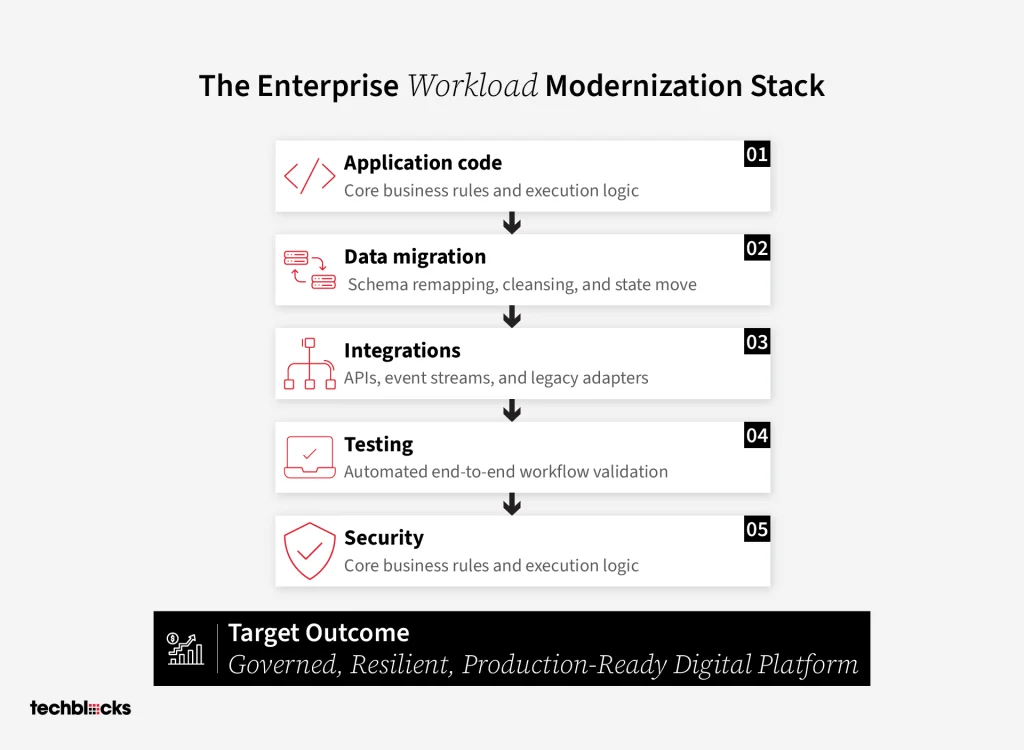
Treating data migration, system interfaces, and quality assurance as independent tasks conceals how deeply these domains depend on one another. When legacy systems are opened up, unexpected complexities across the peripheral environment continuously inflate the overall modernization workload with:
- Compounding Data Remediation: Cleansing decades of inconsistent legacy schemas and corrupt records demands extensive engineering pipelines before cutover can begin.
- Unmapped Interface Rework: Modifying applications fractures undocumented point-to-point connections, forcing teams to build bespoke integration adapters and replacement APIs.
- Regression Testing Sprawl: Altered data models and integration contracts trigger exhaustive, multi-system validation cycles across connected enterprise platforms.
- Compliance and Security Verification: Reconfigured transaction boundaries demand automated identity checks, payload encryption, and continuous audit logging to satisfy strict regulatory standards.
When downstream interfaces fail and data structures drift, quality teams face massive manual testing backlogs that stall platform deployment schedules. These non-functional requirements multiply engineering hours, turning a minor application update into an expansive infrastructure and data overhaul.
Paying for Legacy and Modern Environments at the Same Time
During modernization, organizations enter an extended transitional phase in which two complete architectures operate in parallel. Initial business cases often budget for a brief cutover, assuming target cloud efficiencies will absorb duplicate running costs. But, in reality, enterprises must simultaneously finance the legacy software, the target cloud environment, and the synchronization layer connecting them. That includes several cost factors:
| Cost Factor | Operational Mechanism | Financial Impact |
| Duplicate Infrastructure | Running on-premises facilities in parallel with expanding cloud environments. | Baseline hosting expenses compound until legacy hardware decommissions. |
| Dual Software Licensing | Paying legacy support contracts alongside new cloud subscription commitments. | Overlapping software agreements eliminate projected near-term cost savings. |
| Data Synchronization | Operating bidirectional pipelines to keep state aligned across both platforms. | Continuous cross-system replication inflates cloud data egress and maintenance spend. |
| Split Operational Support | Managing two complete technology stacks with parallel monitoring and runbooks. | Support payroll expands to sustain legacy stability alongside new platform triage. |
Enterprises must establish explicit decommissioning triggers and model transition economics before initiating target cloud migrations. Integrating disciplined cloud engineering practices with active FinOps governance ensures visibility across temporary migration expenses and prevents lingering dual-run expenditures.
Measuring Migration Progress Instead of Modernization ROI
Most enterprise modernization programs track success by reporting completed migration milestones, moved workloads, and total applications transitioned. These activity metrics show whether scheduled engineering tasks occurred across the portfolio according to original delivery timelines.
Yet, completing an infrastructure migration does not reveal whether the engineering investment created tangible operational or financial value. Engineering teams often mark migrations complete at cutover, while the relocated application continues to generate high operational expenses. To avoid that, executive reporting must shift from tracking operational activity to evaluating durable business outcomes across the software lifecycle:
- Infrastructure and maintenance costs: Modernization must generate measurable reductions in recurring hosting expenses, proprietary vendor licenses, and routine platform maintenance.
- Delivery velocity and lead time: Engineering teams should demonstrate faster release cadence, shorter lead times for changes, and reduced deployment bottlenecks.
- System reliability and scalability: Resilient architectures demonstrate lower defect escape rates, reduced production incident frequency, and stable performance under fluctuating workloads.
- Engineering capacity and innovation: Successful programs liberate developer capacity from legacy incident firefighting to accelerate the delivery of net-new business capabilities.
Moving an enterprise application to the cloud is an initial implementation milestone. The actual return on modernization comes from the operational improvements and cost savings achieved after the migration. Evaluating application modernization costs only through the initial project budget overlooks the long-term value of modernizing legacy workloads. Enterprises should compare the total investment with improvements in platform stability, lower maintenance costs, and higher developer productivity.
Modernizing the Application Without Modernizing Its Operating Model
Replacing legacy code delivers diminishing returns when operational workflows remain manual, fragmented, and slow. Organizations frequently migrate software components while leaving behind outdated operating habits that inflate ongoing infrastructure budgets:
- Manual deployment cadence: Engineering teams maintain rigid, multi-week release approval processes that eliminate the operational velocity gained from modern cloud runtimes.
- Fragmented delivery pipelines: Disconnected build tools and manual deployment scripts increase configuration drift across environments and delay scheduled production releases.
- Reactive system observability: Teams rely on manual log searches and isolated monitoring tools rather than centralized telemetry to diagnose production performance issues.
- Manual quality verification: Engineering capacity remains tied to repetitive regression scripts, creating substantial delivery bottlenecks before each new feature release.
- Siloed support structures: Operations squads handle routine infrastructure maintenance manually, leaving the enterprise with inflated support costs and slow incident triage.
Under the mentioned conditions, the application becomes technically modern while the surrounding operating economics remain dated. Sustainable modernization requires teams to get rid of this difference and synchronize software engineering, cloud architecture, automated pipelines, quality frameworks, and data operations across the delivery lifecycle.
Where Application Modernization Budgets Get Exposed?
Modernization budgets become vulnerable when planning assumptions pass into delivery without accounting for the complexity of the existing environment. The seven cost traps emerge at different stages, but each creates the same financial problem: scope, dependencies, or operating costs become visible only after capital and timelines have already been committed.
The table below connects each planning gap to the financial consequence it can create:
| Cost Trap | What the Original Plan Often Misses | Financial Consequence |
| 1. Strategic Qualification | Evaluates software by age instead of business criticality, change frequency, and commercial value. | Misallocates capital to low-impact systems while core platforms retain technical debt and bottlenecks. |
| 2. Legacy Estate Complexity | Sizes scope by code volume, ignoring hidden business rules, stored procedures, and integrations. | Mid-project architectural discovery causes sprint delays, peripheral rework, and burned contingency. |
| 3. Premature Architecture | Commits to migration paths before calculating lifecycle TCO, system lifespan, and delivery velocity. | Apparent migration savings transform into compounding cloud bills, licensing fees, and operational drag. |
| 4. Peripheral Scope Omission | Isolates application code while overlooking data cleansing pipelines, bespoke adapters, and regression testing. | Peripheral remediation and manual testing backlogs inflate engineering hours well beyond budget. |
| 5. Extended Coexistence | Assumes a rapid cutover without defining legacy retirement criteria, data sync, or dual-run costs. | Protracted parallel runs enforce duplicate hosting, overlapping licenses, and split support payroll. |
| 6. Output-Based Metrics | Tracks completed migration tasks rather than post-cutover maintenance savings, velocity, and stability. | Teams declare victory at cutover while the enterprise captures zero measurable modernization ROI. |
| 7. Unaltered Operating Model | Modernizes code while retaining manual release gates, fragmented pipelines, and reactive monitoring. | Modern runtimes fail to accelerate delivery, compounding cloud hosting fees atop legacy operating costs. |
A Modernization Program in Practice
These cost traps become clearer when applied to a real modernization program. A global logistics and supply chain leader was operating critical workflows across AS/400 mainframes, fragmented applications, and manual processes spanning purchase orders, bookings, shipment tracking, and delivery.
The fragmented environment meant that new digital initiatives often depended on workarounds, duplicate data entry, and coordination across teams and logistics partners. Modernization therefore needed to address more than the underlying application technology. The program focused on consolidating workflows, automating manual processes, and creating a more connected operational platform.
The modernization program focused on three areas:
- Unify core workflows: Purchasing, booking, tracking, and delivery were brought into a single serverless cloud platform, replacing fragmented workflows and point-to-point processes.
- Automate high-friction processes: Order intake and data-capture activities were automated to reduce manual entry, repetitive work, and operational rework.
- Connect partners and customers: Logistics partners were integrated into a shared data model, while customers gained direct access to shipment status and exceptions.
The modernization delivered measurable improvements:
- 200% faster order processing
- 50% reduction in end-to-end workflow turnaround time
- 25% lower support costs for the modernized domain
The case demonstrates the central point of this article: modernization value is not created simply by moving an application to the cloud. It comes from removing the operational complexity surrounding the application and improving how the business processes, integrates, and operates its workflows.
How TechBlocks Addresses the Modernization Journey
For larger application estates, the same principle extends beyond a single workload. TechBlocks connects portfolio assessment, architecture, migration, integration, and post-cutover operations to address the cost traps before they compound.
- Legacy Estate Assessment and Roadmap: AI-assisted discovery maps dependencies across mainframe and fragmented applications and assigns each workload to a clear modernization pathway: retire, retain, replatform, or refactor.
- Migration and Re-architecture: Wave-based execution moves applications off legacy platforms and re-architects high-value workflows into serverless, event-driven services where the business case supports the change.
- Cloud-Native Foundations: Secure cloud foundations and FinOps modeling prepare the platform for scale while keeping transition and dual-run costs visible.
- Application, Data, and Integration Modernization: Monolithic processes and fragile point-to-point integrations are replaced with API-first designs and a unified data model connecting orders, shipments, and partners.
- DevSecOps and Platform Engineering: Automated pipelines, testing, and observability are embedded into the delivery lifecycle to improve release speed and post-migration reliability.
Application Migration & Modernization
Accelerate Your Application Modernization Journey
Transform legacy applications into scalable, cloud-ready platforms with a structured modernization strategy, seamless migration, and AI-native engineering.
Look Beyond Migration Costs When Planning Modernization
Sustainable enterprise application modernization requires evaluating the total transformation journey before committing enterprise capital. Enterprises must map legacy dependencies, sequence application priorities, and model dual-run transition expenses before choosing migration pathways. An executable business case accounts for baseline technical debt, operational transition friction, and post-cutover operating economics. Defining verifiable outcomes and legacy retirement milestones upfront ensures capital investments deliver measurable operational returns.
TechBlocks delivers targeted application modernization services that connect portfolio discovery directly to resilient cloud execution. Our squads integrate software engineering, cloud foundations, data modernization, and DevSecOps pipelines into a unified delivery model. This engineering approach exposes hidden architectural complexity before it inflates delivery budgets and delays commercial returns.
Plan a disciplined, comprehensive application modernization strategy for your enterprise with TechBlocks.
Book a 15-minute discovery call today.
Frequently Asked Questions
Estimate total costs by evaluating application complexity, data remediation pipelines, interface dependencies, and multi-system testing. Budgets must account for parallel-run infrastructure, bidirectional synchronization, and legacy decommissioning expenses rather than target-state hosting fees alone.
Prioritize applications based on business criticality, change frequency, maintenance burden, and expected commercial value. Organizations should target high-friction workloads where modernization resolves severe operational bottlenecks, while leaving stable, low-change systems retained or retired.
Evaluate rehosting, replatforming, refactoring, rebuilding, or retiring against remaining system lifespan, technical debt, and business value. Balance upfront migration capital against long-term operational costs to choose the pattern that minimizes total cost of ownership
Measure return on investment through post-cutover operational improvements rather than completed migration milestones. Track reductions in maintenance expenditure, hosting costs, deployment cycle times, production defect escape rates, and reclaimed engineering innovation capacity.
Engage external modernization consulting when legacy complexity, unmapped dependencies, and data migration create delivery uncertainty. Specialized partners deliver cross-functional architecture, DevSecOps automation, and FinOps governance to mitigate platform risk and prevent prolonged coexistence costs.