

Key Takeaways
- Software age alone never justifies modernization unless technical debt restricts developer velocity or elevates operational risk.
- Modernization becomes critical when routine maintenance and manual workarounds consume engineering capacity instead of delivering new features.
- Defensible business cases evaluate the cost of staying by calculating recurring maintenance expenses, lost developer capacity, and delayed revenue.
- Address isolated technical debt through targeted refactoring, reserving full modernization for systemic architectural coupling that limits business growth.
- Upgrading application code delivers minimal value unless engineering teams modernize underlying deployment pipelines and operational models simultaneously.
When processing business transactions through legacy enterprise applications, organizations typically overlook the technical debt that accumulates across core software components. As a result, engineering teams gradually start spending more sprint time on maintaining workarounds and custom integrations, fixing defects, and responding to incidents. In fact, in the US, repairing technical debt requires 2.07 workdays per 1000 lines of code, which keeps engineers away from developing new business capabilities.
Legacy applications that cannot support modern capabilities such as AI integration and cloud-native services can put enterprises behind competitors. Decision-makers therefore need to determine when maintaining a legacy application costs more than modernizing it.
Technical Debt Is Not the Same as Old Technology
Application age alone is an unreliable indicator for initiating a software modernization program. A decade-old legacy system can remain stable, cost-effective, and fully aligned with business needs. Meanwhile, a newer cloud application can quickly accumulate technical debt when built on a weak architecture. Enterprises waste capital when they approve application modernization simply because a platform uses an older framework.
When Does Technical Debt Become a Business Problem?
The real difference lies between older technology that still works efficiently and software that has become too costly to maintain or change. A major legacy application modernization initiative becomes necessary when technical debt slows delivery, raises operating costs, or creates serious security and reliability risks. Enterprises should therefore evaluate the business impact of technical debt instead of solely using application age as the deciding factor.
Five Signals Technical Debt Is Becoming a Modernization Problem
Technical debt usually creates a series of delivery bottlenecks that reduce engineering productivity and raise operating costs over time. Enterprises should monitor five signals to detect when technical debt transforms into an urgent modernization priority:
1. Routine Maintenance Consumes Engineering Capacity
Teams start spending increasing amounts of each sprint fixing defects, applying patches, and maintaining infrastructure. As a result, senior developers have less time to build new products and business capabilities.
2. Small Changes Require Excessive Effort
Minor updates demand code refactoring, manual checks, and coordination across several teams. Long regression cycles make simple releases slow and expensive.
3. Connected Systems Make Every Release Risky
Shared databases, brittle triggers, and undocumented point-to-point integrations create hidden application dependencies. Updating one module disrupts reporting systems, financial processes, or partner services.
4. Security and Compliance Costs Keep Rising
Unsupported frameworks, outdated libraries, and ageing runtimes create unresolved vulnerabilities. Engineering teams rely on temporary controls and frequent remediation to meet audit and regulatory requirements.
5. Rigid Architecture Limits Business Growth
Older architecture may not support real-time data, elastic cloud scaling, modern APIs, or enterprise AI. Such limitations delay new digital services and make third-party integration harder.
An isolated defect can often be resolved through routine patching or targeted refactoring. When several warning signs appear together, broader legacy modernization may be needed to reduce maintenance costs and restore engineering capacity.
Calculate the Cost of Keeping the Application
The annual cost of running a legacy application includes direct operating expenses and the engineering effort required to keep it functional. Hosting contracts, hardware, and software licences create visible costs, while defect remediation, custom workarounds, regression testing, security updates, and incident response consume additional budget.
As maintenance demands increase, senior developers have less capacity to deliver new products and commercial features. Delayed releases can postpone revenue and create missed business opportunities. A credible financial assessment should compare both cost paths over the same period, measuring current operating, maintenance, risk, and capacity costs against the phased investment, transition expenses, and expected post-modernization savings.
| Cost of Keeping the Application | Cost of Modernization |
| Maintenance and Support: Ongoing payroll funds manual fixes, workarounds, and routine system support. | Discovery and Engineering: Initial investment covers estate discovery, architecture planning, and software implementation. |
| Legacy Infrastructure: Hosting, hardware, mainframe computing, and proprietary licenses create recurring costs. | Target-State Infrastructure: Cloud computing, managed services, and storage create ongoing consumption-based costs. |
| Technical Debt Remediation: Developers repeatedly patch outdated libraries and apply temporary security controls. | Migration and Transformation: Engineering teams address structural debt through refactoring, modularization, and migration. |
| Operational Risk: Fragile dependencies and unresolved vulnerabilities increase the risk of incidents and outages. | Transition Risk: Phased cutovers and automated testing manage short-term migration and deployment risks. |
| Slow Delivery: Manual testing and long release cycles delay new features across digital channels. | Delivery Automation: Modern pipelines and automated testing can shorten release cycles after implementation. |
| Lost Engineering Capacity: Maintenance work prevents developers from building new business capabilities. | Future Engineering Capacity: A less coupled architecture can return developer time to product development and innovation. |
Not Every Technical Debt Problem Requires Modernization
Not every software platform burdened by technical debt requires an expansive and expensive modernization initiative. Enterprises can resolve isolated technical issues through targeted engineering work without altering the primary system architecture, saving cost and time.
For example, targeted refactoring of internal code structure eliminates technical debt without changing external behavior, and costs between $150,000 and $500,000 over 6-18 months.
Meanwhile, a complete rewrite of internal and external systems costs enterprises between $400,000 and $1.2M+ for over 24 months.
Engineering teams frequently address isolated technical debt through targeted engineering actions like:
- Refactoring Weak Modules: Improve unstable code without changing the full application architecture.
- Upgrading Infrastructure: Move workloads to more reliable and efficient infrastructure.
- Replacing Unsupported Dependencies: Remove outdated libraries, frameworks, and third-party components.
- Expanding Automated Testing: Reduce manual verification and identify defects earlier.
- Improving Observability: Add stronger monitoring, logging, and performance visibility.
- Isolating Legacy Services: Place integration boundaries around older components to reduce dependency risks.
- Retiring Unused Functions: Remove obsolete features that create unnecessary maintenance work.
Such actions can reduce immediate risk while preserving capital for higher-priority investments.
Ultimately, the decision depends on how widely technical debt affects the platform. Targeted remediation remains practical when issues are isolated and their costs are predictable. Modernization becomes more relevant when tightly coupled code, fragile integrations, security gaps, and scaling limits affect the entire system. At that point, repeated patches consume engineering capacity without lowering long-term maintenance costs.
A disciplined application modernization strategy should compare the cost, risk, and expected lifespan of incremental remediation with the investment and long-term value of broader architectural change.
Choose the Modernization Path Based on the Problem
Enterprises should modernize legacy applications via a path that addresses the specific constraint that’s creating technical debt. Moving an application to newer infrastructure may solve hardware or hosting problems, but it will not correct weak architecture, fragile integrations, or inefficient delivery processes.
A successful modernization program removes the underlying engineering constraint through specific pathways rather than merely relocating legacy code to newer hardware:
- Rehost: Move a stable application to cloud infrastructure when aging hardware or a data center exit is the main concern. The application code remains largely unchanged.
- Replatform: Move the application to managed databases, containers, or updated runtime services when infrastructure management creates excessive overhead.
- Refactor: Restructure valuable business logic into modular services and APIs when monolithic code slows maintenance and releases.
- Rebuild: Develop a new cloud-native application when the existing architecture cannot support required scalability, analytics, integrations, or digital capabilities.
- Retire: Decommission applications whose business value no longer justifies their infrastructure, licensing, and maintenance costs.
Turn Technical Debt Into a Modernization Business Case
Building a modernization business case requires technology leaders to follow a disciplined progression before committing engineering capital. This operational sequence connects baseline software constraints directly to measurable commercial outcomes and capital allocation decisions:
- Establish the Current State: Audit application architecture, data schemas, integration dependencies, security exposures, and developer maintenance hours across the portfolio.
- Quantify the Cost of Staying: Measure recurring infrastructure licensing, emergency incident response, compliance patching, and lost developer capacity caused by developer time spent maintaining legacy applications.
- Define the Target State: Identify specific business capabilities, transaction volumes, release cadences, and cloud services required to support future operational growth.
- Select the Modernization Approach: Match each system to an explicit pattern based on technical debt, architectural complexity, and lifecycle economics.
- Define Measurable Outcomes: Track post-migration maintenance savings, deployment frequency, defect containment, platform scalability, and free dev time for product development.
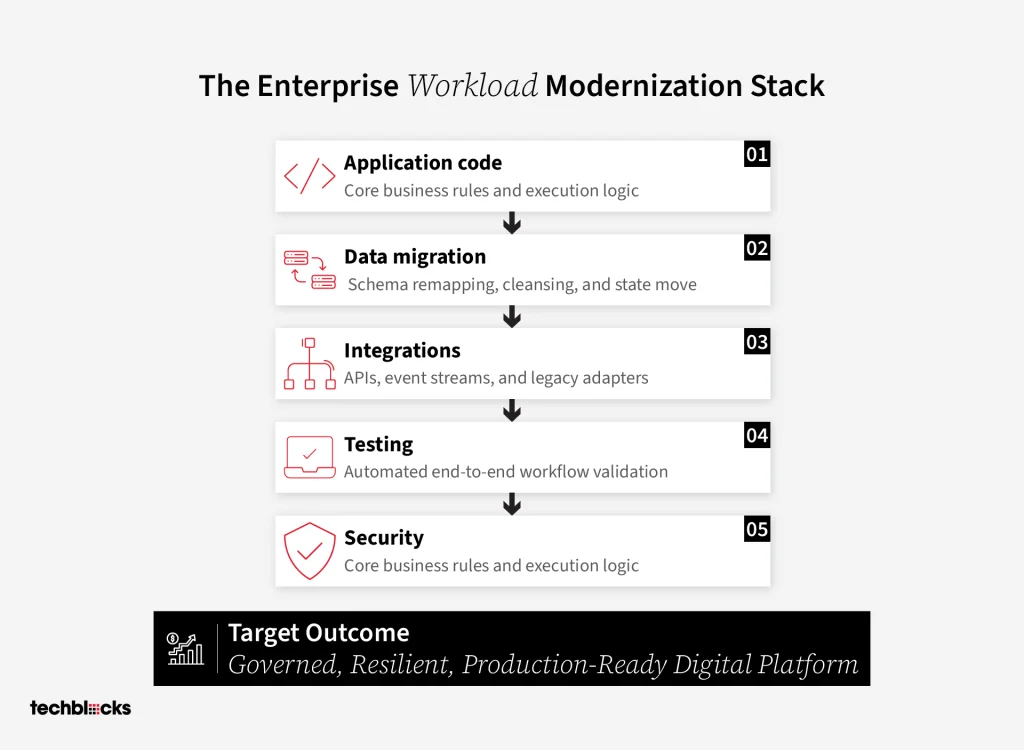
Removing technical debt is only an initial operational milestone for the enterprise software estate. The true objective is engineering an application environment whose total cost, operational risk, and commercial agility remain sustainable for years.
Successful enterprise application modernization requires engineering teams to bridge strategic discovery with reliable cloud execution. That’s where TechBlocks excels by delivering comprehensive application modernization consulting and engineering services through five core disciplines:
- Modernization Strategy & Portfolio Assessment: AI-assisted accelerators inventory dependencies and business criticality to map each workload to a clear pattern.
- Cloud Migration Factory & Foundations: Repeatable playbooks and automated wave-based migrations establish secure cloud landing zones with FinOps models that manage dual-run costs.
- Application & Experience Modernization: Engineering squads decompose monolithic software using strangler patterns, converting legacy code into scalable microservices, containers, or serverless architectures.
- Data & Integration Modernization: Brittle point-to-point connections are replaced with API-first architectures, event-driven streaming fabrics, and modern cloud data lakehouses.
- Platform Engineering, DevSecOps & Ongoing Run: Automated CI/CD pipelines, policy-as-code, and site reliability engineering ensure modernized platforms remain secure, observable, and compliant 24/7.
Modernization Becomes Necessary When Technical Debt Constrains the Business
The case for modernization becomes clear when preserving the existing application limits the enterprise’s ability to grow, respond, and invest effectively. At that point, continued maintenance protects outdated constraints while consuming capital that could create greater business value elsewhere.
A sound modernization decision should therefore produce a lasting operational advantage. The enterprise should gain an application estate that costs less to manage, responds faster to change, and gives engineering teams greater capacity to deliver new capabilities.
TechBlocks turns that business case into an executable modernization program. By connecting investment priorities with architecture and engineering execution, TechBlocks helps enterprises move beyond recurring technical debt and build platforms that remain practical to operate, change, and evolve. This disciplined approach ensures modernized platforms deliver predictable release velocity, lower operational expenditure, and sustained, future-proof business agility.
Get a thorough assessment of your enterprise’s modernization requirements with TechBlocks.
Book a 15-minute discovery call today.
FAQs on
Modernization may be justified when technical debt slows development, raises maintenance costs, or creates serious security and reliability risks. Application age alone is not enough if the platform remains stable, secure, and cost-effective.
Enterprises should measure infrastructure and licensing costs, maintenance hours, defect remediation, security patching, and incident response. The calculation should also include lost engineering capacity and the business impact of delayed product releases.
No. Applications with isolated issues may be stabilized through targeted refactoring, dependency upgrades, improved testing, or API-based isolation. Broader modernization becomes relevant when technical debt affects the architecture, connected systems, delivery speed, and operating costs.
Replatform when the application mainly needs a newer runtime or managed infrastructure. Refactor when valuable business logic should be retained but the existing code structure limits maintenance and releases. Rebuild when the current architecture cannot economically support required capabilities, scalability, or integration needs.
Enterprises may need a consulting partner when legacy dependencies, data migration, integration complexity, or transition risks exceed internal capacity. A partner can coordinate architecture, migration planning, DevSecOps, testing, and cost management.