
Every enterprise engineering leader has lived through the same ritual over the last few years. You hand out hundreds of AI coding assistant licenses—Copilots, custom chat windows, autocomplete plugins—and wait for the 10x engineering miracle to show up on your balance sheet. The pitch was intoxicating: developers would type faster, boilerplate code would vanish, and products would magically ship twice as fast.
So, your teams started generating code at a staggering volume. But look at your release calendars today. Are you actually deploying to production significantly faster? Or are your pipelines just as congested, your technical debt piling up higher, and your time-to-market largely unchanged?
The uncomfortable truth is that speeding up how fast a developer writes a line of code does nothing to fix a broken software delivery lifecycle.
We have fallen headfirst into a dangerous trap: treating AI as a developer toy rather than an operational revolution. Equipping engineers with a clever autocomplete tool is like putting a jet engine on a horse-drawn carriage. You aren’t modernizing your engineering capability; you are just accelerating the chaos. If you want software engineering to be truly AI-native, you have to stop looking at localized tools and start fixing the systemic architectural drag, manual governance, and legacy bottlenecks holding your entire organization back.
The Illusion of Velocity: Why Faster Typing Doesn’t Mean Faster Delivery
The disconnect between individual output and enterprise delivery timelines reveals a fundamental flaw in how productivity is measured.
When enterprise technology leaders review adoption metrics for AI coding assistants, the initial figures appear compelling. Research from organizations like GitHub and McKinsey indicates that generative AI tools can boost local coding speed and developer productivity by 25% to 50%. For executive leadership, these numbers signal an immediate opportunity for unprecedented efficiency gains.
However, enterprise release frequencies often remain stagnant, and time-to-market for strategic initiatives stays flat. The underlying cause is structural: writing code represents only a fraction of the total software development lifecycle.
Accelerating the fraction of engineering time spent on active coding without addressing coordination, code review, compliance, and deployment creates severe downstream friction. Feeding automated output into legacy pipelines faster than manual governance and testing frameworks can process it merely shifts the bottleneck, resulting in congested release cycles rather than accelerated delivery.
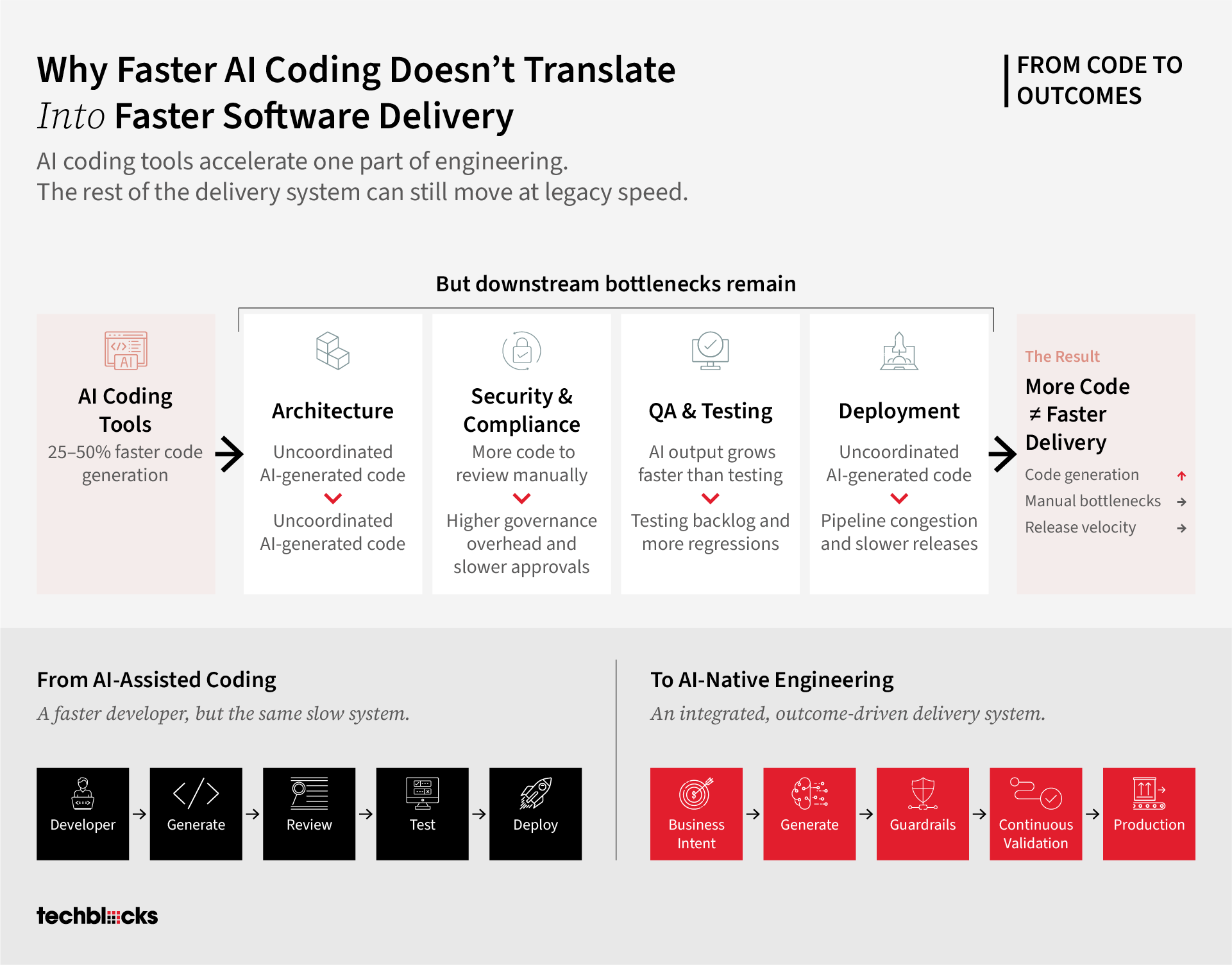
Code generation assistants focus primarily on syntax creation and boilerplate reduction. Consequently, deploying these tools optimizes an isolated segment of the workflow while leaving the remaining operational stages governed by traditional manual processes.
The Core Fallacy: Treating AI as a feature to be installed rather than an operating model to be adopted guarantees that your organization will remain trapped in legacy delivery speeds.
True modernization requires examining the entire value chain. When planning and compliance mechanisms operate at legacy speeds, optimizing isolated coding tasks creates structural imbalance, ultimately limiting enterprise return on investment.
The Architecture Bottleneck: When Code Generation Outpaces Guardrails
Rapid code generation without synchronized architectural oversight introduces systemic vulnerabilities across the enterprise. When development teams multiply their output using automated tools without corresponding governance upgrades, technical debt accumulates at an unprecedented scale.
- Unchecked Drift: Developers quickly generate thousands of lines of code that bypass standard architectural patterns, leading to fragmented microservices and brittle dependencies.
- Compound Security Flaws: AI-generated snippets can inadvertently introduce subtle security vulnerabilities or outdated libraries at a volume that manual code reviews cannot hope to catch.
- Maintenance Paralysis: Without strict structural guardrails, the long-term cost of maintaining rapidly generated code quickly eclipses the initial gains in typing speed.
Scaling output without scaling architecture transforms speed into a liability, converting minor technical debt into systemic operational gridlock.
QA in the Age of AI: Why Manual Testing Gates Break Under Automated Strain
The downstream fallout of unchecked code generation hits quality assurance hardest.
When traditional engineering cycles already trap up to 50% of developer hours in manual debugging, test writing, and bug patching, flooding the pipeline with unconstrained AI code creates a complete operational standstill.
Consider the three core points of failure where legacy QA collapses under automated pressure:
- The Speed Mismatch: Human-driven test creation moves at linear speeds, completely unable to match the exponential volume of automated output.
- The Defect Multiplier: High-velocity code pushed through manual review gates invariably lets critical edge-case bugs slip into production.
- The Bandwidth Sink: Engineers end up spending more time firefighting regression errors than building new product features.
Trying to secure high-speed code with manual checkpoints is a structural dead end. Overcoming this requires eliminating human-gated testing bottlenecks entirely in favor of autonomous, continuous validation loops that test and verify software concurrently with its creation.
From Developer Toys to Enterprise Reality: The Anatomy of True AI-Native Engineering
Look at your engineering organization right now. If your developers are celebrating a 30% jump in local typing speed while your release cadence remains flat, you are caught in the developer toy trap.
Why do multi-million-dollar AI tool deployments routinely stall before reaching production? Why does accelerating code generation often result in a slower time-to-market?
At TechBlocks, we’ve spent years working inside the trenches of enterprise software delivery, and the answer is always the same: organizations try to solve a systemic, architectural bottleneck with a desktop utility. They hand their engineers a high-speed generation tool, point it at a legacy pipeline clogged with manual QA gates and fragmented microservices, and wonder why the system breaks.
True AI-native engineering is not about writing code faster; it is about eliminating the friction between business intent and production reality.
The TechBlocks Approach: Engineering the AiDE Model
To move from isolated productivity hacks to an enterprise-grade capability, TechBlocks pioneered the AiDE (AI-Driven Engineering) operating model. We don’t bolt AI onto the keyboard; we weave it into the fabric of the entire software lifecycle.
Consider how this transforms the core verticals of enterprise delivery:
| Enterprise Vertical | The Legacy Friction Point | The TechBlocks AiDE Solution |
| Architectural Governance | Technical debt accumulates silently as uncoordinated teams generate code in silos. | Real-time guardrails that evaluate system design and compliance during generation. |
| Quality & Validation | Human-gated staging queues and manual regression testing create a permanent backlog. | Autonomous, self-healing validation loops that test code integrity continuously. |
| Enterprise Integration | Disjointed microservices and slow handoffs stall feature velocity. | End-to-end orchestration that maps business logic directly to production value. |
The Hard Questions Every Enterprise Must Answer
If you want to transition from a tooling experiment to an autonomous engineering organization, you have to confront uncomfortable realities:
- Are you measuring the right metrics? If your KPIs are still anchored to lines of code or local developer speed, you are incentivizing technical debt rather than flow efficiency.
- Where does your code actually stall? If generation takes hours but validation and compliance take weeks, your bottleneck isn’t typing—it’s your governance model.
- Is your AI reasoning across system boundaries? If your coding assistants only see the open file on the screen rather than the entire enterprise architecture, you are just automating syntax, not software delivery.
The Path Forward
Software engineering is no longer about how fast an individual can type. It is about building a synchronized, governed engine where ideas flow cleanly from enterprise intent to production value without hitting a manual wall.
When you stop treating AI as a toy and start treating it as an operating model, billed hours cease to be the baseline of value—and true engineering velocity begins.
The New Engineering Economy: Architecting for Flow, Not Frictional Output
The illusion of the desktop assistant has been dismantled, the architectural drift mapped, and the QA gridlock diagnosed. This brings enterprise software delivery to its ultimate economic crossroads.
When code generation becomes virtually free, the traditional economics of software engineering invert entirely.
For decades, enterprise budgets have relied on a simple equation: developer hours multiplied by billing rates. Success meant measuring input—counting lines of code, staffing larger teams, and tracking hours logged against sprints. In an AI-native economy, measuring raw input is a direct liability.
Metrics for the Autonomous Era
Managing tomorrow’s engineering model with yesterday’s scorecard guarantees failure. Leading organizations are shifting their telemetry toward three critical outcomes:
- Flow Efficiency: Measuring the actual elapsed time it takes for a business requirement to convert into verified, production-ready value, entirely free of manual handoff delays.
- Structural Integrity: Evaluating system health by how effectively automated guardrails prevent technical debt from compounding during high-speed generation.
- Cognitive Bandwidth: Tracking how successfully senior engineering talent is reallocated away from manual code reviews and firefighting into high-level system design and strategic innovation.
Conclusion: The End of Billed Hours, The Beginning of Autonomous Delivery
The software industry stands at a permanent inflection point.
An organization can choose to treat artificial intelligence as a glorified autocomplete tool—a marginal efficiency gain that pads local typing speeds while leaving downstream bottlenecks completely untouched. Alternatively, it can confront the reality that AI is fundamentally rewriting the DNA of software development.
The core thesis is absolute: the future belongs to enterprises that stop selling hours and start engineering flow. By replacing manual friction with autonomous validation, localized scripts with systemic intent, and fragmented tools with a unified AiDE framework, the objective isn’t just writing software faster.
It is redefining how software value is created. The tools have changed. The operating model must change with them.
Architect true enterprise speed
Master The Future Of Autonomous Software Engineering Today
Eliminate downstream bottlenecks and architect seamless flow from business intent to production.

FAQs on AI Coding Tools
AiDE embeds real-time guardrails directly into the generation pipeline, evaluating system boundaries, compliance, and design patterns during code creation rather than relying on slow, retrospective reviews. This ensures all automated output continuously adheres to core enterprise architecture standards without slowing down development velocity.
Enterprises must shift telemetry to Flow Efficiency (tracking elapsed time from business intent to production), Structural Integrity (evaluating debt suppression via guardrails), and Cognitive Bandwidth (measuring how successfully senior talent is reallocated from manual firefighting to high-level system design and strategic enterprise innovation).
Exponential AI code generation completely overwhelms linear, human-gated staging queues. This creates a severe speed mismatch where legacy testing cannot keep pace, turning quality assurance into a massive gridlock of regression errors and failed builds that halts production and traps valuable developer bandwidth.
Isolated tools focus strictly on local syntax acceleration, speeding up individual typing while leaving downstream pipelines untouched. An AiDE model weaves artificial intelligence across the entire enterprise value chain, unifying intent mapping, security compliance, and continuous validation into a synchronized, closed-loop delivery system.
Organizations must move away from billing raw input like headcount and hours by adopting outcome-based flow. This requires automating manual handoffs, eliminating legacy staging queues, and aligning leadership KPIs with rapid time-to-market, structural integrity, and sustainable system velocity rather than resource volume.