

Shoppers today change channels effortlessly, jumping from social media ads to mobile apps, buying online, and picking up in-store. For retail CIOs, keeping up with those shifting habits is a constant balancing act. The real challenge, however, usually lies hidden beneath the surface: years of accumulated legacy software, disconnected inventory systems, and fragile third-party integrations that make everyday operations feel like an uphill climb.
When boards push for a massive digital overhaul, the pressure to move fast is intense. But diving straight into a platform replacement without a clear evaluation plan is a fast track to budget overruns and delayed roadmaps. To build a modern commerce engine that actually delivers on its promises, retail technology leaders need to look critically at their entire operational ecosystem first.
Here are the seven essential pillars every retail CIO should evaluate before launching a commerce transformation:
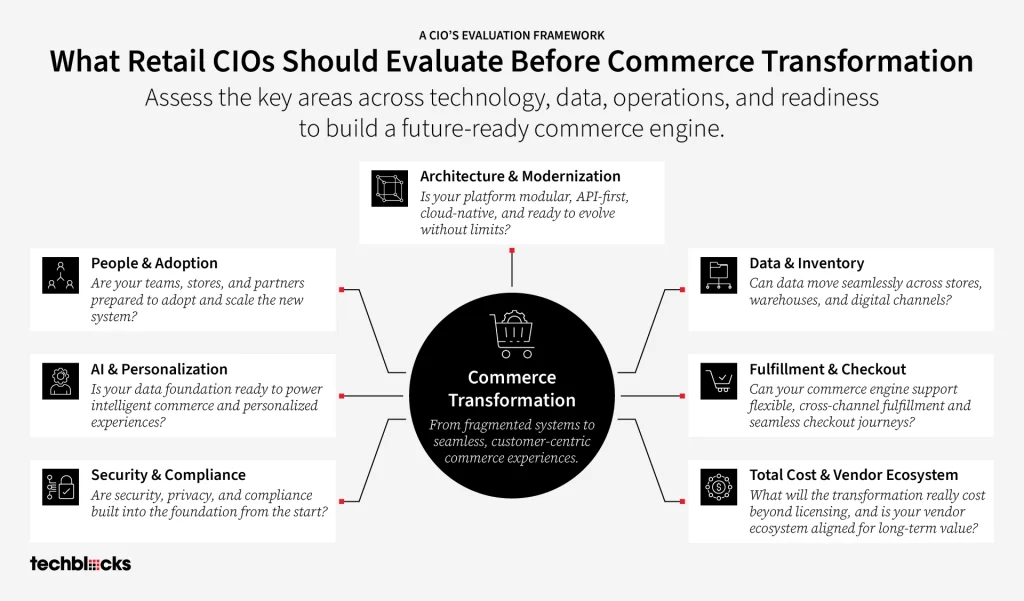
Pillar 1: Architectural Modularity & MACH Readiness
Most retail tech stacks resemble a house of cards. Over the years, teams bolt new features onto rigid, legacy monoliths until the entire system becomes too fragile to change. When a flash sale hits or seasonal traffic spikes, these old architectures buckle under pressure, leading to downtime and lost revenue.
A transformation should start with an assessment of whether the existing architecture can support a decoupled approach built around MACH principles: Microservices, API-first, Cloud-native, and Headless. Moving to modular architecture ensures the front-end shopping experience can evolve independently from the backend order management.
- Breaking the Monolith: You need to assess whether your core architecture can separate front-end customer experiences from back-end logic.
Why? If the front-end and back-end are permanently tied together, a simple layout update requires a major system deployment, creating massive operational bottlenecks.
- API-First Extensibility: Verify that your platform allows third-party logistics, payment gateways, and merchandising tools to plug in smoothly.
Why? Relying on custom point-to-point code means every single software update from a vendor risks breaking your entire integration pipeline.
- Peak Traffic Resilience: Evaluate your underlying infrastructure scalability to ensure the platform handles high-traffic retail events without performance degradation.
Why? A slow or crashing checkout page during a holiday rush instantly drives customers straight to your competitors.
Pillar 2: Unified Data Architecture & Single View of Inventory
A great digital storefront means very little if a customer buys an item online that is actually out of stock in the local warehouse. Yet, data fragmentation remains one of retail’s biggest silent killers. Point-of-sale systems, warehouse management software, and e-commerce platforms frequently operate in complete isolation.
That assessment should extend to how data flows across the entire organization. Retail leaders need to audit these flows and establish a real-time, single view of inventory across physical stores, dark stores, and distribution centers, an increasingly important foundation for modern retail operations.
- Auditing Data Flows: Map precisely how data moves between point-of-sale systems, warehouse software, and e-commerce platforms.
Why? Without a clear audit, hidden data silos will continue to cause synchronization lags, resulting in inaccurate stock counts and operational blind spots.
- Real-Time Inventory Visibility: Ensure accurate, enterprise-wide tracking across physical stores, local dark stores, and distribution centers.
Why? Customers expect to see precise stock levels instantly; failing to provide this leads directly to canceled orders and lost customer trust.
- Customer Data Readiness: Assess your data hygiene and customer segmentation models before migrating platforms.
Why? Clean, unified data is the baseline requirement for powering accurate personalization engines and targeted loyalty programs that drive repeat purchases.
Pillar 3: Omnichannel Fulfillment & Checkout Agility
Modern shoppers expect to buy online and pick up in-store, ship from local stockrooms, or return items through entirely different channels than the ones they purchased from. When these fulfillment paths are disconnected, logistics costs soar and customer satisfaction plummets.
The same scrutiny applies to fulfillment logic and checkout flows, which must support flexible, cross-channel experiences without relying on manual intervention from store associates. CIOs should assess whether the underlying systems can handle these workflows consistently across channels.
- Fulfillment Flexibility: Evaluate your readiness for complex workflows like buy-online-pick-up-in-store, ship-from-store, and seamless cross-channel returns.
Why? Rigid supply chain systems trap inventory in specific locations, preventing you from fulfilling orders efficiently from the closest available source.
- Frictionless Checkout Flows: Assess your payment flexibility, mobile-first transaction performance, and integrated fraud detection tools.
Why? A clunky or slow checkout process on a smartphone screen causes high cart abandonment rates during peak shopping hours.
- Operational Workflow Alignment: Ensure that store associates and warehouse staff have intuitive, low-training tooling to manage modern fulfillment options.
Why? If back-end fulfillment tools are too complex, frontline employees will struggle to process orders accurately during rush periods, leading to fulfillment errors.
Pillar 4: Total Cost of Ownership (TCO) & Vendor Ecosystem
Looking at software licensing fees alone is one of the quickest ways for a retail commerce transformation to spiral out of control financially. The true cost of a new platform goes far beyond the initial purchase price, encompassing complex data migration, extensive custom integrations, and ongoing maintenance.
Before committing to a vendor, CIOs need to look at the big picture and calculate a realistic total cost of ownership over a multi-year horizon while evaluating long-term flexibility.
- Uncovering Hidden Implementation Costs: Factor in the expenses associated with data migration, custom integrations, and staff training rather than just software licensing fees.
Why? Overlooking these operational expenses during the planning phase is a primary reason tech projects blow past their approved budgets.
- Evaluating Vendor Lock-In Risks: Compare the flexibility of open, composable architectures against proprietary, all-in-one SaaS ecosystems.
Why? Highly proprietary platforms can trap your enterprise in rigid pricing structures and limit your ability to swap out underperforming features later.
- Assessing Time-to-Value Metrics: Evaluate how quickly the proposed platform can actually launch and start delivering measurable financial returns.
Why? A transformation that takes years to deploy ties up capital and delays the revenue growth needed to justify the investment to stakeholders.
Pillar 5: Security, Compliance & Data Privacy Baselines
Retailers handle a massive volume of sensitive customer information, from credit card details to personal shipping addresses and loyalty program data. A single security vulnerability or compliance failure can lead to catastrophic financial penalties and permanent reputational damage.
Security and privacy also need to be built directly into the core development pipeline rather than treated as an afterthought. Technology leaders should establish the required controls across commerce applications, payment workflows, data environments, and deployment processes.
- Enforcing Regulatory Compliance: Verify that your commerce architecture strictly adheres to regional and global data privacy regulations like GDPR and CCPA across all touchpoints.
Why? Customer data flows seamlessly through modern digital storefronts, and non-compliance risks heavy legal fines and eroded consumer trust.
- Maintaining Payment Card Security: Assess rigorous PCI-DSS compliance frameworks and modern tokenization protocols for handling customer financial transactions.
Why? Protecting payment data from interception is non-negotiable; a security breach at checkout can instantly halt sales and devastate brand equity.
- Embedding Automated Vulnerability Scanning: Ensure that continuous security testing and zero-trust access controls are integrated directly into your deployment pipeline.
Why? Relying on manual security reviews leaves windows of vulnerability open as new code updates and microservices roll out continuously.
Pillar 6: AI & Personalization Readiness
Artificial intelligence and machine learning have shifted from nice-to-have experimental features to absolute requirements for modern retail survival. Shoppers now expect intelligent search bars that understand intent, real-time product recommendations, and dynamic pricing that mirrors market demand.
However, deploying advanced AI tools on top of messy, unorganized enterprise data is a recipe for failure. Before launching a commerce transformation, CIOs must evaluate whether their underlying data infrastructure is actually mature enough to support intelligent automation.
- Auditing Data Lake Maturity: Determine whether your existing enterprise data lakes are clean, structured, and accessible enough to feed AI algorithms.
Why? AI models rely entirely on high-quality historical data; feeding them fragmented or duplicate information will only generate inaccurate recommendations and poor user experiences.
- Deploying Automated Merchandising: Assess your capability to integrate automated product recommendations, smart search, and fraud-scoring agents into the storefront.
Why? Manual merchandising cannot keep pace with fast-changing shopper preferences, whereas AI-driven curation significantly boosts average order values.
- Establishing Scalable Experimentation: Evaluate your tools for running continuous A/B testing and rapid algorithmic optimization across digital touchpoints.
Why? Winning digital experiences require constant testing and refinement rather than static, one-time design launches.
Pillar 7: Change Management & Internal Adoption
The most advanced tech stack in the world will fail if the people using it every day reject it. Retail transformations often focus so heavily on software architecture and APIs that leadership forgets about the human element, specifically, the store associates and warehouse staff who must operate the new systems under high-pressure conditions.
Technology readiness alone is not enough; organizations also need the people and processes required to operate the new commerce platform effectively. That means investing in change management, intuitive training programs, and cross-functional alignment before the new system goes live.
- Enablement for Store Associates: Plan comprehensive, low-barrier training programs for frontline staff to adopt new omnichannel POS and inventory tools.
Why? If new systems are too complex or poorly explained, store associates will bypass them during busy shifts, leading to inventory errors and customer friction.
- Bridging Siloed Departments: Establish structured collaboration frameworks to break down traditional walls between siloed IT, marketing, merchandising, and supply chain teams.
Why? Digital commerce touches every corner of the retail business; isolated departments working toward conflicting goals will quickly derail project momentum.
- Governing Implementation Partners: Create clear accountability structures and performance benchmarks to manage external vendors and implementation partners.
Why? Without tight governance, external partners can introduce project drift, scope creep, and unexpected billing overruns that compromise the entire initiative.
Conclusion: De-Risking the Commerce Journey
Modern retail survival depends entirely on technology that moves as fast as customer expectations. Rushing into a digital platform overhaul without a rigorous, multi-dimensional evaluation strategy guarantees budget blowouts, frustrated shoppers, and compounding technical debt.
True enterprise modernization is not just an IT upgrade; it is a fundamental business transformation. By auditing these seven core pillars before writing a single line of code, retail CIOs can eliminate hidden operational risks, secure executive alignment, and build a high-performance commerce engine designed for sustained market leadership.
DESIGN FOR WHAT’S NEXT
TechBlocks Helps Build Commerce Systems Ready For Change
Assess your technology, data, fulfillment, security, and adoption readiness before making transformation decisions.
Frequently Asked Questions
Most failures stem from treating platform modernization as a pure IT upgrade rather than an enterprise-wide shift. When organizations skip a rigorous pre-transformation audit, they overlook deep-seated data silos, legacy architectural bottlenecks, and change management friction. This leads to massive budget overruns, delayed roadmaps, and systems that fail to deliver on customer expectations.
MACH principles decouple your front-end customer experience from your back-end order management. For retail teams, this means you can update your mobile app, launch a new seasonal campaign, or integrate a third-party logistics vendor in days rather than months, without risking system-wide downtime during peak shopping surges.
While software licensing fees are obvious, the most expensive surprises usually hide in custom data migration, brittle point-to-point integrations, and frontline staff training. Overlooking these operational expenses during the planning phase is the primary reason tech projects blow past their approved budgets and stall halfway through deployment.
Retail inventory is traditionally trapped in isolated silos, separate point-of-sale systems, local store stockrooms, and regional distribution centers rarely talk to each other in real-time. Without a unified data architecture, businesses suffer from stock synchronization lags, which result in oversold products, canceled orders, and frustrated shoppers.
Deploying advanced AI tools and personalization engines on top of messy, unorganized enterprise data is a recipe for failure. Retail leaders must first ensure their underlying data lakes are clean and structured. Once that foundation is set, AI can effectively automate merchandising, smart search, and dynamic pricing without generating inaccurate recommendations.