
Private equity investment committees underwrite deals on the promise of aggressive digital transformation and multiple expansion, assuming software and data will immediately lower the cost-to-serve. However, operating partners walking into newly acquired portfolio companies on day two routinely inherit a severe operational bottleneck: fragmented legacy tech stacks, unmanaged technical debt, and bloated third-party vendor burn rates that quietly sabotage the 100-day plan. Treating post-acquisition technology as a standard IT lift-and-shift or relying on traditional time-and-materials outsourcing guarantees margin compression, turning what should be a core value driver into a compounding operational tax.
To protect valuation multiples under compressed three-to-five-year holding periods, PE operating partners must abandon legacy labor-arbitrage models and implement institutionalized, AI-native Global Capability Center frameworks. To understand how private equity firms can engineer this transition, this article will explore:
- First, why legacy offshore outsourcing models trap portfolio companies in linear headcount scaling and hidden financial drag.
- Consequently, how shifting to modular, outcome-driven engineering pods powered by AI automation proves tangible ROI within a strict 8-week window.
- Finally, how centralized Centers of Excellence and continuous digital hygiene ensure every asset remains fully exit-ready for secondary buyouts or public listings.
The Post-Acquisition Value Paradox: Why Traditional IT Playbooks Fail
Private equity operating partners inherit a profound structural contradiction on day one: the deal model relies on rapid digital acceleration and margin expansion, yet the acquired asset is invariably anchored by legacy infrastructure and traditional vendor relationships. For decades, the default response to post-merger technology bottlenecks was to scale headcount through conventional outsourcing or time-and-materials contracts. However, this playbook creates a direct conflict with private equity economics.
Under traditional vendor arrangements, financial incentives are entirely misaligned with portfolio goals. Providers profit from bloated teams, drawn-out roadmaps, and billable hours, which directly penalizes speed and capital efficiency. As engineering hours multiply without a corresponding increase in delivery output, technical debt accumulates silently beneath the surface. For a portfolio company racing against a compressed holding period and servicing acquisition debt, this structural friction turns technology from a primary driver of multiple expansion into an expensive, recurring operational liability.
Moving Beyond GCC 1.0 and 2.0: The Shift to AI-Native Execution
When traditional outsourcing and ad-hoc contractors fail to move the needle for our private equity partners, the conversation inevitably shifts toward internalizing engineering operations through a dedicated Global Capability Center. However, simply copying and pasting historical offshore playbooks will never solve modern portfolio challenges. Over the years, we at TechBlocks have watched enterprises cycle through capability center iterations that promised structural efficiency but ultimately left leadership trapped in outdated operational models.
To understand why traditional offshore hubs frequently become bottlenecks rather than value drivers, it helps to examine how the ecosystem has evolved:
- GCC 1.0 (Labor Arbitrage): The earliest model focused strictly on real estate footprints and low-cost headcounts, treating geography as the primary financial lever while trapping technical innovation inside rigid organizational silos. Success was measured by physical seats filled rather than software shipped.
- GCC 2.0 (Linear Digital): Subsequent iterations successfully adopted cloud environments and standard DevOps tooling, yet their capacity scaling remained entirely linear. Achieving higher software output still required adding more full-time employees, which immediately drove up management overhead, coordination drag, and administrative complexity.
- GCC 3.0 (The TechBlocks AI-Native Framework): Our approach breaks the linear headcount trap entirely. By deploying outcome-led, modular engineering pods augmented by intelligent software engines, we embed AI automation directly into the core delivery pipeline. This allows portfolio companies to scale engineering velocity exponentially without inflating operating costs.
For PE operating partners, adopting a specialized, AI-native framework like GCC 3.0 changes the entire economic equation. We designed this model specifically to convert an offshore hub from an administrative cost center into a high-performance, predictable engine capable of driving immediate, measurable value creation across the entire portfolio.
The Mechanics of GCC 3.0: Modular Pods and Outcome-Indexed Commercials
Post-acquisition technology execution breaks down when firms rely on traditional time-and-materials contracts that financially reward vendors for slow delivery and bloated headcounts. To protect operating cash flow and hit aggressive 100-day milestones, private equity firms need an engineering model built on radical accountability and speed.
The GCC 3.0 framework restructures offshore delivery around three operational pillars designed to eliminate waste:
Autonomous, Domain-Specific Pods
Instead of assembling massive, unstructured offshore hierarchies, the model deploys self-contained, cross-functional engineering units tailored to specific value drivers such as cloud refactoring, data pipeline modernization, or core product scaling. Each pod functions as an independent unit equipped with pre-built code modules and proprietary accelerators, bypassing the months typically wasted on team onboarding, tribal knowledge transfer, and environment setup.
Native AI Integration Across the Delivery Pipeline
Artificial intelligence is embedded directly into every stage of the software development lifecycle rather than deployed as an isolated point tool. By automating routine code generation, predictive bug detection, regression testing, and technical documentation, these engineering pods remove manual bottlenecks and compress release cycles from quarters into weeks.
Risk-Sharing, Outcome-Indexed Commercials
Financial incentives are tied directly to verifiable operational milestones rather than open-ended billable hours. Commercial agreements are structured around tangible portfolio outcomes, such as achieving specific software velocity metrics, accelerating time-to-market for key enterprise features, or hitting targeted reductions in cloud infrastructure overhead, ensuring that every dollar spent directly drives multiple expansion.
Engineering the 100-Day Plan: Accelerating Synergy Realization
The clock starts ticking the moment a deal closes, and the initial 100 days dictate whether a portfolio company accelerates its value creation thesis or becomes permanently bogged down by technical debt. Traditional IT integrations typically waste the critical opening weeks on prolonged discovery meetings, fragmented stakeholder interviews, and slow consensus-building.
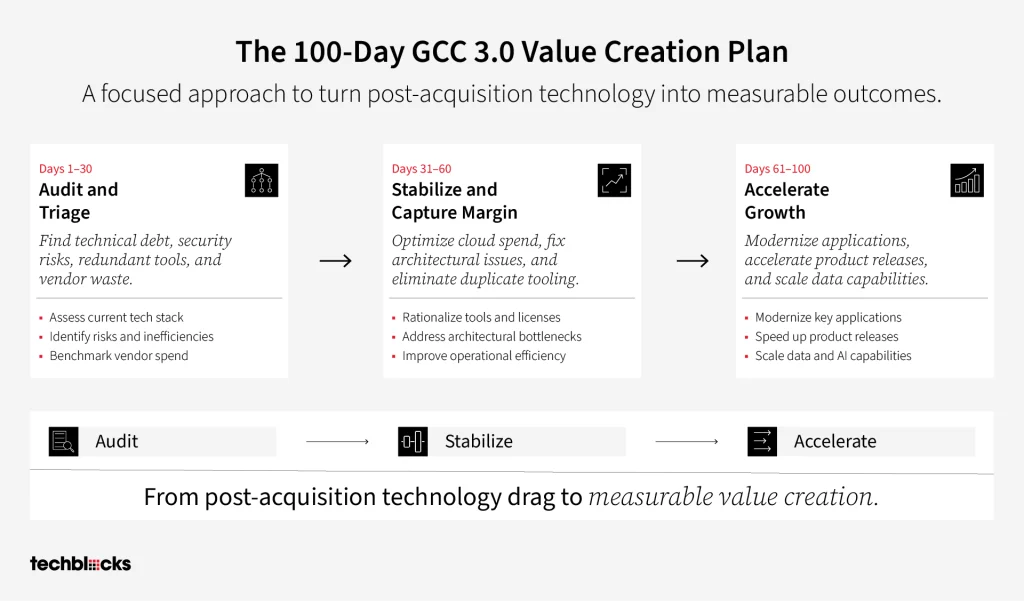
To eliminate this friction, the GCC 3.0 framework replaces open-ended discovery with a compressed, phased execution timeline designed to deliver immediate operational impact.
The 100-Day Value Realization Phases
- Days 1 to 30 (Audit & Triage): Autonomous pods deploy automated diagnostic tools to sweep the acquired codebase, infrastructure, and vendor contracts. This uncovers hidden security vulnerabilities, redundant software licenses, and critical technical debt within days rather than months.
- Days 31 to 60 (Stabilization & Margin Capture): Engineering units target immediate cash bleed. By optimizing cloud resource allocation, patching architectural flaws, and eliminating duplicate tools, they secure fast operational savings that feed directly into EBITDA.
- Days 61 to 100 (Velocity & Growth Acceleration): With core systems stable, modular pods pivot to top-line growth. They accelerate product roadmaps, modernize customer-facing applications, and scale data pipelines to ready the asset for its next market phase.
Traditional IT Integration vs. The GCC 3.0 100-Day Playbook
| Operational Dimension | Traditional Outsourcing Approach | The GCC 3.0 Framework |
| Initial Discovery | Manual audits taking 45–60 days; reliant on tribal knowledge. | Automated AI code and infrastructure scans completed in week one. |
| Cost Management | Vendor rewards extended timelines and bloated headcount. | Focus on immediate resource optimization and margin protection. |
| Velocity & Delivery | Slower release cycles; high coordination drag across silos. | Compressed release cycles driven by modular, pre-accelerated pods. |
| Accountability | Billed on hours logged regardless of business outcome. | Indexed to milestone delivery, velocity targets, and EBITDA impact. |
By replacing slow, analog onboarding with a structured, AI-driven 100-day rhythm, private equity operating partners bypass legacy bottlenecks and establish predictable, high-velocity momentum right out of the gate.
Case in Point: Transforming Portfolio Economics Through AI-Native Engineering
When it comes to private equity value creation, there are many cases that we at TechBlocks can talk about, and how companies go wrong, and where they might need help. In this case, our team helped a leading retail giant in North America rescue a flagship digital modernization initiative that had spiraled from a $30 million budget into a $120 million financial liability, bogged down by two years of stagnant execution.
The underlying problem was a legacy offshore model that burned $2.2 million monthly on manual, ticket-driven releases, undocumented codebases, and fragmented U.S. and Canadian tech stacks. Leadership had complete lack of visibility into delivery velocity, and the mounting cash drain threatened the broader investment thesis while omnichannel demands accelerated.
Resolving the crisis required a complete systemic overhaul, replacing the traditional vendor structure with our GCC 3.0 framework to establish immediate operational control:
- Aggressive Right-Shoring and Footprint Restructuring: Within 90 days, we established a multi-region capability footprint across North America and offshore hubs. We consolidated over 260 specialized engineers into 19 autonomous, domain-specific pods, successfully dropping monthly burn from $2.2 million to $1.0 million while eliminating middleman vendor overhead.
- Architectural Decoupling and Engineering Modernization: Our pods dismantled the tangled legacy monoliths, breaking them down into clean, manageable microservices. We embedded automated CI/CD pipelines, DevSecOps protocols, and AI-driven site reliability agents that handled 24/7 incident response, stabilizing 12 separate customer-facing digital platforms.
- Execution Telemetry and Cost Governance: We replaced ambiguous vendor status reports with real-time executive dashboards. This telemetry linked every engineering sprint directly to cost-per-story-point metrics, release health, and proactive FinOps optimization.
Quantifiable Enterprise Impact
| Performance Metric | Legacy Outsourcing Baseline | The GCC 3.0 Transformation |
| Monthly Operating Burn | $2.2M per month (severe cash bleed) | $1.0M per month (lean, predictable run rate) |
| Release Velocity | Multi-year delays; high-risk manual deploys | 4x faster release cycles with continuous AI deployment |
| Engineering Cost Efficiency | Spiraling budget overruns ($120M sunk) | 45% reduction in ongoing engineering costs |
| Cumulative Value Creation | Trapped value and failed transformation | $70M in verified savings realized over five years |
The intervention proved that traditional labor arbitrage models are fundamentally incompatible with modern post-acquisition timelines. Shifting to modular, AI-native engineering pods allowed the retail giant to eliminate operational waste, regain absolute control over its product roadmap, and secure long-term portfolio profitability.
Conclusion: Institutionalizing Value Creation Through AI-Native Engineering
When private equity firms execute an acquisition, the ultimate measure of success is not merely closing the deal, but the speed and certainty with which technology assets translate into multiple expansion. Traditional offshore models, rooted in rigid headcount scaling, labor arbitrage, and reactive maintenance, consistently fail to meet the demands of modern post-acquisition timelines. They trap capital in administrative bloat, obscure delivery telemetry behind walls of technical debt, and leave operating partners blind to actual software velocity.
As portfolio complexity accelerates, technology leadership requires a fundamental operating model shift. The TechBlocks GCC 3.0 framework replaces legacy outsourcing friction with an autonomous, outcome-indexed engine driven by modular pods and native artificial intelligence. Transforming capability centers from reactive cost centers into predictable drivers of margin protection and top-line growth allows private equity sponsors to safeguard their investment thesis, compress time-to-market, and secure high-value exits ahead of schedule.
AI-Native Engineering for Growth
Accelerate Your Portfolio Value Creation With GCC 3.0
Transform your offshore operations from a cost center into a high-velocity growth engine.

Frequently Asked Questions
Legacy outsourcing relies on rigid headcount billing and manual tasks. Traditional vendors trap capital in administrative bloat while leaving leadership completely blind to actual software delivery velocity.
Autonomous engineering teams embed automated code generation, regression testing, and continuous monitoring. Modern pods multiply software output significantly without requiring any additional administrative headcount from sponsors.
Commercial contracts tie financial compensation directly to verified milestone completion, release frequency, and measurable cost reductions rather than simply rewarding hours logged by the vendor.
Specialized pods systematically decouple legacy enterprise monoliths into clean microservices. Engineering teams establish automated deployment pipelines and robust infrastructure baselines across all distributed development locations.
Executive dashboards track actual cost-per-story-point metrics, deployment health, and resource utilization daily. Portfolio companies achieve complete operational transparency without relying on manual status updates.