

Writing software looks completely different than it did just a couple of years ago. Instead of drafting every single line by hand, we spend our time steering AI assistants through scaffolding, refactoring, and feature work at breakneck speed.
It feels like magic until you hit the wall that every heavy AI user eventually runs into: context bloat and wasted tokens.
When a chat thread runs too long, the model’s window fills up with endless trial-and-error noise, obsolete search logs, and repetitive prompts. And it costs you more than just money on your API bill. Cluttered context actually makes the AI worse, it starts forgetting instructions, missing crucial details, and hallucinating fixes. Suddenly, you’re spending more time correcting the assistant than it would have taken to write the code yourself. It creates a weird paradox for teams: our individual output is through the roof, but our overall delivery costs stay stubbornly high because efficiency keeps getting swallowed by messy feedback loops.
The fix isn’t using AI less; it’s learning how to manage AI tokenomics. When you know how to direct the AI’s attention cleanly, your workflow stays fast, sharp, and sustainable.
Whether you’re an individual developer cleaning up your daily prompting habits or a team trying to scale AI smoothly across a large codebase, a little structure goes a long way. Here are the top 7 principles for token-efficient software delivery to help you get the most out of every single token.
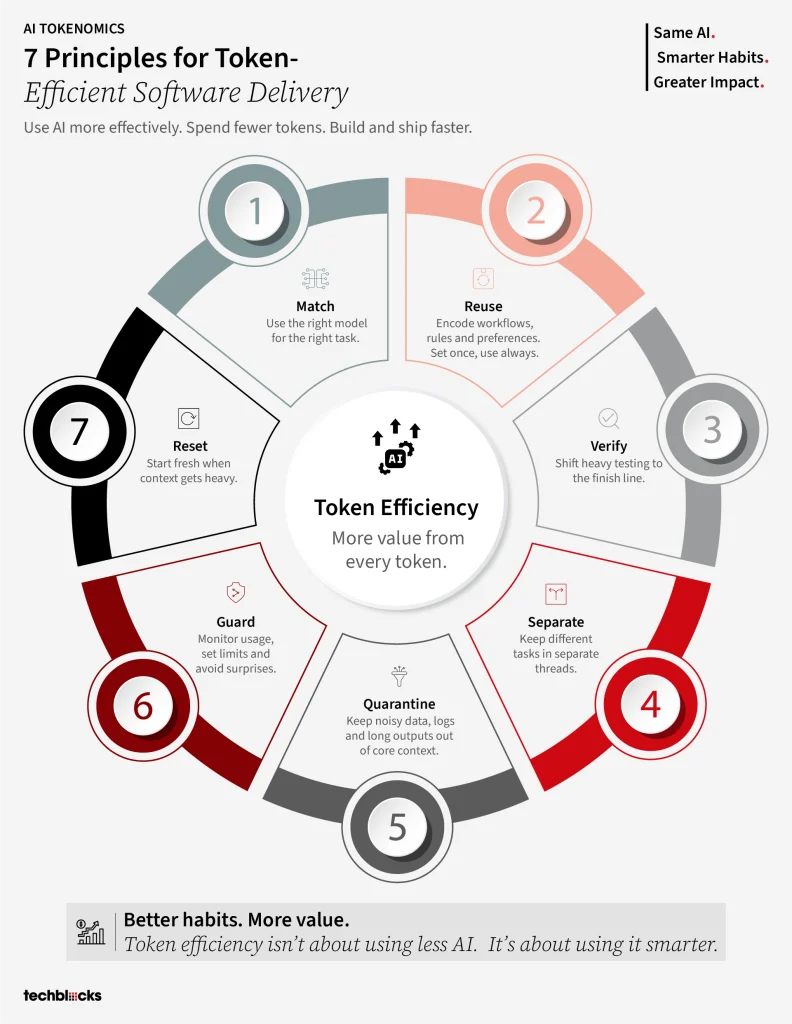
1. Match the Model to the Problem (Stop Over-Engineered Prompts)
Not every coding task requires a heavy, frontier-level model. Dropping a simple formatting fix, a routine variable rename, or basic boilerplate code into a massive, high-reasoning model is a fast way to burn through your token budget and introduce unnecessary latency.
The trick is matching the model’s horsepower to the actual friction level of the job:
- Default to fast, agile models for your everyday coding, standard scaffolding, and straightforward refactoring. They are more than capable of handling the heavy lifting and keep your local feedback loop lightning-fast.
- Scale up only when necessary, reserve long-context, high-reasoning models strictly for complex architectural design, deep debugging sessions, or untangling hairy, multi-system dependencies that stall out lighter models.
By starting light and only stepping up when a task genuinely demands it, you keep your daily token spend lean without sacrificing the depth you need when things get complicated.
2. Lock Down Reusable Skills and Rules (Write Once, Automate Forever)
If you find yourself explaining your testing protocols, directory structures, or code-formatting quirks in every single prompt, you are leaking tokens on repeat.
Agents don’t need conversational reminders of how your environment works every time you spin up a thread. Instead, package your workflows, guidelines, and tool preferences into persistent configuration file, like dedicated local skill scripts or centralized instruction files (SKILL.md or AGENTS.md).
When your assistant triggers these files automatically, your prompts stay clean, focused, and concise. You stop wasting context on preamble, and you stop the agent from wasting time searching your codebase for rules you’ve already established. Set the standards once, let the config handle the handoff, and keep your daily token budget locked in on the code itself.
3. Shift Verification to the Finish Line
One of the quickest ways to choke a chat session is forcing the AI to constantly verify its own work mid-stream. Running multi-step UI tests, opening up browser windows for visual inspection, or triggering heavy end-to-end test suites after every minor code tweak will drain your token window before you even hit the halfway mark of a feature.
Instead, change when and how you test:
- Front-load the fast checks: Let the agent handle local builds, unit tests, and quick functional checks early to catch basic syntax or logic errors organically.
- Save the heavy verification for the end: Push expensive, resource-heavy smoke tests, visual regression checks, and browser validations right to the final handoff.
Treating verification as a milestone rather than an ongoing conversation keeps your active coding loops lean, fast, and remarkably token-efficient.
4. Separate the Master Plan from the Execution (The Elephant & Goldfish Trick)
If you try to keep a single chat session alive through an entire multi-week feature build, you are guaranteed to hit a wall. As the conversation stretches on, the context window fills with old code iterations, discarded ideas, and debugging dead ends, causing the model to get sluggish, drop instructions, or start hallucinating.
To break this cycle, borrow a page from engineering strategy:
- The “Elephant” Phase (High-Context Planning): Spin up a high-reasoning, long-context session specifically to map out your system architecture, dependencies, and a detailed execution plan. Let the model digest the big picture once.
- The “Goldfish” Phase (Clean Execution): Take that blueprint and execute it in short-lived, low-token sessions. Keep your prompts laser-focused on small chunks of the plan, and checkpoint your progress frequently with clean commits.
When a session starts feeling heavy, throw it away, pull your latest commit, and start fresh. You get the benefit of a brilliant master plan without paying the token penalty of a bloated chat history.
5. Quarantine Research and Output-Heavy Tasks
Asking your active coding assistant to perform open-ended codebase searches, parse thousands of lines of raw server logs, or generate massive blocks of documentation inline is a surefire way to poison your working context.
When you flood an active development thread with thousands of tokens of raw log data or recursive file lookups, the model’s core instructions get buried under the noise.
Instead, treat research and heavy generation as isolated side-quests:
- Offload to sub-agents: Delegate deep research, dependency audits, or separate frontend and backend scaffolding to dedicated sub-agents or separate helper threads.
- Review only the artifacts: Let the helper handle the heavy data crunching, and feed only the final, distilled output back into your main working session.
By keeping your primary chat thread clear of raw data dumps and heavy text generation, you preserve the AI’s attention span and keep your token usage ruthlessly efficient.
6. Put Leashes on Autonomous Loops and Background Polling
Autonomous agents and background supervisor loops are incredible for finding optimization opportunities, scanning codebases for pending work, or auto-fixing minor linter errors. But left unmonitored, they can quietly run amok and burn through your entire enterprise token budget in a single afternoon.
High autonomy requires tight guardrails:
- Avoid constant polling: Do not let agents check status or poll repositories in an unconstrained loop. Use event-driven wakeups so they only spin up when a specific trigger occurs (like a new pull request or a failed build).
- Enforce strict limits: Always set hard iteration caps, tight timeout thresholds, and clear stop conditions for any autonomous script or background worker.
Freedom without guardrails is a fast track to a drained token account. Give your automated tools clear boundaries so they work for your efficiency rather than against it.
7. Know When to Toss the Thread and Start Fresh
It’s tempting to keep a single chat window open all day, treating it as an ongoing conversation where the assistant “knows” everything you’ve worked on so far. But in the world of AI tokenomics, clinging to a stale thread is one of the quietest ways to leak tokens and invite errors.
If you are pivoting to a completely new bug fix, a different component, or an entirely separate feature, don’t try to drag your old baggage into the new chat.
- Let go of legacy context: When the topic changes, start a fresh session. A clean slate allows the model to pull in only the specific files, snippets, and instructions it actually needs for the task at hand.
- Keep conversations atomic: Short, focused threads run faster, cost less, and drastically reduce the chances of the model getting confused by crossed wires from earlier in the day.
From Individual Habits to Enterprise Scale: The Real Economics of AI Delivery
Mastering those seven principles will instantly clean up your daily workflow, cut out unnecessary token waste, and keep your AI assistant sharp and responsive. But for engineering leaders, managing token efficiency on a developer-by-developer basis is only scratching the surface.
When you scale AI across dozens of repositories, multiple agile pods, and complex codebases, token sprawl stops being a minor annoyance, it turns into a major financial and operational blind spot.
The Enterprise AI Paradox
Most organizations are spending heavily on AI coding tools, agent frameworks, and climbing token bills. Yet leadership faces a frustrating wall: they can’t actually prove what AI changed, what it cost, or whether delivery improved.
Traditional IT consulting models make this even harder. In a standard time-and-materials setup, efficiency is quietly penalized. If an AI agent drafts code in a fraction of the time, traditional vendors keep billing for the hours anyway, padding their margins while you carry 100% of the execution risk. Speed and token savings don’t lower your bottom line, they just line the vendor’s pockets.
Enter AiDE: A Smarter Way to Deliver
Fixing this requires moving past disconnected tools and adopting an integrated operating model. TechBlocks AiDE (AI-Native Delivery Engine) was built to solve this exact challenge.
AiDE connects user stories, engineering effort, code survival, AI usage, quality signals, and token consumption into a single, measurable system. Through its analytics layer (AiDE Insights), engineering leaders get real-time visibility into token spend, model mix, and ROI per ticket, turning opaque API costs into predictable engineering health.
The Power of Outcome-Based Engineering
When you match token-efficient habits with an outcome-driven platform like AiDE, the entire commercial dynamic changes. You stop paying for headcount, timesheets, and activity reports.
Instead, you shift to outcome-based delivery:
- Real accountability: You pay for validated Delivery Units tied directly to business features, with sprint velocity and cost efficiencies contractually guaranteed.
- Built-in economics: Token consumption, specialized agent frameworks, and developer tools are fully factored in, meaning no surprise bills or hidden tooling fees.
- True risk transfer: If agreed-upon performance targets are missed, the performance fee is waived.
Token optimization isn’t just about saving a few cents on an API call or writing cleaner code. When paired with the right delivery framework, it becomes the foundation for predictable, high-speed, and accountable software engineering.
Conclusion: A Smarter Way Forward for AI Engineering
As we now know, mastering token efficiency at the keyboard is only half the battle. Individual habits keep your local feedback loops fast and your daily prompts clean, but managing resources across an entire organization demands a completely different playbook.
When you move from a single developer workstation to enterprise architecture, surviving the AI era requires more than just smart prompt hygiene. It takes unified visibility, strict governance, and engineering models built around true accountability rather than endless experimentation.
By tying token discipline directly to intelligent delivery systems, engineering leaders can finally stop guessing at AI costs and performance. You get the predictability, risk management, and reliable delivery your business demands, turning raw engineering speed into undeniable competitive advantage.
Transform Your Software Factory
Ready to Modernize Your Software Delivery?
Discover how AiDE brings guaranteed outcomes and complete token transparency to your enterprise.
FAQs on AI Tokenomics
Review developer tooling telemetry and API usage dashboards to track token volume per repository and feature branch. High token consumption without a corresponding code commit typically indicates bloated chat threads, unconstrained background agent loops, or missing reusable configuration files that force repetitive context explanations.
Avoid vanity metrics like lines of code generated. Instead, measure code survival rate (the percentage of AI-generated code reaching production without rewrites), cycle time reduction from ticket assignment to merge, and token cost per validated delivery unit to establish a true picture of engineering efficiency versus API spend.
Implement a tiered routing and model governance strategy. Establish clear team guidelines or IDE configurations that default day-to-day scaffolding, variable renames, and routine refactoring to fast, lightweight models, reserving expensive, high-reasoning frontier models strictly for complex architectural planning and deep debugging.
Shift contract structures away from billable hours toward validated Delivery Units tied directly to business features. Require technology partners to bake token efficiency, automated verification pipelines, and velocity guarantees into agreements to transfer execution risk back to the provider if delivery milestones or defect rates are missed.
Prohibit background agents and supervisor loops from running on unconstrained polling schedules. Enforce strict event-driven triggers (such as pull request creation or failed build tests), establish hard iteration and timeout caps, and require human-in-the-loop checkpoints before any autonomous script pushes code changes to shared staging environments.