The global Field Service Management market is expected to grow to $11.87 billion by 2032, reflecting a robust CAGR of 12.2%. This growth translates to a broad adoption of AI in workflow automation, enabling the optimization of scheduling, dispatch, and resource planning.
Yet despite this momentum, many energy and utility providers still operate with manual scheduling, disconnected systems, and reactive maintenance models. This not only slows down response times but also drives up operational costs and limits visibility across critical assets and field teams. Over time, these inefficiencies weaken service reliability, compliance, and customer confidence.
Field service automation changes this. By integrating IoT-driven monitoring, AI-powered scheduling, and real-time workforce coordination, operations shift from reactive fixes to proactive precision, reducing costs and boosting service reliability.
What is Field Service Automation and Why Does It Matter?
At its core, field service automation software does more than digitize processes. It drives operational transformation. It links asset data, workforce schedules, inventory levels, and customer communication into a single, live ecosystem.
This matters because the energy and utility sector operates under constant pressure: complex regulatory demands, the need for infrastructure reliability, and high customer expectations. By integrating automation into field operations, organizations not only respond faster but also shift from a reactive service to a predictive, outcome-based service delivery.
Key Components of an Automated Field Service Workflow
A strong field service automation platform typically includes:
- Automated Scheduling and Dispatch: Matches jobs with the best‑suited technician based on skills, location, and availability.
- IoT‑Enabled Asset Monitoring: Detects anomalies before they lead to breakdowns, enabling predictive maintenance.
- Mobile Workforce Tools: Give technicians on‑site access to work orders, safety protocols, and asset history.
- Inventory and Parts Management: Tracks usage and automates reordering to avoid delays.
- Customer Communication Integration: Provides real‑time updates on technician arrival and job status.
- Data Analytics and Reporting: Delivers insights into operational performance for continuous improvement.

How Field Service Automation Software Enhances Efficiency
In asset‑intensive industries like energy and utilities, efficiency is not measured by speed, predictive capability, precision, or resource optimization. Even a brief outage can disrupt communities, breach regulatory commitments, and escalate costs.
Field service automation software addresses these operational pressures by removing bottlenecks and enabling a proactive, data‑driven service model.
- Predictive Maintenance: IoT‑enabled sensors and analytics identify potential equipment failures before they escalate, reducing costly downtime and improving service reliability.
- Higher First‑Time Fix Rates: Access to real‑time asset history, diagnostic data, and parts availability ensures technicians resolve issues on their first visit, minimising repeat dispatches.
- Safety & Compliance: Digital workflows embed safety protocols and regulatory requirements into every service call, automatically capturing proof of compliance.
- Faster Billing & Revenue Recognition: Service completion data flows instantly into back‑office systems, accelerating invoicing and improving cash flow.
Case Study:
Superior Propane’s Analytics Transformation
When Superior Propane, Canada’s largest propane distribution company, relied on manual spreadsheets for reporting, it could take up to five days to generate operational reports. This lag limited visibility into delivery performance, route efficiency, and service metrics, slowing the ability to respond to operational needs.
TechBlocks redesigned this process with a unified business intelligence (BI) platform integrated directly with field operations and inventory systems. This transformation reduced reporting times from five days to just two hours.
Managers gained immediate access to live dashboards and analytics, enabling them to:
- Optimise delivery routes based on demand and capacity.
- Monitor asset utilization in real time.
- Adjust technician schedules for better efficiency.
The result was not only improved operational responsiveness but also measurable cost savings and enhanced customer service reliability. This project demonstrates how automation, paired with advanced analytics, delivers a tangible competitive edge in field service operations.
Industries Benefiting from Field Service Automation
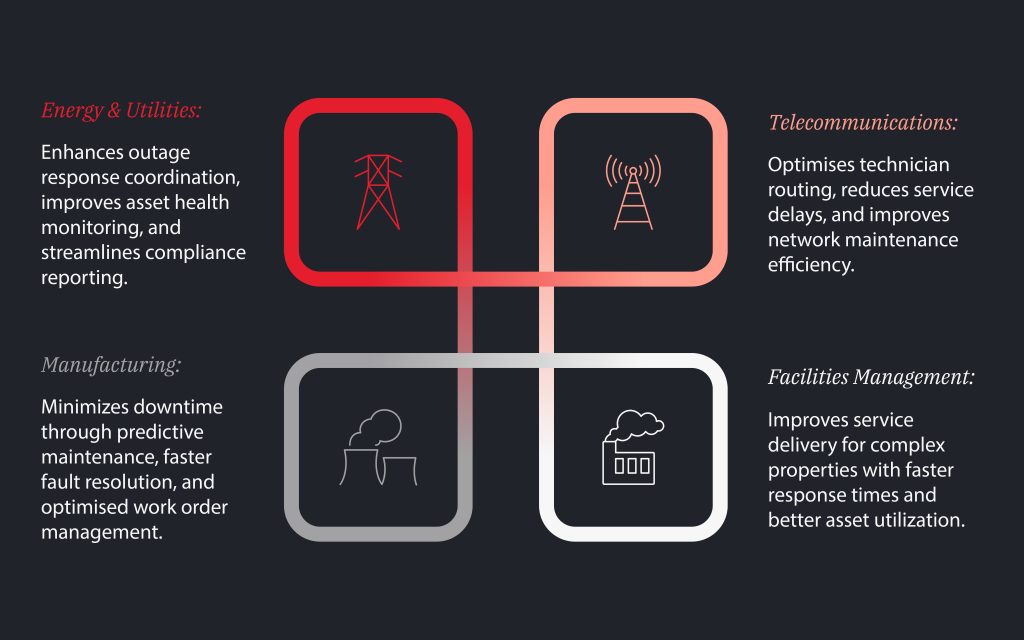
Energy & Utilities
Enhances outage response coordination, improves asset health monitoring, and streamlines compliance reporting.
Telecommunications
Optimizes technician routing, reduces service delays, and improves network maintenance efficiency.
Manufacturing
Minimizes downtime through predictive maintenance, faster fault resolution, and optimized work order management.
Facilities Management
Improves service delivery for complex properties with faster response times and better asset utilization.
For insights on operational efficiency in a different context, see our SAP Mining guide.
Choosing the Right Field Service Automation Platform
Selecting a field service automation platform is more of a strategic investment in operational resilience. The right platform must align with industry demands, integrate into existing systems, and scale as the organization grows.
Key features to look for include:
- Scalability: Ability to handle growing asset volumes, service territories, and workforce expansion.
- Integration: Seamless connectivity with ERP, CRM, GIS, IoT platforms, and other operational systems.
- Configurable Workflows: Flexibility to adapt to industry‑specific processes, compliance rules, and safety standards.
- Offline Capabilities: Ensures technicians remain productive even in low‑connectivity or remote areas.
- Advanced Analytics & Dashboards: Real‑time performance tracking to support data‑driven decision‑making.
However, having the right platform is only half the equation. Implementation, integration, and ongoing optimization determine whether the investment delivers measurable results or becomes just another underused tool.
Also Read how digital transformation turned an outdated E-Commerce Platform into a modern growth engine.
Building a Future‑Ready Field Service Operation with TechBlocks
This is where TechBlocks plays a pivotal role. In the energy and utilities sector, success depends on more than deploying software; it’s about embedding automation into the very fabric of operations.
TechBlocks delivers end‑to‑end field service automation solutions that bring together:
Unified Operations
Linking asset management, workforce scheduling, inventory tracking, and customer engagement into a single intelligent ecosystem.
Predictive Service Models
Using IoT and AI to forecast maintenance needs and optimize resource allocation.
Real‑Time Operational Intelligence
Custom dashboards and KPIs designed for energy and utility leaders.
Compliance‑Embedded Workflows
Service calls aligned with industry regulations and safety requirements, with built‑in audit trails.
When organizations pair the right platform with TechBlocks’ industry expertise, they gain more than an automation solution; they create a future‑ready field service operation that’s agile, data‑driven, and built for sustainable growth.
Also Read how customer service was transformed through digital innovation in this case study.
Ready to turn your field service operations into a competitive advantage?
Discover how TechBlocks can help you design, implement, and optimise a future‑ready field service automation strategy that delivers measurable results.
Explore TechBlocks’ Energy & Utilities Solutions
FAQs on Field Service Automation
Field service automation improves technician productivity by ensuring that each technician is assigned the right job and provided with the necessary tools and real-time asset data. This reduces travel time, avoids unnecessary repeat visits, and increases the likelihood of resolving issues on the first attempt. As a result, technicians can complete more jobs in less time while maintaining high service quality.
Yes. Field service automation software usually refers to a specific application that focuses on a single function, such as scheduling or asset tracking. A field service automation platform consolidates multiple capabilities, including scheduling, dispatch, asset monitoring, compliance management, inventory control, and analytics, into a single, connected system that can scale and adapt to evolving operational requirements.
Automation can manage and streamline nearly every aspect of field service, including:
Job Scheduling & Dispatch: Matching technicians to the right job at the right time.
Predictive Maintenance: Using IoT data to anticipate equipment failures.
Inventory Management: Tracking parts usage and automating replenishment.
Compliance & Safety Checks: Embedding safety protocols and capturing digital proof of compliance.
Customer Communication: Sending real‑time updates on technician location and job progress.