

AI is changing the cost structure of software engineering faster than enterprises are changing the way they buy it. Token consumption now varies with model choice, context length, reasoning depth, tool calls and agentic workflow design; McKinsey reports that the same task can produce up to 30× variation in token usage, while 93% of surveyed enterprises exceeded their AI budgets. Deloitte’s research shows the financial exposure can become material quickly: one healthcare enterprise reached 1 trillion tokens in six months, creating more than $6 million in annualized, previously unplanned costs.
Yet token spend is only half of the economic equation. An enterprise can spend more on AI and ship a capability three months earlier, eliminate substantial rework, or reduce defects. It can also spend millions on inference while generating code nobody deploys. The difference isn’t the token bill; it is what the consumption produced. That creates a problem for the traditional engineering commercial model: if AI changes the cost of producing software, but the enterprise still pays primarily for hours, capacity or headcount, where does the economic value of AI actually accrue?
This article examines the shift through three questions:
- What do tokens actually tell an enterprise about the cost of AI-assisted engineering?
- How can engineering leaders connect AI consumption to measurable delivery and business value?
- When that connection becomes measurable, should enterprises pay for engineering effort—or for defined outcomes?
Tokens Are Becoming a Cost Layer, Not a Value Metric
The first mistake enterprises can make with AI economics is treating token cost as the objective rather than the input to the objective.
Token consumption is becoming a meaningful component of software delivery economics. Model selection, context length, reasoning depth, tool calls, retries and agent autonomy can materially change the cost of completing the same engineering task. Recent research has found up to 30× variation in token consumption for comparable agentic tasks, creating a cost structure far less predictable than the traditional developer-hour model.
Three questions now matter more than the size of the AI bill.
Where is AI creating cost?
AI consumption can accumulate across requirements analysis, repository exploration, code generation, testing, debugging and review. An agent working across a large codebase may make multiple model calls, retrieve substantial context and repeat reasoning before producing deployable software. The cost of intelligence is moving inside the engineering workflow.
Does lower token spend produce lower delivery cost?
Not necessarily. A cheaper model can increase review and rework. A smaller context window can trigger additional retrieval. Fewer agent iterations can shift work back to developers. Lower inference spend can therefore coexist with higher engineering cost.
| Cost decision | Possible engineering consequence |
| Cheaper model | More rework |
| Smaller context | More retrieval and agent calls |
| Fewer iterations | More developer intervention |
| Lower token limits | Longer delivery cycles |
The objective cannot be minimum token consumption. It has to be better economics for the engineering work produced.
What did the AI consumption actually buy?
A token ledger can tell an enterprise how much intelligence it consumed. It cannot tell an enterprise whether the consumption produced a feature, accelerated a release, eliminated engineering effort or prevented production defects.
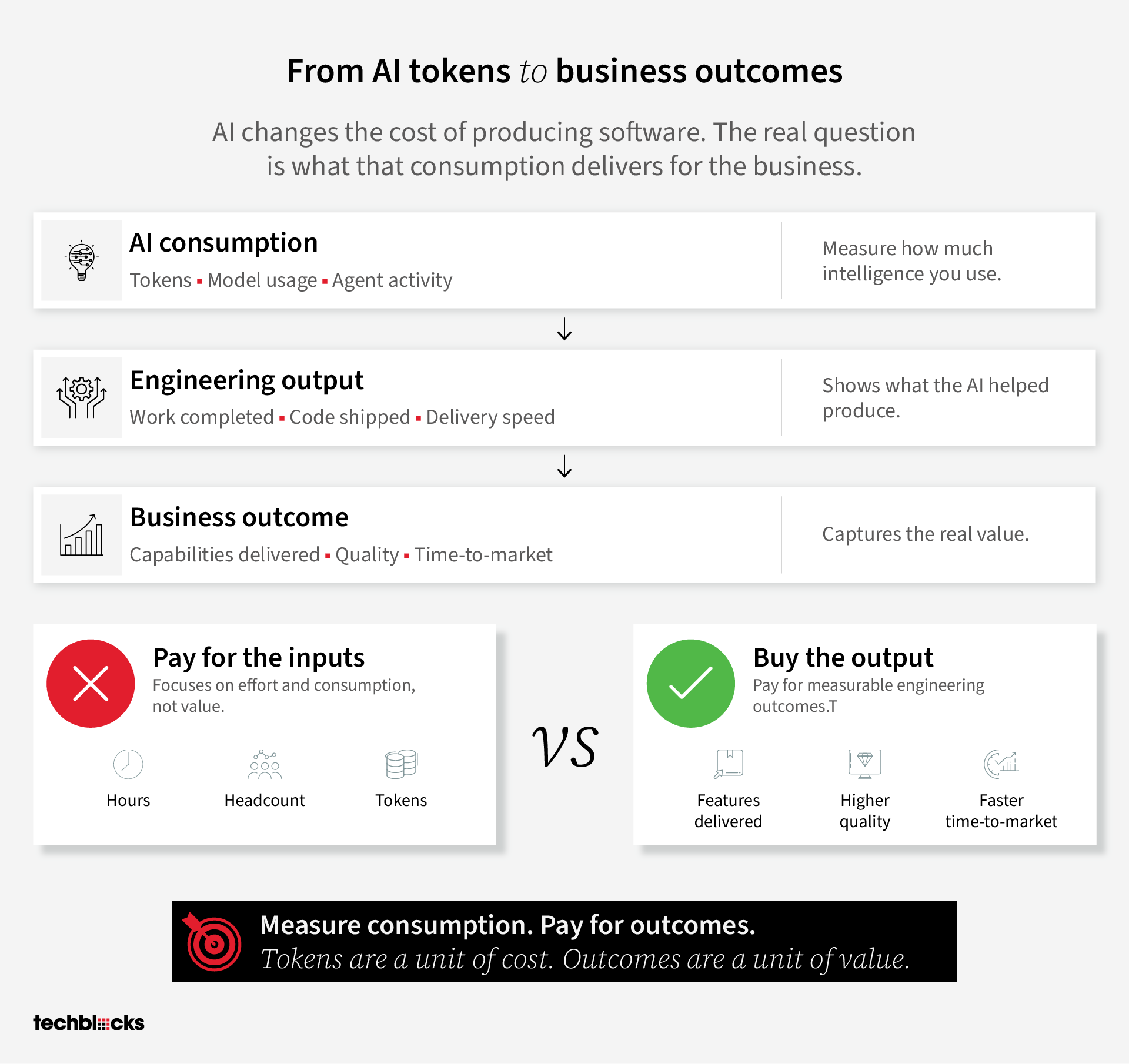
The economic chain therefore extends beyond the AI bill:
AI consumption → Engineering work → Delivered capability → Business value
The first layer is measurable today. The challenge is connecting it to the layers above. Tokens are a unit of consumption. They are not a unit of engineering value. And once enterprises accept that premise, the next question becomes much harder: how do you measure the value created by AI inside the engineering workflow?
The Missing Measurement Layer Is Between AI Usage and Business Value
The second mistake is treating AI usage as evidence of AI productivity. An engineering organization can report model calls, token consumption, AI-assisted pull requests and developer adoption with impressive precision. None of those metrics establish whether software delivery became faster, cheaper or better. The problem sits between AI activity and engineering output.
Consider a feature built with an AI coding agent. The agent generates the initial implementation, writes tests, reviews its own changes and fixes failures. The engineering dashboard records substantial AI usage. But what happens next?
- How much of the generated code survives into production?
- How much developer modification was required?
- How much rework followed the initial implementation?
- Did cycle time actually fall?
- Did defect density change?
- Did the feature reach customers sooner?
Without those measurements, AI contribution remains an assumption.
AI usage needs an engineering attribution layer
A stronger measurement chain connects the AI activity to the work item:
| Layer | What should be measured |
| AI consumption | Tokens, model calls, agent runs, tool usage |
| AI contribution | Generated code, AI-assisted changes, modifications |
| Engineering output | Stories completed, code shipped, tests passed |
| Delivery performance | Cycle time, throughput, rework, deployment frequency |
| Quality | Defect density, escaped defects, change failure |
| Business output | Features released, capabilities delivered, time-to-market |
The critical point is attribution. If an AI agent generates 10,000 lines of code and engineers rewrite 7,000, counting all 10,000 as AI productivity overstates the contribution. If an agent generates 3,000 lines and 2,800 survive production while reducing a two-week implementation to three days, token consumption tells only a small part of the economic story.
Productivity has to survive contact with production
AI-generated output is not the same as durable engineering value.
The meaningful measurement begins after generation:
Generated → Modified → Tested → Shipped → Survived → Created value
A productivity metric based only on generated code rewards volume. A delivery metric based on production-ready work rewards useful output.
The same principle applies to AI adoption. An organization with 90% developer adoption may have excellent tooling penetration and mediocre engineering economics. Another with lower adoption may generate greater value if AI is concentrated in workflows where reasoning, automation and agentic execution remove significant engineering effort.
AI contribution needs to be measured against the engineering outcome it changes, not the activity it generates.
Once enterprises can make that connection, engineering productivity stops being a proxy exercise around developer activity. It becomes an economic measurement problem: how much measurable delivery value does each unit of human and machine effort produce?
When Engineering Capacity Becomes Elastic, Hours Stop Being the Right Unit
For decades, software engineering has operated on a predictable commercial assumption: engineering capacity is largely a function of people and time. A larger team creates more capacity; additional scope requires additional effort; contracts translate the effort into a price.
Agentic engineering changes the economics of capacity. One engineer can now orchestrate multiple AI systems across analysis, implementation, testing and remediation, while computational effort can scale independently of headcount. The relationship between engineering capacity and human effort is no longer linear.
For buyers, the implication is difficult to ignore. If an engineering organization can increase delivery capacity without increasing its workforce at the same rate, an hourly or headcount-based contract can begin rewarding the wrong economic behavior. The buyer carries the benefit of AI-driven productivity while continuing to purchase the inputs used to produce the work.
The more rational unit sits closer to the business requirement itself: a defined piece of engineering work delivered within agreed parameters for cost, quality and time.
That could mean a product capability, a modernization increment, an integration, or another clearly bounded engineering outcome. The important property is measurability. Both sides should know what constitutes completion, what quality threshold applies, how performance will be assessed and what the delivered unit costs.
This creates a fundamentally different incentive structure:
| Effort-based engineering | Outcome-based engineering |
| Commercial value tied to capacity | Commercial value tied to delivery |
| More effort can increase revenue | Better productivity can improve margin |
| AI productivity can disrupt the pricing model | AI productivity can improve delivery economics |
| Buyer pays for production inputs | Buyer pays for agreed engineering output |
AI does not merely make engineers more productive. It changes the economics of engineering capacity itself.
Once capacity and human effort stop moving together, the commercial model has to account for the difference. The question becomes whether an enterprise is willing to keep paying for the mechanism of production—or move toward a model built around what the engineering organization actually delivers.
The Enterprise Should Measure Consumption, but Buy Outcomes
Once AI changes the amount and mix of effort required to produce software, the commercial question changes with it.
An enterprise still needs to understand token consumption, model usage, agent activity, developer effort and infrastructure cost. Those inputs determine the economics of delivery and need to be visible. But none of them is the thing the business ultimately commissioned. The business commissioned a capability, a release, a modernization increment, an integration or another defined piece of software.
The commercial unit should therefore move closer to the outcome being delivered.
Outcome-based delivery only works when “outcome” has an engineering definition. A contract needs enough precision for both sides to know what is being purchased, how progress will be measured, what quality level is acceptable and what happens when performance falls short.
| Commercial dimension | What needs to be defined |
| Delivery unit | The capability or engineering increment being purchased |
| Throughput | Expected rate of validated delivery |
| Quality | Acceptance, defect and reliability thresholds |
| Economics | Cost associated with the delivery unit |
| Performance | Accountability when agreed targets are missed |
The model also needs an evidence layer. Without one, an enterprise cannot reliably distinguish productive AI usage from expensive experimentation, or higher engineering capacity from higher engineering activity. A delivery system needs to connect the original work item with the production process: AI sessions and token consumption, generated code, developer modifications, testing, rework, deployment and the code that ultimately survives in production.
The measurement chain turns AI economics into delivery economics.
Once the relationships are visible, we can answer questions a token dashboard or utilization report cannot:
- What did the AI consumption produce?
- How much human effort did the work still require?
- How much of the generated output reached production?
- What did the completed delivery unit cost?
- Did AI improve throughput, quality or both?
- Where did the productivity gain accrue?
We, at TechBlocks, built AiDE around this operating model. Its Delivery Ledger connects user stories, AI-assisted code, developer modifications, code survival, rework, reversions, token consumption and delivery cost. The resulting evidence supports Delivery Units and contract-backed Engineering Outcomes, giving the commercial relationship a measurable basis beyond headcount, hours and activity.
AiDE: AI-Native Delivery Engine
See Outcome-Based Engineering in Practice
Connect AI usage, delivery performance and cost through measurable Delivery Units and contract-backed Engineering Outcomes.

The practical advantage extends beyond pricing. Once the delivery partner is accountable for a defined result, the choice of model, agent, automation, developer capacity or engineering workflow becomes an optimization problem for the provider rather than a production constraint imposed on the buyer.
AI productivity can therefore improve the economics of the engagement instead of simply improving the utilization of the delivery team.
Our position is straightforward: measure the inputs closely enough to understand the economics, then contract around the outputs the business actually needs. The enterprise still needs to know what AI costs. It simply no longer needs to confuse the cost of producing software with the value of having software delivered.
Conclusion: AI Changes the Economics. Engineering Must Capture the Value.
AI is changing the economics of software delivery. Token consumption, agent usage and engineering capacity are becoming variable inputs, while delivery speed, quality and business impact remain the measures enterprises ultimately care about.
The opportunity is bigger than reducing AI spend. Enterprises can use AI to increase engineering capacity, accelerate strategic initiatives and deliver more business value without scaling effort at the same rate. Capturing the upside requires a delivery model capable of measuring the full economic chain—from AI consumption and engineering effort to shipped software and business outcomes.
The next generation of software delivery will be measured by what engineering produces, not how much effort it consumes.
Ready to Rethink Your Engineering Economics?
Let’s explore how AI-native delivery can improve cost, capacity, velocity and business outcomes.
Frequently Asked Questions
Yes. Token consumption should be tracked as part of the delivery cost structure, alongside model usage, agent activity, developer effort and infrastructure costs. Token spend alone, however, does not indicate productivity or business value. Enterprises need to connect AI consumption to engineering output, delivery performance and production outcomes.
AI ROI requires more than measuring developer adoption, token consumption or AI-generated code. Enterprises should connect AI activity to measurable changes in cycle time, throughput, rework, defect rates, production-ready output and the cost of delivered capabilities. The resulting data provides a stronger basis for evaluating whether AI is creating economic value.
Time-and-materials models price engineering around human effort. AI can reduce the amount of human effort required to deliver a given capability while increasing overall engineering capacity. The result can disconnect the buyer’s price from the actual cost and value of delivery, particularly when AI productivity improves without changing the commercial model.
Outcome-based software delivery ties commercial accountability to defined engineering results rather than hours, headcount or activity. A credible model establishes measurable Delivery Units, throughput expectations, quality thresholds, cost baselines and performance accountability. The approach gives both the enterprise and delivery partner a clear basis for measuring what was delivered and at what economics.
AI-native delivery provides the measurement and operating layer required to connect AI consumption with engineering and business outcomes. A system such as AiDE can connect user stories, AI-assisted development, developer modifications, code survival, rework, token consumption and delivery cost, creating the evidence required for measurable Delivery Units and contract-backed Engineering Outcomes.