

Cloud spending rarely stays where an enterprise expects it to. A new product launch increases traffic. An application scales to handle demand. Data teams expand processing workloads. Engineers change an architecture to improve performance or reliability. Each decision can alter infrastructure consumption, often without anyone outside the team seeing the financial impact until the next cloud bill arrives.
For Finance, that creates a forecasting problem. For engineering leaders, it creates an accountability problem. For product teams, it makes the cost of growth harder to quantify. And for business leaders, a growing cloud bill does not reveal whether the additional spend is supporting revenue-generating activity or simply adding infrastructure overhead.
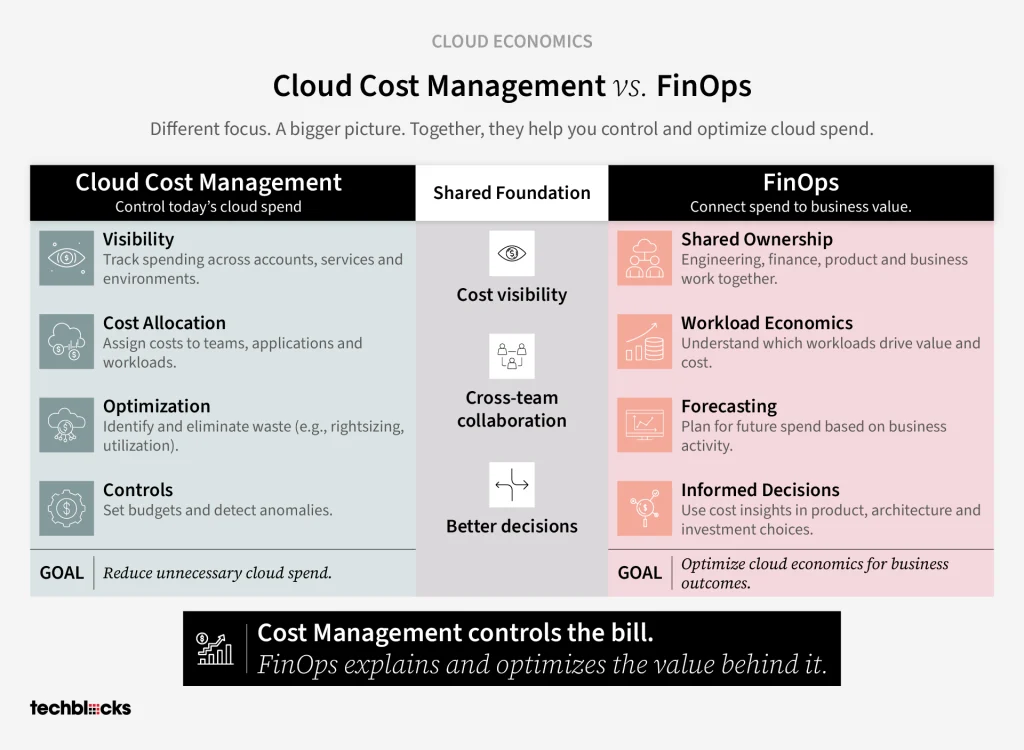
Enterprises have responded by putting stronger controls around cloud spending, tracking usage, allocating costs, setting budgets, identifying waste, and optimizing resources. Cloud Cost Management provides the foundation for controlling consumption.
But controlling the bill is only part of the problem. When engineering teams own infrastructure decisions, products drive workload demand, and cloud consumption changes with business activity, cost data needs to reach the people making those decisions. FinOps extends cloud cost management into a broader operating model where engineering, finance, product, and business teams share responsibility for cloud economics.
The two approaches overlap, but they solve different parts of the problem. In this guide, we’ll examine how Cloud Cost Management and FinOps differ, where each fits within an enterprise cloud operating model, and how organizations can move from simply managing cloud spend to understanding the economics of the workloads behind it.
Cloud Cost Management: Establishing Control Over Cloud Spend
Cloud Cost Management starts with a relatively direct question: Where is the money going?
An enterprise needs visibility into spending across cloud accounts, services, environments, applications, and workloads before it can decide where to intervene. Cost allocation connects that spend to the resources generating it, while utilization analysis helps identify idle, underused, or overprovisioned capacity. Budgets and anomaly detection add financial guardrails, giving teams a way to spot unexpected changes before they become recurring expenses.
Cost Management can drive concrete optimization actions such as rightsizing resources, scheduling non-production environments, managing storage, improving utilization, and evaluating cloud commitments. The objective is to reduce unnecessary consumption without compromising the technical requirements of the workloads involved. That gives Cloud Cost Management a clear operational role: measure consumption, assign the cost, identify inefficiency, and create controls around cloud spend.
The harder question is what caused that cost and whether the underlying consumption was justified.
A compute increase may be the result of inefficient provisioning, or simply the consequence of 40% more transactions. Storage costs may rise because of unused data, or because a new product now depends on retaining larger datasets. A more expensive architecture may be justified by lower latency or higher resilience. Looking at the resource cost alone cannot resolve those questions.
Cloud Cost Management provides the financial visibility needed to surface them. FinOps takes the next step by connecting that information to ownership, workload economics, forecasting, and the engineering and business decisions driving consumption.
FinOps: Connecting Cloud Spend to the Decisions Behind It
Cloud spending becomes harder to manage when the teams generating consumption are separated from the teams reviewing the expenditure. Finance may see a rising infrastructure budget. A platform team may see higher compute consumption. An engineering team may see increased database load. A product team may see transaction growth. Each team is looking at the same cloud environment through a different lens, but none of those views alone explains the economics of the workload.
FinOps connects those views by tying cloud consumption to workloads, ownership, business activity, and financial planning. The model extends cost data beyond resource-level reporting and assigns it to the workloads, teams, products, and business activity responsible for consumption. Engineers can evaluate architecture choices alongside their financial impact. Finance can build forecasts using workload growth and planned capacity rather than historical spend alone. Product teams can examine how new features or customer activity affect operating costs.
Consider an ecommerce platform preparing for a major sales event. Higher compute, database, storage, and network consumption may push cloud spending upward. Cost Management can identify where the increase occurred and which resources contributed to it. FinOps adds the operating context: How many transactions generated the additional consumption? What did each transaction cost? Was the capacity increase expected? Which workloads drove the change? Does the new cost profile need to be reflected in future forecasts?
That shift, from reporting consumption to managing the economics of consumption is the central role of FinOps. It also changes who participates in cloud cost decisions. Engineering, Finance, Product, Platform, and business teams all become part of the conversation when cloud consumption directly affects workload performance, product economics, capacity planning, and financial forecasts.
Why Enterprise Cloud Economics Gets Harder to Manage
Cloud cost becomes difficult to manage when consumption and accountability stop following the same organizational boundaries.
A centralized cloud team may control the environment, but the decisions that determine consumption often sit elsewhere. Developers choose instance configurations. Architects choose database and application patterns. Platform teams define scaling policies. Data teams determine processing and storage requirements. Product teams introduce features that change traffic and usage patterns.
The problem is not visibility alone; it is the separation between financial visibility and the teams making consumption decisions.
A monthly cloud bill can show that compute spending increased by 20%, but the number alone says little about what happened. Traffic may have increased by 40%. A new workload may have been deployed. An autoscaling policy may be generating excess capacity. An AI workload may have introduced a new pattern of inference consumption. Without workload-level attribution and operational context, the same increase can look like waste, growth, or investment.
Optimization creates another layer of complexity. Reducing infrastructure spend is not automatically an economic improvement if the change increases latency, reduces availability, raises data-retrieval costs, or limits the capacity required for future demand. The relevant question is not simply whether a resource became cheaper, but whether the workload became more economically efficient without compromising its requirements.
Unit economics adds another dimension. If cloud spend rises 15% while transaction volume rises 40%, total spend alone presents an incomplete picture. Cost per transaction may have improved even though the infrastructure bill increased. The same principle can apply to cost per customer, API request, workload, or amount of data processed.
Enterprise cloud economics therefore requires more than centralized visibility. The organization needs enough context to connect consumption with ownership, workload behavior, technical trade-offs, and business activity. That is the problem FinOps is designed to address beyond the core controls of Cloud Cost Management.
Cloud & DevOps
Turn Cloud Costs Into Actionable Engineering Decisions
Connect FinOps, cloud engineering, and workload economics to improve cost visibility, accountability, and optimization.

Cloud Cost Management vs. FinOps: Where Cloud Economics Gets Broader
Cloud Cost Management is concerned with the financial behavior of cloud infrastructure. An enterprise needs to know which services consume the budget, how spending is distributed across accounts and workloads, where utilization is poor, and which resources can be optimized. Cost allocation, budgets, utilization analysis, rightsizing, scheduling, storage optimization, commitment management, and anomaly detection all serve that purpose.
The financial picture changes when cloud consumption has to be traced back to the teams, workloads, and business activity driving it.
An engineering team might choose an architecture that costs more to operate but supports higher throughput. A product launch might increase compute and database consumption because customer activity has grown. Finance might need to forecast infrastructure expenditure based on expected workload growth rather than last quarter’s spending. A business leader might want to know whether cloud costs are increasing faster or slower than the transactions, customers, or revenue they support.
| Cloud Cost Management | FinOps |
| Measures cloud expenditure across accounts, services, environments, and workloads | Connects expenditure to workload owners, business activity, and operational decisions |
| Allocates costs to establish financial visibility | Assigns accountability to the teams influencing consumption |
| Optimizes resources, utilization, storage, scaling, and commitments | Evaluates economics alongside performance, reliability, scalability, and business requirements |
| Controls budgets and investigates unexpected spending | Forecasts future consumption using workload growth, product plans, seasonality, and capacity requirements |
| Reports cloud expenditure and savings opportunities | Tracks unit economics such as cost per transaction, customer, API request, or workload |
| Supports infrastructure cost decisions | Brings cloud economics into engineering, product, finance, and business planning |
The same cost data can support very different decisions. A Cloud Cost Management program might identify that a workload’s compute cost has increased by 20%. A FinOps practice would connect that increase to workload demand, transaction growth, architecture, capacity planning, or product activity and use the finding in the next engineering or financial decision.
When Does an Enterprise Need FinOps?
Not every cloud environment needs the same level of economic management.
A company with a small number of centrally managed workloads may have little difficulty assigning costs, monitoring budgets, and optimizing infrastructure through a Cloud Cost Management program. The teams controlling provisioning and the teams reviewing expenditure are often close to each other, workloads tend to be easier to understand, and consumption patterns may be relatively predictable.
The management challenge changes when engineering, product, data, and business teams begin making their own consumption decisions.
Engineering teams may provision and modify infrastructure independently. Different products may run separate workloads. Business units may maintain their own cloud environments. Kubernetes, serverless platforms, data processing, and AI workloads can introduce consumption patterns that change with demand. A product roadmap can also become an infrastructure roadmap, with every new capability introducing additional requirements for compute, storage, networking, or data processing.
Once multiple teams and products influence cloud consumption, the questions extend beyond resource optimization:
- Who owns the cost of a workload?
- What will increased demand do to infrastructure expenditure?
- How much does it cost to serve an order, customer, API request, or AI interaction?
- How should an architectural change affect the forecast?
- Which teams should account for unexpected consumption?
- How does cloud expenditure relate to the business activity it supports?
Those questions are the point at which FinOps needs to become part of the operating model.
Cloud spend itself is not a reliable trigger for adopting FinOps. Two enterprises with similar cloud bills can have very different economic management requirements. One may have centralized provisioning and predictable workloads; another may have hundreds of teams influencing consumption across products, platforms, and providers.
More relevant factors include who controls consumption decisions, how variable workloads are, how precisely costs can be allocated, how closely cloud usage tracks business activity, and how often teams need to balance cost against technical and business requirements.
From Cloud Cost Control to Cloud Economics
Cloud Cost Management gives enterprises the foundation to understand and control cloud expenditure. FinOps takes that financial visibility into the decisions that shape cloud consumption.
For TechBlocks, that shift is not about treating FinOps as a separate layer added to an existing cloud environment. Cloud economics sits across the way an organization architects, builds, operates, scales, and plans its cloud workloads. An architecture decision affects infrastructure requirements. Workload growth affects capacity. Capacity affects expenditure. Product and customer growth can change consumption patterns. Finance then needs those consumption signals to build more accurate forecasts and investment plans.
A cloud economics practice brings those relationships into the same operating model. Teams can evaluate architecture alongside cost, performance, scalability, reliability, and operational requirements. Workloads can be measured through metrics such as cost per transaction, customer, API request, or AI interaction. Engineering and product teams can see the financial consequences of decisions they control, while Finance and business leaders gain greater context around the expenditure they are planning for.
The capabilities build progressively: Visibility → Allocation → Optimization → Accountability → Forecasting → Unit Economics
Cloud Cost Management establishes the visibility and controls. FinOps connects them to the people, workloads, and business decisions that influence consumption.
Conclusion: Cloud Economics Requires More Than Managing the Bill
Cloud infrastructure is ultimately shaped by decisions made across the enterprise. Managing the resulting expenditure requires more than identifying expensive resources or finding savings opportunities. It requires a connected view of cloud architecture, workload behavior, engineering decisions, financial planning, and business growth.
At TechBlocks, we bring cloud strategy, architecture, engineering, and FinOps together to help enterprises connect infrastructure and workload decisions with cost, performance, scalability, and business outcomes. The result is a cloud operating model where economics is considered alongside technical and business requirements from planning through execution, not assessed after the spend occurs.
Build a Cloud Economics Strategy for Enterprise Growth
Connect cloud architecture, engineering, and FinOps with measurable financial and business outcomes.
FAQs on Cloud Cost Management vs. Cloud FinOps
FinOps can establish a consistent framework for understanding cloud economics across AWS, Microsoft Azure, Google Cloud, and other providers. Standardized allocation, tagging, workload ownership, and cost metrics help enterprises compare consumption across providers without relying on each provider’s reporting structure.
Shared costs can be distributed using allocation rules based on factors such as usage, workload consumption, team ownership, or business activity. The allocation method should be consistent, transparent, and appropriate to the way shared infrastructure is consumed.
Kubernetes can make cost attribution more difficult because infrastructure is shared across clusters, namespaces, nodes, and workloads. FinOps practices can connect underlying infrastructure costs to namespaces, applications, teams, or workloads to provide greater visibility into containerized consumption.
An anomaly should be investigated in the context of workload activity rather than treated automatically as waste. Teams can examine changes in traffic, deployments, scaling behavior, resource configuration, and business activity to determine whether the increase requires corrective action.
AI workloads can introduce highly variable costs through model inference, training, data processing, storage, and accelerated compute. Cloud economics can help enterprises measure those costs against usage metrics such as requests, tokens, interactions, or completed workloads, giving teams a basis for evaluating the economics of different AI architectures and usage patterns.