

For decades, custom software procurement has relied on a comforting illusion: the timesheet. Engineering budgets are calculated in billable hours, sprints are mapped to seats, and vendor relationships are anchored in time-and-materials contracts. Despite logging thousands of hours and burning through projected budgets, enterprise software delivery remains notoriously slow, expensive, and unpredictable.
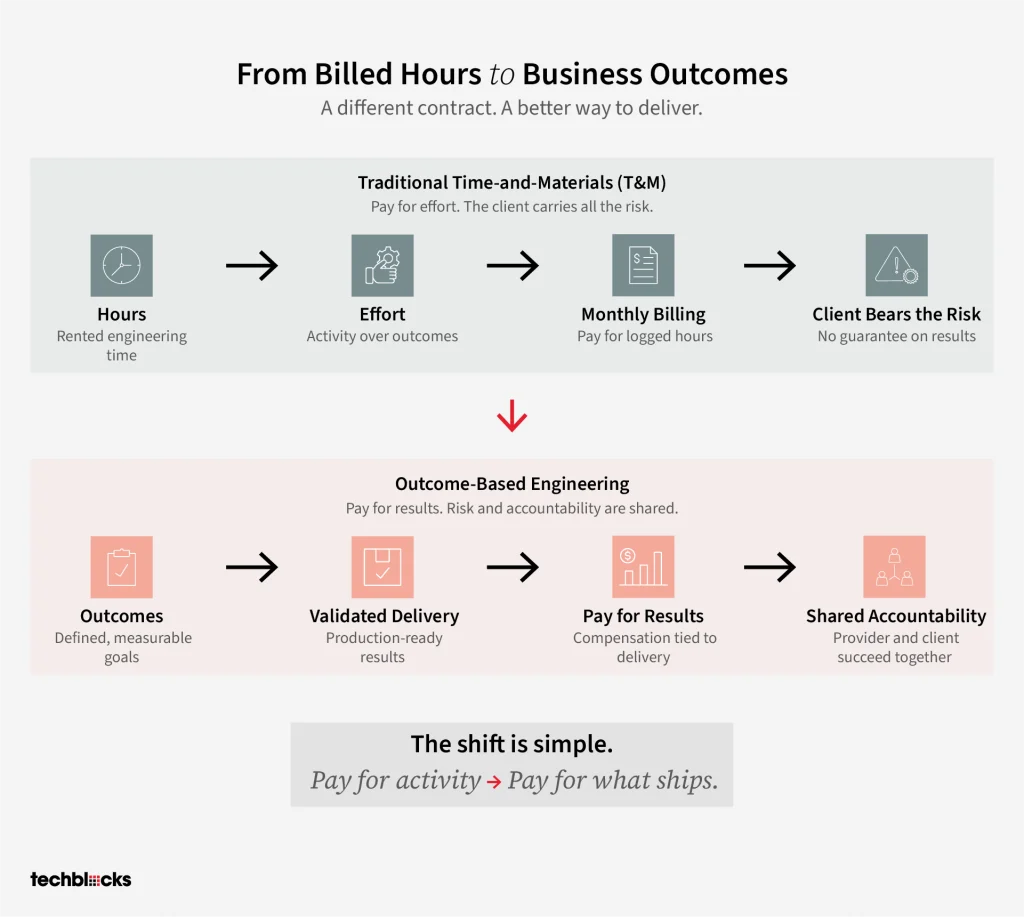
The root cause is a fundamental misalignment of incentives. Traditional models reward inefficiency because prolonged technical bottlenecks and scope creep directly translate to more billable hours for the vendor. Meanwhile, the client absorbs all the execution risk, paying heavily for mere activity while receiving zero guarantees on actual business results. Organizations face mounting pressure to accelerate time-to-market and justify every tech dollar, making it clear that treating software development like a factory of rented hours is no longer viable. Billing for effort is obsolete, and true value requires a definitive shift to outcome-based contracts where accountability replaces timesheets.
In this article, we explore:
- The structural flaws of time-and-materials agreements and why they inherently penalize speed.
- The mechanics of outcome-based contracts, shifting the focus from logged hours to validated delivery units.
- How modern delivery engines transfer execution risk back to providers to secure predictable business ROI.
Why Time-and-Materials is Broken in Modern Software
To understand why traditional engineering contracts fall short, look closely at their core engine. The time-and-materials (T&M) model runs on a strange contradiction: it charges organizations for the duration of a problem instead of its resolution, naturally setting up a few critical roadblocks:
The Incentive Paradox
In a T&M contract, speed is essentially penalized. If an engineering partner streamlines a deployment pipeline or solves a tough architectural bottleneck in half the expected time, their billable revenue drops right along with it. On the flip side, messy processes, unclear requirements, and dragging out technical debt are what maximize vendor profits. The longer a team takes to ship code, the more billable hours stack up.
Asymmetric Risk Distribution
Beyond misaligned incentives, traditional contracts leave the client holding 100% of the execution risk. When a project stalls out due to slow developer onboarding, sudden turnover, or sluggish velocity, the financial penalty hits the client’s balance sheet alone. The vendor faces zero consequences for missed targets because their revenue is completely secured by the ticking clock of logged hours.
The Productivity Trap
This structural flaw leads straight into a classic productivity trap. When software delivery starts dragging, the standard corporate reaction is usually to throw more headcount at the issue, adding seats and burning more billable hours. Instead of speeding things up, expanding a T&M team on a broken process just adds coordination overhead, stirs up code churn, and drains budgets faster without moving any real business metrics forward.
The Anatomy of an Outcome-Based Engineering Contract
Fixing broken software agreements means rewriting the contract rules entirely. Rather than paying for the journey, modern organizations are shifting toward agreements that pay exclusively for arrival.
Here is what defines this new framework:
Core Shift: Compensation is completely decoupled from human hours and tied strictly to measurable, production-ready deliverables.
- Validated Delivery Units: Milestones are tied to concrete realities, like a verified performance benchmark, a fully deployed workflow, or a production-ready feature. If the code fails to meet agreed standards, the unit is unfulfilled and unpaid.
- Shared Accountability: Both sides finally share the same incentives. Providers are driven to use automated testing, streamlined architectures, and high-efficiency tooling because their margins rely on hitting targets cleanly and quickly.
- Risk Transfer: Execution risk shifts off the client’s balance sheet entirely. Instead of absorbing delays, talent shortages, or architectural missteps, the burden moves back to the provider, ensuring engineering budgets map strictly to predictable results.
When the contract demands proof over presence, software development stops being a budget black hole and transforms into a predictable business asset.
From Theory to Reality: What Outcome-Based Execution Looks Like
Now that we understand how contract mechanics must shift, let’s look at what this model actually changes on the ground. Transitioning from effort to impact is not just a legal exercise; it completely rewrites the daily operational rhythm of a software initiative, replacing ambiguity with absolute clarity.
Consider a typical enterprise migrating a legacy core system. In a traditional time-and-materials setup, the project kickoff immediately triggers a slow-motion countdown of billable hours. Status updates focus on activity: how many user stories were discussed, how many developers were onboarded, and how many hours were logged. Meanwhile, actual business value sits weeks or months away behind a wall of vague progress reports.
An outcome-based delivery model flips this dynamic entirely. Instead of managing activity, teams manage verifiable progress across three operational shifts:
- Objective Telemetry Replaces Timesheets: Daily check-ins and manual status reports are replaced by live telemetry dashboards. Progress is tracked through concrete engineering signals, such as deployment frequency, change failure rates, and cycle times, giving everyone absolute visibility into whether code is actually moving closer to production.
- Fixed-Cost Predictability Replaces Monthly Burn: Financial planning transforms from an open-ended guessing game of monthly burn rates into a predictable capital allocation. Budgets are tied directly to milestones, meaning money leaves the account only when a validated delivery unit is successfully cleared.
- High-Efficiency Tooling Replaces Brute-Force Headcount: Because providers carry the execution risk and profit margins depend on hitting targets cleanly, brute-force staffing is out. Teams are driven to leverage automated pipelines, intelligent code generation, and modern delivery engines like AiDE to build faster, reduce code churn, and deliver superior results with leaner teams.
When execution is measured by what actually ships rather than how long it took to build, software delivery finally behaves like a true business asset.
The Contrast in Action: Billed Hours vs. AiDE Outcome Delivery
To truly understand why billable hours belong in the past, consider how a standard feature rollout unfolds under both models:
| Dimension | The Traditional T&M Model (Billed Hours) | The AiDE Operating Model |
| Primary Driver | Effort & Time: Vendors maximize billable seats, long onboarding phases, and extensive manual coding cycles. | Impact & Velocity: Focus is locked entirely on shipping validated features and hitting performance baselines. |
| Risk Bearer | The Client: Absorbs 100% of the cost for developer turnover, sluggish velocity, and architectural trial-and-error. | The Provider: The delivery engine absorbs execution risk; compensation is tied directly to cleared delivery units. |
| Transparency | Opaque & Manual: Relies on subjective weekly status updates, retrospective meetings, and unverified timesheets. | Autonomous & Real-Time: Driven by live telemetry, structured workflows, and transparent progress metrics. |
| The Economic Result | Budget Bloat: Inefficiencies reward the vendor with higher revenues, stretching timelines and draining capital. | Capital Efficiency: High-speed execution and predictable milestones lower total cost of ownership and accelerate ROI. |
How the AiDE Operating Model Powers the Shift
This is where our AiDE operating model changes the game from the inside out. At TechBlocks, we built AiDE not as another digital timesheet aggregator or rigid software tool, but as a disciplined framework to eliminate the friction of traditional software development at its core. By aligning execution governance, intelligent delivery workflows, and strict accountability, we tie our success directly to your business goals, ensuring you only ever invest in software that works, scales, and delivers value from day one.
Conclusion & The Way Forward: Rewriting Your Next Tech Contract
The era of paying for a seat, a sprint, and a timesheet is officially drawing to a close. For years, enterprises have accepted time-and-materials contracts as a necessary tax on innovation, absorbing all the execution risk while vendors were financially rewarded for inefficiency. But as the speed of business accelerates, treating software development like a factory of rented hours is no longer a viable strategy.
True digital leadership requires moving past the illusion of effort and demanding absolute accountability for results. By replacing open-ended billing with outcome-based contracts and validated delivery units, organizations can shift the financial burden back where it belongs, turning unpredictable engineering expenses into high-confidence business investments.
Rethink Software Delivery
Ready to Eliminate Execution Risk?
Discover how outcome-based contracts and transparent delivery models secure predictable results for your enterprise.

FAQs
Under an outcome-based model governed by the AiDE operating model, the delivery unit remains unfulfilled and unpaid until it meets the strict, pre-defined acceptance criteria. The provider absorbs the cost of remediation, ensuring you never pay for code that fails to perform.
Instead of guessing how many hours developers will log, scoping focuses on defining concrete business outcomes, performance benchmarks, and modular deliverables. Capital is tied directly to these milestones rather than open-ended team allocations.
High-efficiency delivery engines leverage advanced automation and disciplined workflows to minimize waste. Because execution risk is absorbed through leaner, more automated operations, providers can offer competitive, predictable pricing without padding hours.
Transparency is driven by real-time telemetry and structured workflow tracking. Stakeholders view live dashboards measuring actual deployment frequency, code stability, and milestone clearance rather than relying on subjective weekly status reports.
Start by carving out a discrete, well-defined pilot project or modular feature set rather than attempting an overnight enterprise-wide shift. Use this initial rollout to establish baseline telemetry, test validated delivery units, and prove the economic efficiency of outcome-based governance.