

For twenty years, the enterprise scaling playbook was built on a straightforward equation: secure low-cost real estate, hire thousands of engineers, and capture labor arbitrage. For an era of predictable, linear software delivery, that model expanded operational capacity and satisfied quarterly cost-reduction targets.
Today, that equation is breaking down. As enterprises race to operationalize artificial intelligence and accelerate software delivery, the traditional Global Capability Center (GCC) is frequently acting as an operational bottleneck rather than an innovation engine. When engineering capacity is measured by headcount volume rather than commercial outcomes, offshore centers accumulate technical debt and administrative overhead instead of driving market velocity.
For technology and business leaders, diagnosing this tipping point requires looking past traditional metrics. This article examines:
- The structural flaws that cause legacy capability models to transition from strategic assets into transformation liabilities.
- The three distinct operational warning signs indicating an offshore center is actively stalling enterprise velocity.
- The architectural transition toward outcome-driven frameworks that replace headcount scaling with modular execution.
The Evolution of Offshore Delivery: From Headcounts to Outcomes
The operational design of the Global Capability Center remained largely unchallenged for years. Enterprises approached offshore expansion through a real-estate and headcount lens: establish a physical center in a region with abundant engineering talent, rapidly scale the roster of full-time employees, and capture immediate savings through labor arbitrage.
In an era defined by predictable, monolithic software releases and lower deployment frequency, this model worked. It provided leadership with a straightforward mechanism to expand operational capacity and check off quarterly cost-reduction boxes.
However, the nature of enterprise software delivery has fundamentally shifted. Microservices architecture, continuous integration pipelines, and the relentless demand for rapid digital product iteration mean that software engineering is no longer an auxiliary administrative function, it is the core engine of commercial growth.
The Limitations of Legacy Models (GCC 1.0 and 2.0)
As technology landscapes evolved, traditional GCCs attempted to keep pace by adopting cloud infrastructure and standard DevOps tooling. Yet, their underlying economic and operational structures remained largely unchanged.
- GCC 1.0 was built around labor arbitrage, optimizing for headcount volume and physical footprint rather than engineering outcomes.
- GCC 2.0 introduced digital tooling and cloud environments, but scaling output still relied on linear hiring, adding more people to solve capacity bottlenecks.
- The Structural Trap: Both legacy models measure success through internal activity metrics, such as hours logged, tickets closed, and team velocity, rather than how engineering effort translates into business outcomes.
The next evolution is GCC 3.0: an outcome-led, AI-native model designed to scale engineering velocity without scaling cost linearly. Instead of treating AI as another layer of tooling, GCC 3.0 embeds AI, automation, and intelligence directly into engineering workflows. Cross-functional delivery pods take ownership of defined outcomes, while centralized Centers of Excellence provide reusable standards, governance, and technical capabilities across teams.
Redefining Enterprise Expectations
Because legacy capability centers are anchored to a cost-center mentality, they struggle to align with modern executive priorities. Today’s technology leaders do not need localized code factories tasked with processing ticket queues. They require integrated product delivery engines that operate with high autonomy and direct accountability.
This requires a complete shift in executive focus:
- Moving away from managing development hours toward governing end-to-end value streams.
- Replacing rigid hierarchy with modular, self-governing execution units.
- Transitioning the mandate of an offshore center from risk mitigation and cost containment to predictable, scalable market velocity.
When offshore centers remain tied to headcount-driven growth models, they become structurally mismatched with enterprise goals. This disconnect is what turns a capability center from a strategic asset into a transformation bottleneck. Understanding this foundational disconnect explains why so many modern digital strategies stall long before they reach scale, setting the stage for a closer look at the exact operational warning signs of a failing capability center.
The Inflection Point: 3 Signs Your GCC is Stalling Transformation
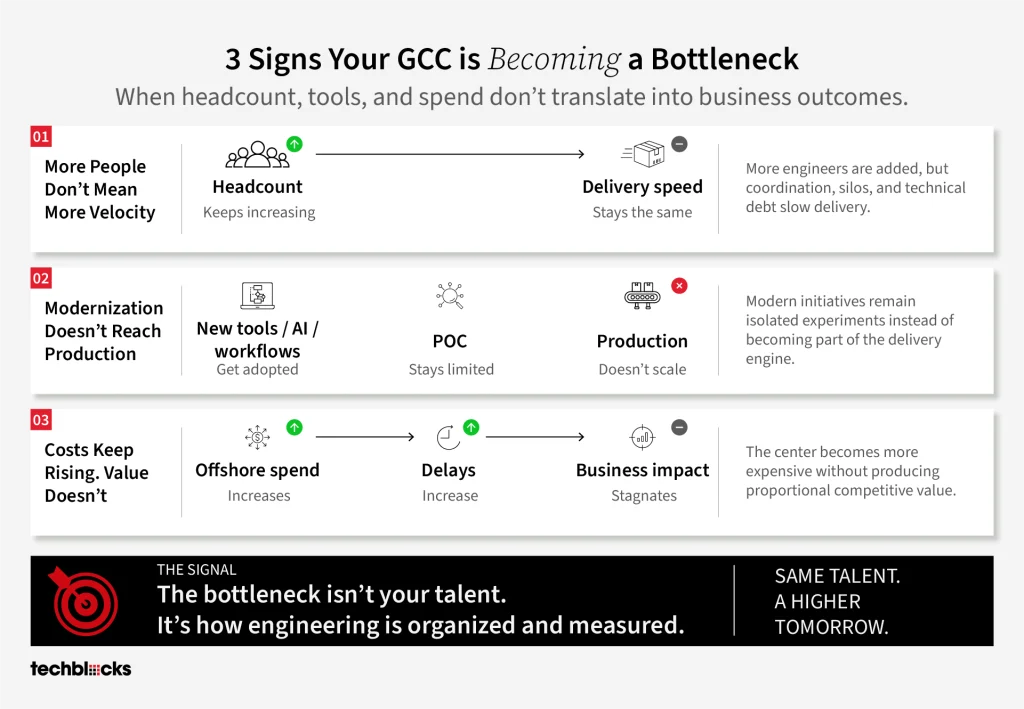
Organizations typically realize their capability center has crossed from an asset into a transformation liability only after millions of dollars have been spent with little to show in competitive advantage. When an offshore hub is built on outdated operational foundations, its failure to scale manifests in three distinct, predictable ways:
1. Scaling Headcount No Longer Scales Velocity
In legacy operating models, taking on new digital initiatives requires a predictable response: hire more engineers, expand physical or virtual floor space, and increase management overhead. But linear headcount growth rarely translates into linear software delivery. When architectural silos, communication friction, and accumulated technical debt multiply alongside headcount, adding more bodies simply introduces coordination drag. Instead of accelerating output, the organization becomes heavier, slower, and harder to pivot.
2. Modern Workflows Trapped in Legacy Process Purgatory
Enterprises face immense pressure to modernize product lines, integrate advanced automation, and accelerate release cycles. Yet, in traditional GCC structures, modern engineering initiatives are treated as experimental side projects rather than operational bedrocks. Advanced methodologies and tooling remain permanently trapped in isolated proofs-of-concept because the underlying software delivery pipelines, cloud foundations, and governance frameworks are not built to support autonomous or agile workflows.
3. The Cost-to-Value Ratio Has Inverted
What began as a disciplined initiative to optimize operating expenses frequently mutates into an expensive offshore burn. When a digital modernization strategy spirals into a multi-million-dollar budget overrun characterized by years of delays and fragmented systems, finance and engineering leadership find themselves managing an administrative burden rather than a high-performance delivery engine.
Recognizing these symptoms is critical because they highlight a deeper structural truth: the bottleneck is rarely a lack of talent. It is an outdated operating model. Overcoming this failure requires examining how outcome-led frameworks replace legacy constraints with sustainable engineering velocity.
The Shift From Offshore Teams to Outcome-Led Engineering
The move beyond labor arbitrage is ultimately an operating-model change. Instead of organizing engineering around functional silos, ticket queues, and sequential handoffs, enterprises are beginning to structure delivery around autonomous teams, embedded intelligence, and measurable business outcomes. This is the foundation of the GCC 3.0 model: an engineering environment designed to increase velocity without depending on linear growth in headcount.
Decentralizing Into Autonomous Delivery Pods
Traditional offshore units often pass work sequentially between development, testing, operations, and other functional teams. Each handoff introduces coordination overhead and makes accountability for the final outcome less clear.
A more modular structure brings cross-functional capabilities together around a defined product or business domain. These delivery pods own work across the lifecycle rather than waiting for separate teams to complete individual stages. AI copilots, automated quality controls, and AI-powered SRE can further augment these teams, increasing their ability to deliver without continuously adding headcount.
The measurement model changes with it. Instead of focusing primarily on hours, tickets, or team activity, pods can be evaluated against release velocity, stability, cost, and business impact.
Embedding Automated Rigor Across the Lifecycle
AI becomes more valuable when it is embedded into the delivery system rather than treated as an isolated productivity tool. Automated testing, continuous compliance controls, observability, and predictive site reliability practices can operate within the engineering pipeline, reducing repetitive work and identifying issues before they become production bottlenecks.
This creates a more continuous path from planning and development through testing and deployment. Engineering teams can increase throughput while maintaining the quality, security, and operational controls required at enterprise scale.
Guardrailing Scale Through Centralized Excellence
Greater autonomy does not mean every team should build its own standards, platforms, or engineering practices. As delivery becomes more distributed, common capabilities become increasingly important.
Centers of Excellence can provide reusable patterns and governance across cloud architecture, data engineering, AI and machine learning, DevOps, quality engineering, and platform engineering. Rather than acting as another approval layer, these capabilities give delivery pods a common technical foundation while allowing them to move independently within their domains.
The result is a different balance between autonomy and control. Engineering teams can move faster, reuse proven capabilities, and remain aligned with enterprise standards—without recreating the organizational complexity that slowed the legacy model in the first place.
Re-engineering Enterprise Execution: The TechBlocks Approach
Architectural models mean nothing if they remain trapped in slide decks while delivery pipelines choke on technical debt. When a tier-one retail enterprise faced a ballooning monthly offshore burn of $2.2 million alongside stagnant release cycles, incremental process adjustments were no longer viable. The challenge demanded an uncompromising operational overhaul.
The solution required replacing legacy ticket queues with autonomous, cross-functional engineering pods deployed within a rigorous 90-day execution window. TechBlocks brought this approach to the engagement, embedding intelligent automation directly across the Plan-Build-Test-Deploy lifecycle instead of throwing more headcount at complex product roadmaps, eliminating the bureaucratic handoffs that traditionally stalled software delivery.
By restructuring capacity around modular accountability rather than administrative oversight, the retailer transformed its operational footprint. Monthly offshore spend compressed from $2.2 million to $1 million, release velocity accelerated by 4x, and total delivery costs dropped by 45%.
This transformation proves that enterprise scaling does not require endless recruitment loops. When engineering execution is built on modular autonomy and governed by real-world outcomes, cost efficiency and elite performance finally move in unison.
Mitigating Risk Through Zero Lock-In Models
Enterprise transformation usually stalls out of fear. The standard enterprise anxiety is entirely rational: ripping out an entrenched, legacy offshore operation risks breaking live production environments before a replacement model proves it can carry the load. Traditional IT vendors exploit this hesitation, locking organizations into rigid, long-term contracts and massive upfront retainers long before any code makes it to production.
Modern engineering leadership breaks this trap by inverting the risk curve entirely. Instead of demanding a massive, organization-wide migration leap of faith, zero lock-in frameworks rely on a granular, phased validation process:
- The Pilot Pod Footprint: Transformation begins small, deploying a single, specialized cross-functional pod to attack a high-friction engineering bottleneck.
- The 6-to-8-Week Proof Window: Within two months, this initial unit must establish hard, verifiable baselines for release velocity, system stability, and code quality.
- Conditional Scaling: Broader structural expansion happens strictly after the metrics clear predefined benchmarks, ensuring investment tracks actual performance rather than sales promises.
By linking commercial agreements directly to demonstrated operational value rather than guaranteed headcount, enterprises eliminate financial exposure. The risk shifts away from the buyer, turning capability center migration from a high-stakes gamble into a predictable, milestone-driven evolution.
Conclusion
A GCC becomes a transformation problem when its scale starts working against the outcomes it was created to deliver. The warning signs are rarely about a shortage of engineering talent. They show up in the gap between growing headcount and stagnant velocity, between modernization investment and actual adoption, and between rising engineering spend and measurable business value.
At that point, adding more people or layering another tool onto the existing structure only extends the problem. The real requirement is to rethink how engineering capacity is organized, governed, and measured.
For technology leaders, that means asking a more fundamental question: Is the GCC still giving the enterprise more engineering capacity, or is it creating more complexity than value?
If the answer is becoming harder to justify, transformation does not need to begin with a wholesale migration. A focused, measurable starting point can establish where the greatest friction exists, demonstrate what can change, and create a basis for scaling with evidence rather than assumptions.
AI-Native GCC 3.0
Turn Your GCC Into An AI-Native Growth Engine
Start with a focused pilot, prove measurable outcomes, and scale engineering velocity without adding linear headcount.

FAQs on GCC
An enterprise should consider transformation when increasing headcount no longer translates into faster delivery, modernization initiatives remain stuck in pilots, or GCC costs rise without proportional business value. These indicate that the operating model, rather than talent availability, may be limiting performance.
Linear headcount growth can introduce additional coordination overhead, architectural silos, communication friction, and technical debt. As a result, adding engineers may increase capacity on paper without producing a proportional increase in software delivery.
The transition involves replacing fragmented, ticket-based teams with modular, cross-functional engineering pods that own product domains and are measured on commercial impact, release velocity, and system stability. Automation and centralized Centers of Excellence can provide the guardrails needed to scale this model.
A phased approach can reduce the risk of a large-scale migration. The article proposes starting with a specialized pilot pod, establishing measurable baselines within a 6-to-8-week proof window, and scaling only when predefined performance benchmarks are met.
Instead of focusing primarily on headcount, enterprises can measure release velocity, system stability, commercial impact, and delivery outcomes. These measures connect engineering activity to the business value the GCC is expected to create.