

AI has changed how software gets built. The way enterprises measure and pay for that work has not caught up. Engineering organizations are adopting coding assistants, autonomous agents, and larger, more capable models. Token consumption is rising. Model invoices are growing. Yet most leaders still cannot answer a simple commercial question:
What reliable software outcome did our AI investment produce, and what did it cost to get there?
A model provider can show tokens and inference charges. A coding tool can show adoption and usage. Jira can show work items. Git can show commits and pull requests. CI/CD can show deployments. Quality systems can show defects. Cloud platforms can show infrastructure costs.
But these systems rarely connect into one view of the economics of delivering a software outcome.
As a result, CTOs and CFOs face an uncomfortable gap:
- AI spend is increasing, but it is unclear where the corresponding engineering value appears.
- A feature’s “AI cost” is often measured as model tokens, while the cost of review, testing, rework, infrastructure, and remediation remains invisible.
- Choosing a cheaper model may reduce inference spend while shifting more effort back to engineers.
- Agents may complete more coding tasks, but it is unclear how much of that work reaches production and survives review.
The real concern extends beyond consumption: what did the AI investment produce, what did the complete delivery cycle cost, and how much resulting capacity can the business use? That is why AI cost management must go beyond the model bill. The relevant unit of measurement is not tokens or hours. It is the total cost of producing a reliable software outcome.
This article examines:
- Where AI costs accumulate across the software delivery lifecycle
- Why token and model spend provides only part of the cost picture
- How engineering leaders can connect AI investment to delivery capacity, quality, and measurable outcomes
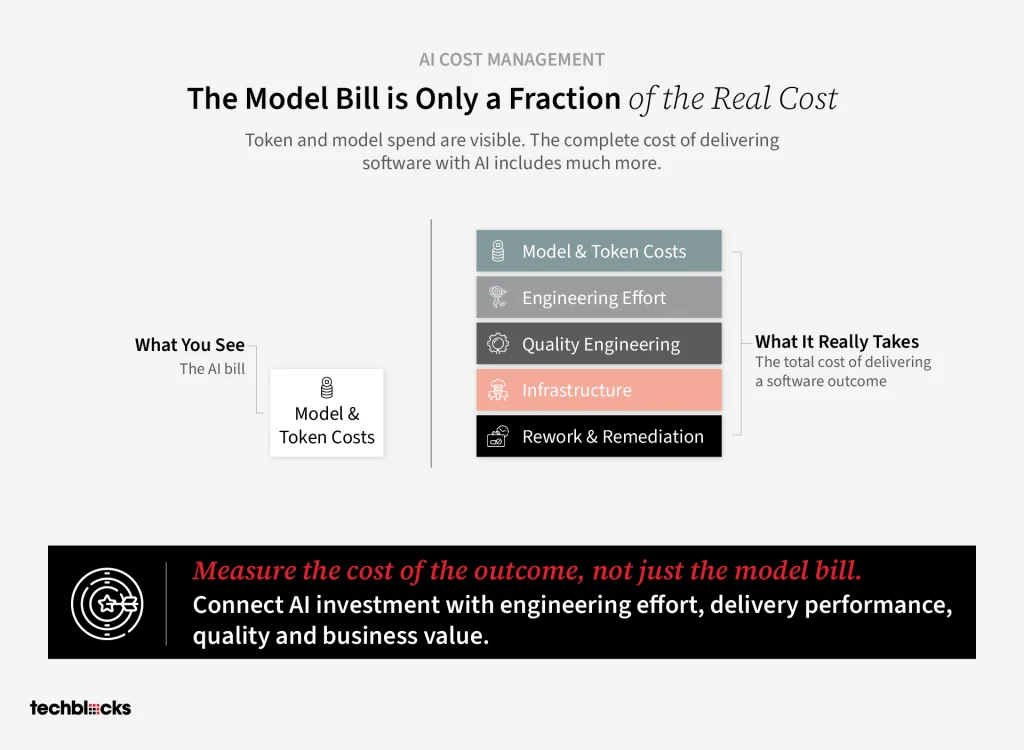
The Model Bill Is Only the Starting Point
Finance teams can usually find the AI invoice. What they cannot easily find is the full cost of an AI-assisted delivery task. Consider a routine engineering request: add a new capability to an existing application. A developer assigns the task to an AI coding agent. The agent:
- Reads the repository and retrieves relevant context.
- Calls a model to generate an implementation.
- Runs tests, identifies failures, and modifies the code.
- Prepares a pull request and responds to review comments.
- Triggers CI/CD, security, and quality checks.
- Supports deployment and, if needed, post-release remediation.
The model provider records tokens and inference calls. The engineering organization experiences a much longer chain of activity.
| Cost layer | Where the cost appears |
| Model consumption | Tokens, inference, context windows, and repeated model calls |
| AI tooling | Coding agents, assistants, licenses, and orchestration tools |
| Engineering effort | Review, debugging, validation, modification, and approval |
| Quality engineering | Test generation, execution, defect detection, and remediation |
| Infrastructure | Compute, CI/CD, storage, observability, and environments |
| Rework | Refactoring, failed implementations, reversions, and production fixes |
Each cost layer can influence another. A smaller model may reduce inference spend while increasing correction time. Greater agent autonomy may reduce developer intervention while increasing model and infrastructure usage. More generated code may accelerate implementation while increasing review and testing effort. A model-cost dashboard can answer one important question: How much AI did the engineering organization consume?
It cannot, by itself, answer the questions leadership actually cares about:
- How much engineering effort did AI eliminate?
- How much generated work reached production?
- How much additional review or rework did AI create?
- Did delivery become faster?
- Did quality improve or deteriorate?
- What did the complete delivery cycle cost?
In an agentic era, the economically meaningful unit is not a token or an agent run. It is the cost of producing a reliable software outcome. Once leadership tries to measure cost at that level, another problem appears: How do you attribute AI spend to the engineering work and outcomes responsible for it?
The Cost of AI Becomes Hard to Explain
An enterprise engineering organization made a deliberate bet on AI. Over two quarters, teams integrated coding assistants into their IDEs, enabled agents for routine development tasks, and adopted larger-context models for complex refactoring. Developers were encouraged to offload boilerplate, tests, and documentation to AI. By the end of the period, the internal dashboards looked promising.
AI usage was up sharply. Token consumption had climbed. Agent runs were increasing month over month. Developers reported feeling faster, especially on routine work. When the CFO reviewed the budget, the numbers told a different story.
- AI-related costs had grown faster than headcount. Cloud spend had ticked up alongside CI/CD usage. The finance team could see more tokens, more tool licenses, and more infrastructure consumption.
- What they could not see was a corresponding change in outcomes.
- Release frequency had not moved much. Cycle time improvements were marginal. Defect rates were stable. The roadmap had not accelerated. No new capabilities had shipped earlier than planned.
In the leadership meeting, the question was not whether AI “worked” at the task level. Everyone agreed it did. The question was why it didn’t show up in what they shipped, how fast, or at what cost.
The CTO could point to activity metrics. The CFO needed outcome metrics. The organization had no shared view connecting AI usage to engineering work, quality, delivery performance, and business value. The pattern is becoming familiar across enterprise engineering organizations: AI has become productive at the task level, while delivery measurement has struggled to keep pace.
The contradiction becomes clear:
- Teams are using more AI.
- Leaders cannot quantify what that usage produced.
- Finance sees rising cost.
- Engineering feels more productive.
- The business does not see faster or cheaper outcomes.
The issue sits in the measurement model: activity is still being treated as a proxy for value. In an AI-native world, the assumption breaks down.
The Real Optimization Target Is the Software Outcome
Once enterprises look beyond the model bill, reducing AI consumption can seem like the obvious next step.
Teams can use lower-cost models for routine work, limit agent runs, reduce context windows, or place tighter controls around token usage. Each decision can lower visible AI spend while creating additional work elsewhere.
A cheaper model may need more iterations before producing usable code. Restricting agent autonomy can shift implementation and debugging back to developers. Smaller context windows can reduce token consumption while increasing retrieval and additional model calls. More generated code can speed up implementation while adding review, testing, security, and remediation effort.
The economics therefore depend on the complete delivery workflow, not model consumption in isolation.
For a complex engineering task, a more capable model may cost more while reducing iterations and senior-engineer involvement. For routine development, a lower-cost model may deliver better economics. Greater agent autonomy can justify higher AI and infrastructure consumption when the resulting capacity creates enough additional value.
The relevant measures span engineering effort, delivery velocity, quality, rework, production output, and total delivery cost. Connecting the measures gives engineering and finance leaders a clearer basis for deciding where AI investment creates genuine leverage.
The real optimization target is the cost and quality of the software outcome, not the size of the model bill.
From AI Cost Visibility to AI Cost Accountability
Most enterprises can see how much AI they are spending. Connecting the spend to engineering outcomes is considerably harder.
Model dashboards show tokens and inference costs. Coding platforms show agent activity. Engineering systems capture work items, code changes, deployments, defects, and cycle time. Finance sees expenditure across models, tools, and infrastructure. The data exists. The economic picture does not.
Introducing AiDE, the AI-Native Delivery Engine
TechBlocks built AiDE, the AI-Native Delivery Engine, to give engineering and finance leaders a unified view of AI-native software delivery.
AiDE connects AI contribution with human effort, quality, delivery performance, cost, and engineering capacity across the software development lifecycle. Rather than evaluating AI through model usage alone, leaders can see how AI contributes to engineering work and software reaching production.
The Delivery Ledger provides traceability across work items, AI-assisted code, developer modifications, model usage, shipped work, rework, reversions, tokens, and cost per ticket. Engineering Health brings delivery and quality measures such as cycle time, deployment frequency, change failure rate, MTTR, and AI-versus-human defect density into the same operating view.
The value comes from connecting the measures. A higher model cost can make economic sense when it reduces rework or senior-engineer involvement. Greater agent autonomy can justify additional AI and infrastructure spend when the resulting capacity creates meaningful business value.
AiDE gives enterprises a way to manage AI as part of software delivery economics, with investment decisions grounded in delivery evidence.
Turn Productivity Into Capacity
Productivity gains become more valuable when recovered engineering capacity is put to work.
At TechBlocks, a large retail engineering organization used AiDE to connect AI contribution with engineering work and delivery outcomes. The deployment reported a 25–30% productivity gain, with recovered capacity reinvested into backlog execution.
Read the full case study to see how the organization measured AI-driven productivity and turned recovered engineering capacity into additional delivery.
Four Shifts for Managing AI-Native Delivery Economics
Finance and engineering need a shared view of AI’s effect on software delivery economics. Four shifts can help establish one.
1. Establish the delivery baseline
Start with the economics of delivery before measuring AI impact. Track engineering capacity, delivery velocity, quality, infrastructure costs, review effort, and rework. A baseline gives leadership a consistent reference for evaluating changes after AI adoption.
2. Measure AI against the work
AI usage shows consumption. Engineering outcomes show what the consumption produced. Connect model and agent activity with requirements, code, developer intervention, testing, defects, rework, and production delivery. The resulting view makes AI performance measurable against completed software rather than tool activity alone.
3. Govern AI according to the task
Different engineering tasks carry different economics. Complex architecture work may justify a more capable model when stronger output reduces iterations and senior-engineer involvement. Routine development may work better with a lower-cost model. Agent autonomy can also vary according to the engineering capacity created relative to additional AI and infrastructure consumption.
4. Convert productivity into capacity
Productivity gains create greater business value when recovered engineering time is deliberately redeployed. Enterprises can direct capacity toward backlog execution, modernization, experimentation, quality improvements, or faster releases. Tracking where recovered capacity goes connects AI adoption with tangible business outcomes.
The objective is disciplined AI investment: understand the economics, govern usage according to the work, and put recovered capacity to productive use.
Conclusion: The Question Is What AI Makes Possible
AI cost management has moved beyond model and token spend. As AI becomes part of everyday software delivery, engineering leaders also have to account for human effort, quality, rework, infrastructure, delivery velocity, and the capacity created through AI adoption.
A lower AI bill can still come with higher engineering costs. Greater AI consumption can make economic sense when it reduces effort, improves delivery, or creates capacity for higher-value work.
For CTOs, CFOs, and engineering leaders struggling to connect AI spend with delivery outcomes, TechBlocks can help build a more accountable AI-native delivery model.
Measure What AI Delivers
Build a More Accountable AI Engineering Model
Bring AI spend, engineering capacity, delivery performance, quality, and business outcomes into one measurable operating model.

Frequently Asked Questions
Measure AI investment against engineering outcomes rather than token usage or adoption alone. Useful measures include delivery velocity, cycle time, developer effort, quality, rework, production output, and engineering capacity created.
No. A lower-cost model can require more iterations, developer intervention, testing, or remediation. The more useful measure is the total cost of producing a reliable software outcome.
Connect model usage and agent activity with engineering work, infrastructure, developer effort, quality, and production outcomes. An AI-native delivery platform can bring the data into a unified operating view.
Govern AI usage according to the nature of the work. Complex tasks may justify more capable models or greater agent autonomy, while routine development may benefit from lower-cost options. Decisions should consider delivery performance, quality, human effort, and total cost.
Recovered engineering capacity can be redirected toward backlog execution, modernization, experimentation, quality improvements, or faster releases. Tracking where the capacity goes helps connect AI productivity with tangible business outcomes.