

A Global Capability Center can begin with a handful of specialists working on a narrow set of problems. Over time, the work becomes broader. Teams learn from one another. Certain practices prove useful. Expertise begins to gather around particular technologies, disciplines, or business domains.
At some point, a practical question emerges: how does the organization keep that expertise from remaining scattered across individual teams?
A Center of Excellence (CoE) provides one answer. It brings together specialized knowledge, standards, tools, governance, and experienced practitioners around a defined capability. Within a GCC, the role can extend well beyond maintaining expertise. A well-designed CoE can turn lessons from individual projects into practices that other teams can adopt, refine, and reuse.
The distinction matters as GCCs take on increasingly strategic responsibilities. AI, data, cloud, cybersecurity, product engineering, and other specialized capabilities cannot always be built effectively through isolated delivery teams. Enterprise-wide capability requires somewhere for knowledge to accumulate, standards to develop, and new approaches to mature.
The result is less a specialist department than a shared capability layer, one that helps the GCC move from delivering work to developing how the enterprise delivers it.
In the sections ahead, we’ll look at what a Center of Excellence actually is, why GCCs need one, how a CoE differs from a conventional specialist team, and what changes when the model becomes AI-native.
What Is a Center of Excellence?
A Center of Excellence is an organizational unit built around a defined area of expertise, with responsibility for developing that capability beyond the requirements of individual projects or teams.
A project team might build an AI application, migrate workloads to the cloud, or establish a new data platform. A CoE works on the questions that extend beyond a single engagement: Which practices should become standard? Which tools can be reused? Which architectural patterns should other teams follow? What knowledge needs to be developed across the organization?
Consider a Cloud CoE. Its remit could include defining architecture patterns, establishing infrastructure standards, developing reusable components, evaluating new technologies, supporting engineering teams, and setting governance practices. A delivery team completes a migration. A Cloud CoE can improve the way an enterprise approaches hundreds of migrations over time.
The same principle applies across different capabilities:
| CoE | Core responsibility |
| AI & ML | AI engineering practices, model development, experimentation, governance |
| Data & Analytics | Data architecture, analytics standards, reusable data capabilities |
| Cloud | Architecture, platforms, migration patterns, cloud governance |
| Cybersecurity | Security practices, controls, threat management, resilience |
| DevOps | Automation, CI/CD, platform practices, engineering standards |
| Product Engineering | Product practices, architecture, engineering excellence |
A CoE turns specialist knowledge into something other teams can use. That usually involves five kinds of work:
- Standards: Establishing technical, architectural, or operational practices that teams can follow.
- Reusable assets: Creating frameworks, platforms, tools, templates, components, and reference architectures.
- Capability development: Building expertise through experimentation, research, training, and knowledge sharing.
- Enablement: Helping delivery teams solve difficult problems without taking ownership of every project.
- Governance: Defining controls, decision rights, quality measures, and practices for the capability.
The operating principle is simple: expertise should travel beyond the people who possess it.
A CoE should not become a permanent consulting desk for every project. Delivery teams should increasingly be able to apply the standards, platforms, tools, and knowledge developed around the capability without requiring the CoE to intervene in every decision.
Within a GCC, the model creates a place where specialized expertise can accumulate, mature, and spread. The GCC gains more than a group of specialists. It gains a mechanism for developing a capability once and extending its value across the enterprise.
Why CoEs Matter to Modern GCCs
A GCC can scale without developing a Center of Excellence. It can hire engineers, create delivery teams, assign projects, and continue expanding headcount as demand grows. The difficulty appears when expertise needs to move across those teams.
One engineering group may develop an effective approach to cloud automation while another solves the same problem differently. An AI team may discover a useful model-development practice that never reaches product teams. Data specialists may establish governance patterns that remain limited to one program.
Without a mechanism for sharing and standardizing those lessons, the GCC keeps solving similar problems in parallel. A CoE changes the economics of expertise.
From project knowledge to enterprise capability
A project produces an outcome for a particular business requirement. A CoE asks whether the knowledge generated along the way can improve the next project.
The distinction becomes especially valuable as GCCs take on specialized capabilities such as:
- AI and machine learning
- Data engineering and analytics
- Cloud and platform engineering
- Cybersecurity
- DevOps and automation
- Product engineering
Each discipline evolves quickly. New tools appear, architectural approaches change, and engineering practices mature. A CoE gives the GCC a dedicated structure for evaluating those changes, developing standards, and helping delivery teams adopt what proves useful.
From individual expertise to institutional knowledge
Specialist knowledge can be fragile when it sits primarily with individuals.
People move between teams. Projects end. Priorities change. Without deliberate knowledge-sharing mechanisms, valuable expertise can disappear into completed engagements or remain concentrated among a small number of specialists.
A CoE creates continuity.
Reference architectures, engineering standards, reusable components, playbooks, training programs, and governance practices allow knowledge to remain accessible even as teams change.
From capability building to capability reuse
The real advantage appears when the same capability can support multiple parts of the enterprise.
A reusable AI framework can shorten development across several products. A common cloud architecture can reduce repeated design work. A shared security practice can raise the baseline across multiple engineering teams.
The GCC moves from building expertise project by project to developing capabilities that can travel across projects.
That shift is one reason CoEs have become increasingly relevant as GCCs take on work that extends beyond traditional delivery. The center is no longer simply a place where work gets done. It becomes a place where the enterprise learns how to do increasingly complex work better.
CoE vs. a Traditional GCC Team
A GCC team is usually organized around delivery. A CoE is organized around capability development.
The difference can be easy to miss because both may contain the same engineers, architects, analysts, or specialists. The distinction lies in the mandate given to the group and where its work creates value.
| Dimension | Traditional GCC Team | Center of Excellence |
| Primary purpose | Deliver defined business or technology work | Develop and scale a specialized capability |
| Scope | Usually tied to specific products, functions, or programs | Spans multiple teams, programs, or business units |
| Success measure | Delivery, quality, cost, timelines | Capability adoption, reuse, maturity, and business impact |
| Knowledge | Applied within delivery work | Codified, shared, and continuously developed |
| Standards | Follows established practices | Develops and evolves practices |
| Reusable assets | May create them as part of delivery | Deliberately builds platforms, frameworks, tools, and patterns for reuse |
| Innovation | Focused on solving immediate problems | Experiments with emerging approaches and evaluates broader adoption |
| Governance | Operates within existing governance | Helps define governance for its area of expertise |
- Consider two cloud engineering groups.
- The first manages migrations, resolves infrastructure issues, and maintains production environments. Its success depends largely on reliable delivery.
- The second develops reference architectures, reusable infrastructure components, cloud governance practices, automation frameworks, and training for engineering teams across the organization. Its work improves the performance of many teams beyond its own immediate workload.
- Both groups may have excellent cloud engineers. Only the second has a mandate to develop cloud capability across the enterprise.
The distinction also changes how leadership should measure performance. A delivery team can demonstrate success through release frequency, reliability, quality, and cost. A CoE needs additional measures: adoption of its standards, reuse of its assets, capability maturity, time saved across teams, quality improvements, and the business outcomes enabled by its work. A CoE therefore should not become a more prestigious name for a specialist delivery team.
The mandate has to change, from delivering expertise to multiplying its value.
What Makes a CoE Work at Enterprise Scale?
Creating a CoE is relatively straightforward. Giving it enough authority, expertise, and relevance to influence the wider GCC is harder. A CoE can have experienced people, a well-defined charter, and an impressive list of responsibilities yet remain disconnected from delivery. The capability needs a working relationship with the teams expected to adopt it. Four elements usually determine whether the model gains traction.
A clearly defined mandate
A CoE needs boundaries. An AI CoE, for example, should not become responsible for every AI-related activity across the enterprise. Its mandate might cover model engineering, AI platforms, experimentation standards, responsible AI practices, and enablement. Clear boundaries prevent overlap with product teams, architecture groups, IT functions, and other CoEs.
Access to real delivery problems
Expertise becomes useful when it encounters difficult problems. A CoE working entirely through theoretical research can drift away from the needs of engineering and business teams. Involvement in live programs gives specialists a better understanding of technical constraints, customer requirements, operational realities, and the trade-offs teams face. The relationship should work in both directions: delivery brings problems to the CoE; the CoE brings improved methods back to delivery.
Reusable capability, not repeated consulting
A CoE should leave something behind after solving a problem. That might be a platform, framework, reference architecture, automation component, governance pattern, training program, or engineering standard. Each reusable asset reduces the amount of effort required when another team encounters a similar problem. Over time, the CoE becomes less dependent on individual interventions and more valuable through the assets and practices it has created.
Measures tied to adoption and outcomes
Counting workshops, documents, experiments, or certifications can make a CoE look busy without showing whether the capability is improving. Better measures ask:
- How widely are CoE standards being adopted?
- How much engineering effort is being saved through reuse?
- How quickly can teams adopt a new capability?
- Has quality or reliability improved?
- Which business outcomes have the capability enabled?
A CoE earns its place in the GCC when expertise becomes measurable enterprise leverage.
How AI Is Changing the Center of Excellence
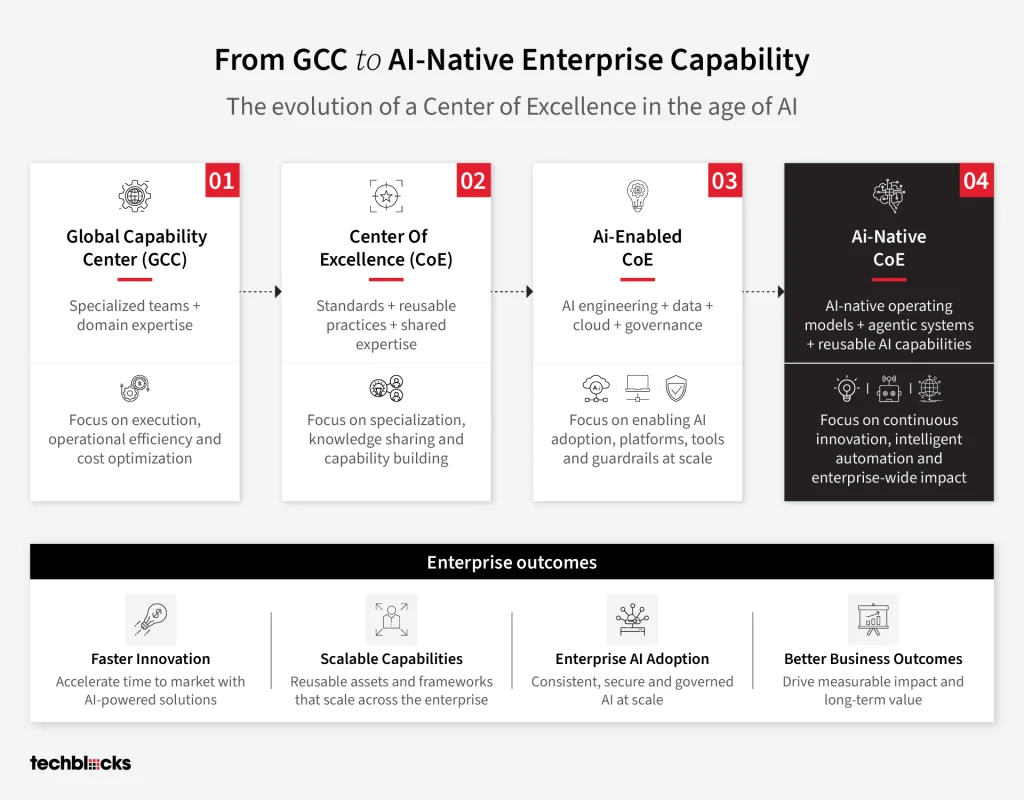
AI is changing the role of a CoE in a more fundamental way than simply adding another specialist discipline. An AI CoE may begin with model experimentation, prompt engineering, or machine learning expertise. As adoption spreads, its responsibilities can move toward AI platforms, agentic systems, model governance, evaluation, reusable components, and AI engineering practices. The CoE increasingly becomes the place where the enterprise works out how AI should be built and used before those practices spread across product and engineering teams.
From expertise to AI-native capability
Traditional CoEs often codify established practices. AI introduces a different requirement: continuous experimentation. Models evolve quickly. New frameworks appear. Agent architectures change. Evaluation methods mature. Governance requirements develop alongside adoption. An AI CoE therefore needs room for experimentation without allowing every delivery team to independently solve the same emerging problems.
The work can include:
- Developing reusable AI components and agent patterns
- Establishing model evaluation and monitoring practices
- Building shared AI platforms and tooling
- Defining responsible AI and governance standards
- Testing emerging models and frameworks
- Enabling product and engineering teams to adopt proven approaches
The CoE becomes a bridge between experimentation and enterprise adoption.
From central expertise to distributed capability
Centralization alone cannot scale AI across a large enterprise. An AI CoE can establish the platforms, standards, guardrails, and reusable assets. Product and engineering teams then apply those capabilities within their own domains. The model resembles a hub-and-spoke structure:
- CoE → develops the capability
- Delivery teams → apply the capability
- Enterprise → benefits from broader adoption
Such an approach prevents every team from building its own AI stack while avoiding a model where every AI initiative has to pass through a single central team. For GCCs moving toward AI-native operating models, the distinction becomes especially useful. The CoE is no longer simply a repository of scarce expertise. It becomes an engine for developing AI capabilities that other teams can adopt at scale.
How to Build a CoE That Scales Across the Enterprise
A CoE should begin with a problem worth solving, not with the decision to create another organizational unit. Perhaps product teams are approaching AI in different ways. Cloud architecture varies from one program to another. Data practices have developed independently across business units. Specialists spend too much time solving problems that other teams have already encountered. A CoE can bring coherence to such situations, provided the mandate is clear from the beginning.
Define the capability before defining the team
“AI” or “data” is rarely a sufficient mandate. An AI CoE might concentrate on AI engineering, agentic applications, model evaluation, governance, or shared AI platforms. A Data CoE might focus on data architecture, quality, lineage, or analytics engineering. A precise mandate gives the team a clear boundary and prevents overlap with product engineering, architecture, security, and other specialist groups.
Give the CoE responsibility for something reusable
Expertise becomes more valuable when it can be applied beyond the original problem. A CoE might develop a reference architecture after working through a difficult implementation. An automation framework might emerge from repeated engineering work. A governance model might simplify how several product teams approach AI. The work should leave behind something useful: a platform, framework, standard, tool, method, or body of knowledge that another team can adopt without starting from the beginning.
Keep specialists close to delivery
A CoE operating far from production environments can lose sight of the problems it was created to solve.
Specialists need exposure to live engineering work, product constraints, operational issues, and business requirements. Delivery teams, in turn, benefit from access to expertise while difficult problems are being solved.
The relationship should gradually reduce dependence on individual specialists. Once a solution has been proven, the CoE should turn the learning into guidance, tooling, training, or reusable technology.
Measure whether the capability is spreading
A CoE can produce a large volume of activity without creating much enterprise value. Workshops, documents, prototypes, and certifications provide useful signals, but adoption tells a more meaningful story.
Leadership should ask:
- How many teams are using CoE standards?
- How widely are reusable assets being adopted?
- How much repeated engineering work has been eliminated?
- Has delivery become faster or more reliable?
- Which business outcomes have improved?
A CoE earns its place when expertise developed in one part of the GCC starts improving work elsewhere. The measure of success is not how much expertise sits inside the CoE. It is how much better the wider organization becomes because the expertise exists.
A CoE Should Make the GCC More Capable
A GCC can gather talented people without ever developing a lasting capability. The difference emerges over time. Teams complete projects, specialists solve difficult problems, and useful approaches appear. Without a structure for capturing and extending those lessons, much of the value remains tied to individual programs or people. A Center of Excellence gives expertise somewhere to develop.
The most valuable CoEs do more than establish standards or provide specialist support. They create platforms, methods, knowledge, and practices that other teams can adopt. AI, data, cloud, cybersecurity, and product engineering can all benefit from such an approach, particularly as GCCs take on work with greater technical and strategic importance.
For a modern GCC, the CoE can become the place where emerging capability is tested, refined, and prepared for wider adoption.
TechBlocks’ GCC 3.0 approach builds on the same progression, with AI-native Centers of Excellence working alongside AI-augmented pods and AI-led business transformation. The aim is to move beyond a model based primarily on delivery capacity toward one built around capabilities that can create measurable enterprise outcomes. A CoE earns its place when knowledge stops belonging to a small group of specialists and starts improving the work of the wider organization.
Build AI-Native Centers of Excellence for Enterprise Scale
Develop specialized GCC capabilities that turn AI expertise into reusable platforms, practices, and measurable business outcomes.
FAQs on Center of Excellence
A specialist team is generally organized around delivery. A Center of Excellence develops the methods, standards, tools, knowledge, and expertise that can support multiple teams or business units. The CoE’s responsibility extends beyond completing individual projects.
Common examples include AI and ML, data and analytics, cloud engineering, cybersecurity, DevOps, product engineering, automation, and enterprise architecture. The right areas depend on the capabilities the GCC needs to develop and the strategic priorities of the enterprise.
No. A small GCC with a narrow delivery mandate may have little need for formal CoEs. The model becomes more useful as the center develops specialized capabilities, supports multiple teams, or needs to establish common standards across a growing organization.
Useful measures include adoption of standards, reuse of platforms and frameworks, reduction in repeated engineering effort, capability maturity, delivery improvements, and business outcomes. Counting workshops, documents, or specialists alone provides little indication of enterprise value.