

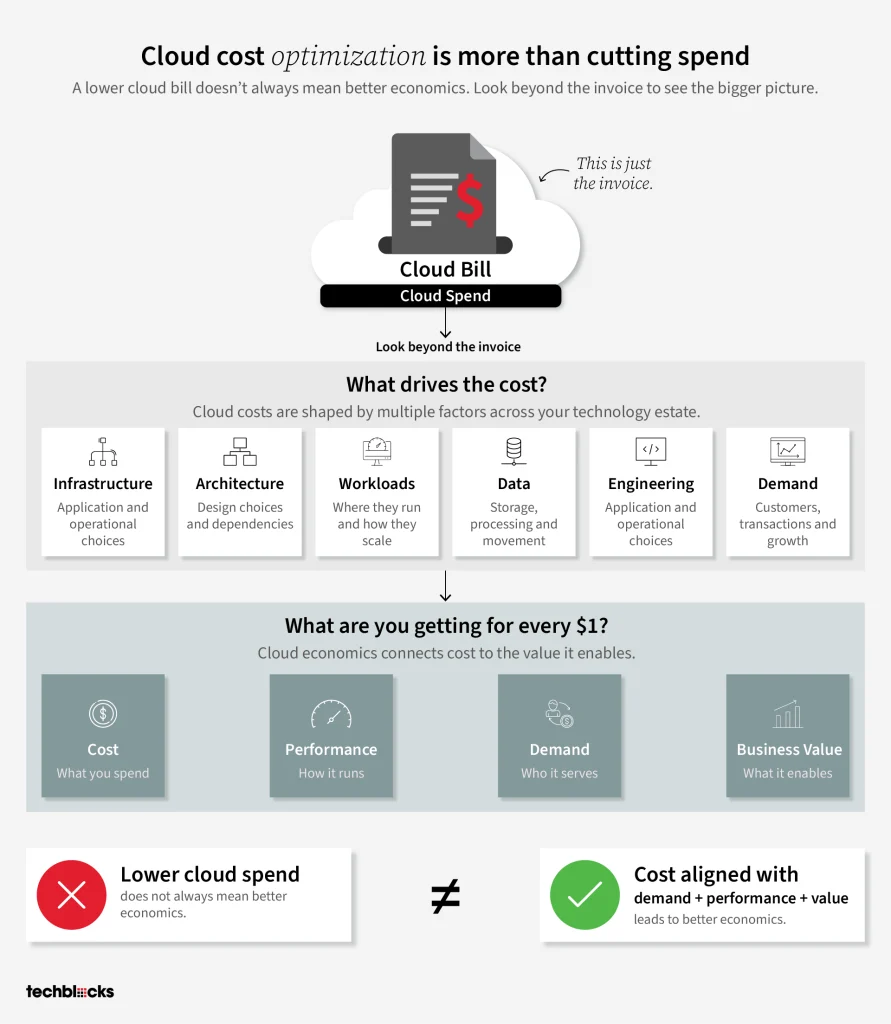
Cloud cost optimization is often judged by one number: the cloud bill. But a lower bill does not necessarily mean better economics. Cutting infrastructure spend can come at the expense of application performance, engineering velocity, resilience, or the capacity required to support growth. Conversely, higher cloud spend may be entirely justified when it enables more transactions, customers, revenue, or digital capabilities.
The real question for technology leaders is what the organization is getting for every dollar of cloud investment. Modern cloud economics connects technology costs with the business value those costs enable. That means looking beyond the invoice to understand how consumption, architecture, workloads, engineering decisions, and business demand shape cloud costs.
A stronger cloud cost optimization program asks three questions:
- What is driving the cost?
- Where can the technology be changed to improve the economics?
- Is the cost scaling appropriately with the value being delivered?
The goal is not simply to spend less on cloud. It is to make better technology decisions as cloud consumption, workloads, and business demands change.
Start With What Is Driving Cloud Cost
Cloud costs are produced by the technology estate, not by the cloud invoice. A workload can become more expensive because demand increased, but it can also become expensive because the architecture requires more compute, data moves unnecessarily between services, workloads are poorly placed, or applications are difficult to operate efficiently. The invoice captures the outcome of those decisions without explaining what caused them.
Before cutting spend, leadership needs visibility into the sources of cost:
| Cost driver | What to examine |
| Infrastructure | Capacity, utilization, provisioning, and resource selection |
| Architecture | Design choices creating recurring compute, storage, or networking costs |
| Workloads | Where workloads run, how they scale, and how efficiently they use resources |
| Data | Storage, replication, processing, and movement across environments |
| Engineering | Application and operational choices affecting ongoing cloud consumption |
| Demand | Growth in customers, transactions, workloads, and digital activity |
The first step in cloud optimization is understanding which factors are actually driving spend. A higher bill may reflect waste, an architectural constraint, inefficient workload behavior, or legitimate business growth. Each requires a different response.
Without this diagnosis, optimization risks treating the symptom rather than the source of the cost.
Move Cloud Cost Optimization Up the Stack
Once the sources of cloud cost are visible, the next question is where to intervene. Some costs can be addressed through infrastructure management. Others are embedded in workload behavior, application design, or architecture and require changes higher in the technology stack.
FinOps increasingly brings cost considerations into architecture and engineering decisions, including modernization, re-platforming, workload placement, and design choices made before deployment. The optimization levers therefore exist at multiple levels:
- Infrastructure: Rightsize resources, improve utilization, and remove unused capacity.
- Workload: Change how and where workloads run based on usage patterns, performance requirements, and scaling behavior.
- Architecture: Redesign systems where structural choices create persistent compute, storage, networking, or data costs.
- Applications: Improve processing patterns and application behavior to reduce unnecessary resource consumption.
- Engineering: Incorporate cost considerations into design, development, deployment, and modernization decisions.
The right intervention depends on where the cost originates. Infrastructure changes can address waste quickly, while application or architectural changes may be necessary when cost is built into the way a system operates. The more structural the cost driver, the more important engineering intervention becomes.
Measure Cloud Economics, Not Just Cloud Spend
Total cloud spend is an important financial measure, but it does not reveal whether technology costs are scaling efficiently with the business. A higher cloud bill may reflect higher demand, a larger customer base, or expanded digital capabilities, or simply increased cost to support the same level of activity.
Cloud unit economics adds the missing context by connecting technology spend to a measurable unit of business or technical value. Depending on the business model, useful measures can include cost per customer, transaction, API call, product feature, workload, or cost to serve.
| Instead of measuring | Measure |
| Total cloud spend | Cost per business unit |
| Cost per GB | Cost per transaction or customer |
| Monthly infrastructure cost | Cost to serve |
| Cloud budget variance | Cost relative to business demand |
| Resource utilization | Value produced per unit of consumption |
The right metric depends on how the business creates value. An ecommerce company may track cost per transaction. A SaaS business may track cost per customer or subscription. An AI application may track cost per API call or token alongside the outcome produced.
Unit economics also gives engineering, finance, and business teams a shared basis for evaluating trade-offs. A workload that costs more may still be economically efficient if the additional consumption supports proportionally greater demand or value. Conversely, a workload with high utilization may still require intervention if its cost is growing faster than the business activity it supports.
The objective is not to minimize every cost. It is to understand whether technology costs are scaling in proportion to the value and demand they support.
AI Changes What “Optimization” Means
AI introduces a different cost curve. Traditional cloud workloads are often evaluated through compute, storage, networking, and utilization. AI adds model inference, token consumption, GPU capacity, data processing, and more variable workload patterns.
The challenge is not simply controlling those new costs. AI optimization involves trade-offs between cost, performance, quality, and business outcome. Choosing a cheaper model may reduce inference costs but affect output quality. Reducing context or token usage may lower consumption but limit the capability of an application. Increasing compute may raise infrastructure costs while improving latency or reliability.
For technology leaders, the relevant question is therefore not “How cheaply can we run this AI workload?” but “What level of cost produces an economically worthwhile outcome?”
Several measures can help evaluate the trade-offs:
- Model cost: What does each model or inference path cost?
- Usage cost: How does cost change with volume, context, and usage patterns?
- Architecture impact: Is the application architecture creating unnecessary AI or cloud consumption?
- Quality trade-offs: What happens to output quality when compute, context, or token usage is reduced?
- Business outcome: What does it cost to complete a customer interaction, automate a workflow, or produce a measurable business outcome?
Cost per token or inference remains an important operating metric. It is not, however, the final measure of AI economics. A more useful view connects consumption with the quality and value of the outcome produced. AI makes unit economics more important because consumption alone cannot explain whether an AI workload is economically efficient.
From Cost Visibility to Cost Control
Knowing where cloud costs come from is only the beginning. The harder challenge is making cost part of the engineering decisions responsible for creating it. Architecture teams need cost implications during design. Platform teams need guardrails before infrastructure is provisioned. Engineering teams need visibility into workload costs alongside performance and reliability. Finance needs enough attribution to connect technology spend with business performance.
This is where TechBlocks approaches cloud engineering differently. FinOps is not treated as a reporting layer added after deployment. Cost considerations are built into the cloud operating model alongside platform engineering and SRE, giving teams the visibility, controls, and engineering practices needed to manage cloud economics continuously.
What this looks like in practice
At the architecture level
Model the economic implications of workload placement, application design, data flows, and modernization decisions before they become infrastructure costs.
At the platform level
Build standardized environments with automated policies, observability, resource controls, and cost visibility rather than relying on teams to manage economics manually.
At the engineering level
Give teams visibility into the cost of the workloads they create and operate, alongside performance and reliability signals.
At the business level
Connect cloud consumption to unit economics and business outcomes so leadership can distinguish productive investment from structural waste.
This makes cost a continuous engineering consideration rather than a financial review performed after deployment.
Conclusion
Cloud cost optimization is ultimately about making better technology decisions. The right target is not a predetermined level of cloud spend, but a technology environment where cost remains aligned with demand, performance, and business priorities as the organization evolves.
For technology leaders, the real test is whether the technology estate can support growth without creating disproportionate cost or complexity.
TechBlocks helps enterprises make those decisions across cloud engineering, application modernization, platform engineering, SRE, and FinOps, bringing cost considerations into the engineering work where long-term cloud economics are shaped.
The better question is not “How much can we cut from the cloud bill?” It is “Is our technology becoming more efficient as our business grows?”
Reengineer Your Cloud Economics
Identify where cloud costs are structurally driven by architecture, workloads, and engineering, and build a more efficient cloud operating model.
FAQs on Cloud Cost Optimization
Cloud cost optimization should identify the sources of spend, determine whether costs are scaling appropriately with demand, and address inefficiencies across infrastructure, workloads, applications, and architecture.
Common cost drivers include infrastructure utilization, architecture, workload behavior, data movement, engineering decisions, and business demand. The right optimization approach depends on identifying which factors are contributing most to spend.
Application architecture influences compute requirements, data movement, storage, service dependencies, and scaling behavior. When cost is structurally tied to architecture, infrastructure-level changes alone may not deliver sustainable savings.
Cloud unit economics connects technology spend to a measurable unit of business or technical value, such as cost per transaction, customer, workload, API call, or cost to serve. The measure helps teams evaluate whether technology costs are scaling efficiently with demand and value.
AI introduces additional cost variables such as model inference, token consumption, GPU capacity, and data processing. Optimization needs to consider cost alongside performance, output quality, usage, and the business outcome produced by the AI workload.