

If more than 80% of technology professionals say AI has made them more productive, why isn’t software reaching production faster?
DORA’s latest research found 90% of technology professionals using AI at work, with more than 80% reporting productivity gains. Yet higher AI adoption was also associated with a 1.5% reduction in delivery throughput and a 7.2% reduction in delivery stability for every 25% increase in AI adoption.
The numbers point to a problem engineering leaders have faced well beyond AI: improving individual productivity does not automatically improve the system responsible for delivering software. Faster coding has limited impact when work still waits on architecture decisions, code reviews, testing, security approvals, unstable environments, or deployment processes. Engineering can produce more output while the delivery system determines how much of it actually reaches production.
The issue is not whether productivity investment works. It is whether the organization has removed the constraints preventing productivity gains from becoming delivery gains.
In the sections ahead, we will examine:
- Where productivity gains get absorbed by queues, dependencies, rework, and delivery bottlenecks
- Why conventional engineering productivity measures can miss the constraints limiting delivery performance
- How leaders can connect productivity investments to faster, more reliable software delivery and measurable business outcomes
Productivity Gains Can Disappear Inside the Delivery System
If developers can build software faster, why does the software still take days to reach production?
The answer often sits outside development itself. A feature can move rapidly from requirements into implementation and then slow down as it crosses review queues, shared environments, testing processes, security controls, release approvals, and production operations.
The delivery path looks more like:
Requirements → Architecture → Development → Review → Testing → Security → Release → Production
AI-assisted development makes the contrast easier to see. A team may reduce implementation time from two days to half a day, yet the pull request can still wait 18 hours for review, integration testing can consume another day, security validation can run in a separate queue, and production releases can remain limited to twice a week.
The development task has become faster. The delivery system has not.
This distinction matters because productivity investments often target the most visible source of engineering effort. DORA’s software delivery framework takes a broader view, measuring how changes move through the system using change lead time, deployment frequency, and failed deployment recovery time. Individual coding speed is not a delivery-performance metric.
Where the time actually goes
The gap becomes visible when productivity improvements are mapped against the constraints surrounding each delivery stage:
| Delivery stage | Local improvement | Possible system constraint |
| Development | AI-assisted coding | Dependency on another team |
| Code review | Better tooling | Reviewer availability |
| Testing | Automated test generation | Slow integration environment |
| Security | Automated scanning | Manual approval |
| Deployment | CI/CD automation | Fixed release windows |
| Production | Better observability | Slow incident response |
Each improvement can be real while the end-to-end delivery cycle barely changes. Faster development can even increase the amount of work waiting downstream when review, testing, security, or release capacity remains unchanged.
DORA’s current guidance recommends mapping the delivery process, identifying the most significant constraint, improving it, and repeating the exercise. The principle changes how productivity investment should be allocated: the highest-value improvement is not necessarily the one that makes an individual activity faster; it is the one that removes the constraint limiting overall flow.
Once the bottleneck moves, the next constraint becomes visible. Productivity investment can then compound across the delivery system instead of accumulating as isolated gains within individual engineering activities.
If the Delivery System Is Still Slow, Where Is the Work Waiting?
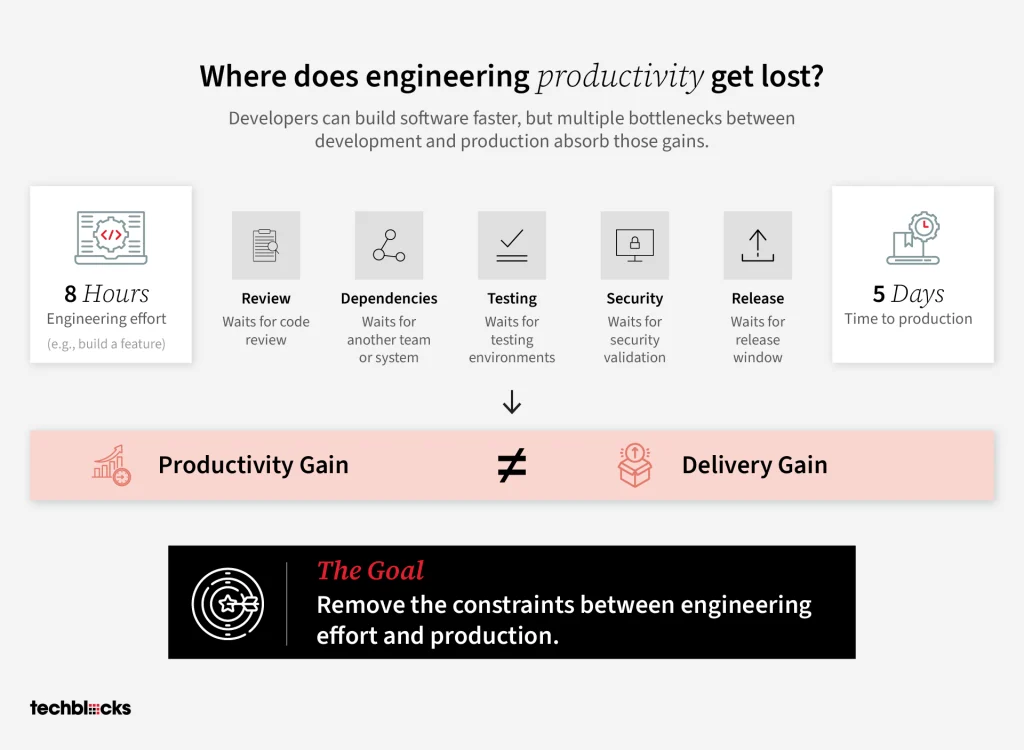
Eight hours of engineering effort can become a five-day delivery cycle. The gap between the two is where much of an organization’s delivery friction lives. A developer finishes a feature. The work then moves through a series of queues and dependencies:
- It waits for review.
- It waits for an environment.
- It waits for another team’s API.
- It waits for testing.
- It waits for security validation.
- It waits for the release window.
The individual activities may appear reasonable in isolation. The accumulated waiting time tells a different story.
Take a feature requiring eight hours of engineering effort but five days to reach production. Reducing development effort to four hours creates a 50% improvement in engineering time. Yet the customer still experiences almost the same delivery cycle when the remaining time is consumed by reviews, dependencies, testing, approvals, and release schedules.
The gap between effort and elapsed time is the signal.
Engineering leaders can use the gap to locate constraints within the delivery path. A large difference may point to limited reviewer capacity, shared infrastructure, cross-team dependencies, slow test environments, manual controls, or release processes unable to support the desired delivery cadence.
The question then changes from: “How much faster did engineering become?” to: “How much faster did the business receive the outcome?”
That distinction makes productivity investment easier to direct. Once the major sources of waiting are visible, leaders can decide where additional automation, platform capability, process redesign, or organizational capacity will have the greatest effect on delivery.
The objective is not to eliminate every wait. Some controls and dependencies are necessary. The objective is to remove avoidable waiting from the critical path, so more of the capacity created inside engineering translates into software reaching production.
Stop Measuring Productivity Through Activity
A productivity dashboard can show improvement while the delivery organization is standing still. More tickets closed. More story points completed. More code generated. More pull requests merged. Each metric can move upward without telling leadership whether software is reaching customers faster, whether quality is holding, or whether engineering has created meaningful additional capacity.
The problem is not the metrics themselves. The problem starts when activity becomes a substitute for delivery performance.
Now take two engineering organizations with the same reported 30% productivity improvement.
- In Organization A, developers use the additional capacity to clear backlog, ship more frequently, and take on strategic initiatives.
- In Organization B, developers produce 30% more output, but review and testing queues grow, rework increases, and release frequency barely changes.
Both dashboards report +30% productivity. Only one organization has converted the gain into better delivery.
A more useful measurement model follows the work beyond the developer’s activity:
- Engineering activity: What work did the team complete?
- Delivery: What actually reached production?
- Flow: How quickly did it move through the system?
- Quality: How much rework did it create?
- Capacity: What additional work can engineering now absorb?
- Business value: What did the additional delivery change for the business?
The measures are connected. More output has limited value when it creates more rework. Faster development has limited value when delivery remains constrained. Additional capacity matters only when the organization can use it for higher-value work.
This changes the leadership conversation around productivity investment. Instead of celebrating a percentage improvement in an isolated activity, leaders can trace the gain through delivery, quality, capacity, and business outcomes.
Productivity is not the number at the start of the chain. It is the additional value the organization can deliver because engineering can now do more with the same, or better-level of effort.
Redesign the Engineering System Around Flow
The constraints rarely belong to one team. A developer may be ready to move a feature forward while the environment, security process, upstream service, testing setup, or release process is not.
Picture a feature moving through a modern engineering organization. Development is AI-assisted. Tests are automated. Infrastructure is cloud-native. CI/CD is in place. Yet an engineer still needs another team to provision an environment, waits for security validation, depends on an upstream service, and works around a release process built for a slower delivery model.
The organization has invested in modern engineering capabilities, but the delivery path still contains points where work changes hands, waits for another dependency, or requires manual intervention.
The response is not another collection of disconnected tools. The engineering system needs to make common delivery paths easier to navigate and reduce unnecessary friction between teams, platforms, and controls.
| Friction in the delivery path | Engineering response |
| Waiting for environments | Self-service platforms and infrastructure automation |
| Repeated dependency work | Reusable services, APIs, and engineering patterns |
| Late security validation | Security controls integrated into development pipelines |
| Manual testing and regression | Automated, AI-assisted quality engineering |
| Slow production feedback | Observability, SRE, and automated telemetry |
| Repeated engineering decisions | Standardized architecture and platform capabilities |
| Fragmented AI usage | Governed AI tools and agentic engineering workflows |
The objective is to reduce the number of times a piece of work has to stop, change hands, or wait for permission to continue. Self-service infrastructure can remove environment queues. Reusable services can reduce repeated dependency work. Integrated security controls can move validation closer to development. Better observability can shorten the distance between production issues and engineering response.
The value comes from how those capabilities work together. An isolated productivity improvement may save minutes or hours inside one activity. A better-connected engineering system can reduce friction across the entire delivery path. This is where productivity investment begins to compound: engineers spend less capacity navigating the delivery system, while more of the capability created through better tooling, automation, and AI reaches production.
Make Productivity Investment Measurable
A productivity investment becomes difficult to defend when the only evidence of success is a percentage.
“Development effort is down 25%” sounds meaningful. Leadership still needs to know what happened next.
- Did more software reach production?
- Did delivery cycles shorten?
- Did engineers take on higher-value work?
- Did quality remain stable?
- Did the investment improve the economics of delivery?
The answers require a connection between engineering activity and business outcomes.
TechBlocks AiDE (AI-Native Delivery Engine) is built around this connection. It brings engineering and delivery signals into a common view, linking user stories, engineering effort, AI contribution, code, quality, token spend, delivered features, and business outcomes. The purpose is not simply to report how much AI or automation is being used. It is to show what the investment is producing across the delivery lifecycle.
A useful measurement chain looks like this:
Productivity gain → Delivery impact → Quality → Capacity → Business outcome
For example, AI may reduce the effort required to implement a feature. The next question is whether the saved capacity produces more completed work. If more work reaches production, leadership can then assess whether delivery became faster without increasing defects or operational risk. The additional capacity can then be evaluated against the strategic work engineering can absorb.
This creates a more useful conversation around productivity investment.
- Instead of reporting: “AI made developers 25% more productive.”
- Leadership can ask: “What did the 25% gain enable us to deliver?”
The distinction becomes especially important as productivity investments grow. AI tools, engineering platforms, automation, and modern delivery practices can each show positive activity metrics while producing very different business results.
The objective is to make the full chain visible, from effort saved to capacity created to value delivered. Once leadership can see where productivity gains go, investment decisions become easier to prioritize, validate, and adjust. The percentage still matters. Where the percentage goes matters more.
Make Engineering Productivity an Executive Investment Decision
Engineering productivity becomes an executive concern when organizations are spending significantly on AI, automation, platforms, and modernization without a clear view of what the investment is producing.
The usual mistake is to evaluate each initiative separately. A developer tool reports time saved. A platform team reports adoption. An AI program reports usage. Engineering reports higher productivity. Meanwhile, the business still experiences the same release timelines, backlog pressure, or difficulty delivering strategic initiatives.
The investment decision needs to start from the business outcome rather than the technology being funded.
If the goal is faster product launches, leadership needs to identify the engineering constraints preventing faster launches. If the goal is greater engineering capacity, the question becomes where investment can release meaningful capacity. If the goal is lower delivery cost, leadership needs to identify which parts of the delivery system consume the most engineering effort without creating proportional value.
The answers create a much clearer basis for investment.
A productivity initiative should have a defined outcome, a way to measure progress toward the outcome, and a point at which leadership can decide whether to continue, redirect, or stop the investment.
This also changes how engineering organizations think about scale. Adding more developers, more AI tools, or more automation does not guarantee better economics when the underlying delivery constraint remains unchanged. Investment needs to strengthen the parts of the engineering system capable of increasing useful delivery capacity.
The discipline matters because engineering productivity is not an end in itself. The real return comes from giving the business greater ability to build, change, and deliver software with better speed, quality, and economics.
For technology leaders, the question is ultimately bigger than “How productive is engineering?” It is “Are our productivity investments increasing the organization’s ability to execute its most important business priorities?”
Conclusion: Turn Productivity Into Delivery Performance
Engineering productivity becomes strategically valuable when it changes what the organization can deliver.
AI, automation, developer platforms, and modern engineering practices can reduce the effort required to build software. The bigger opportunity is what those gains make possible: shorter delivery cycles, greater engineering capacity, better quality, and faster execution of business priorities.
For technology leaders, productivity should therefore be treated as a delivery and business-performance question, not simply an engineering efficiency metric. The important measure is how effectively the organization converts investment in people, platforms, automation, and AI into software reaching production and business outcomes.
TechBlocks helps enterprises build this connection across AI-native software engineering, architecture, platform engineering, DevSecOps, and delivery intelligence.
The organizations gaining the most from productivity investment will not necessarily be the ones generating the most code. They will be the ones removing the constraints between engineering effort and business delivery.
Ready to Turn Productivity Into Delivery Performance?
Ready to Turn Productivity Into Delivery Performance?
FAQs on Engineering Productivity Investments
Productivity gains at the developer level can get absorbed by code review, testing, dependencies, security controls, release processes, and other delivery constraints. The key is to identify where work slows down after development and measure whether productivity gains actually improve end-to-end delivery.
AI adoption or hours saved alone don’t establish business impact. Leaders need to connect AI contribution with engineering effort, delivery throughput, quality, capacity released, cost, and ultimately the business outcomes produced.
Measure the relationship between engineering activity and delivery outcomes: lead time, throughput, quality, reliability, capacity created, cost per outcome, and business value. Activity metrics still have a role, but shouldn’t become the definition of productivity.
Trace work from commitment through production and examine where it spends time waiting, being reworked, or moving between teams. Comparing active engineering time with total delivery time can expose constraints invisible in conventional productivity reporting.
Connect engineering investment with delivery performance and business outcomes. A connected delivery model can show how improvements in AI-assisted engineering, automation, platforms, and DevSecOps translate into faster releases, greater capacity, better quality, lower delivery costs, or faster execution of strategic initiatives.