

Imagine walking into a quarterly board review where the head of data science proudly presents a new credit-decisioning model boasting 98% accuracy in sandbox testing. The engineering team celebrates the technical achievement. However, looking at the P&L reveals rising processing costs, stubbornly flat credit default rates, and an eighteen-month delay crawling out of the pilot phase.
This silent crisis haunts modern banking boardrooms. Across the financial sector, billions of dollars remain trapped in isolated AI pilots. Institutions treat artificial intelligence as a data science milestone rather than a core financial asset, chasing vanity metrics like F1-scores while ignoring structural friction dragging down operating margins.
Banking executives, Chief Risk Officers, and technology leaders must bridge the gap between successful sandbox models and hard balance sheet returns by adopting a new operational playbook. This article examines:
- Why traditional technical KPIs actively obscure the real economic cost of enterprise AI deployments.
- The three critical pillars of modern banking AI ROI: operational margin compression, risk-adjusted capital efficiency, and revenue velocity.
- How outcome-led execution frameworks, such as those pioneered by TechBlocks, eliminate CapEx-heavy deployment models and turn artificial intelligence into a predictable growth engine.
Why Traditional Banking Metrics Fail Enterprise AI
Traditional financial institutions evaluate software investments through predictable, legacy lenses. Chief Financial Officers and Chief Risk Officers rely on established Key Performance Indicators (KPIs) like cost-to-income ratios, return on assets, and capital adequacy requirements.
However, data science teams evaluate artificial intelligence using an entirely different dictionary. They measure success through technical validation indicators: latency, throughput, precision, recall, and F1-scores.
This linguistic and operational disconnect creates severe organizational friction. A model achieving 99% accuracy in a controlled laboratory environment satisfies engineering validation. Yet, accuracy remains a vanity metric if the underlying system suffers from high latency during peak transaction hours, fails compliance audits, or requires manual human intervention to reconcile false positives.
The Cost of Sandbox Purgatory
Financial institutions frequently trap millions of dollars in prolonged proof-of-concept phases. Teams spend quarters optimizing algorithms in isolation, ignoring how the software integrates into rigid core banking architectures.
When a high-performing model finally faces production deployment, unexpected integration bottlenecks emerge. Legacy mainframes reject modern API payloads, security frameworks flag automated workflows, and compliance teams demand explainability layers that standard machine learning black boxes cannot provide. The initiative stalls, turning a promising capability into an expensive administrative burden.
Shifting the Governance Paradigm
Enterprise leadership must stop asking: “Does the model work?”
That question belongs in the sandbox. The governing question for a modern financial institution must be: “Does the business model scale profitably because of the model?” Realigning technology metrics with hard balance sheet realities requires shifting focus away from isolated technical performance toward end-to-end P&L impact.
The Three Pillars of Modern Banking AI ROI
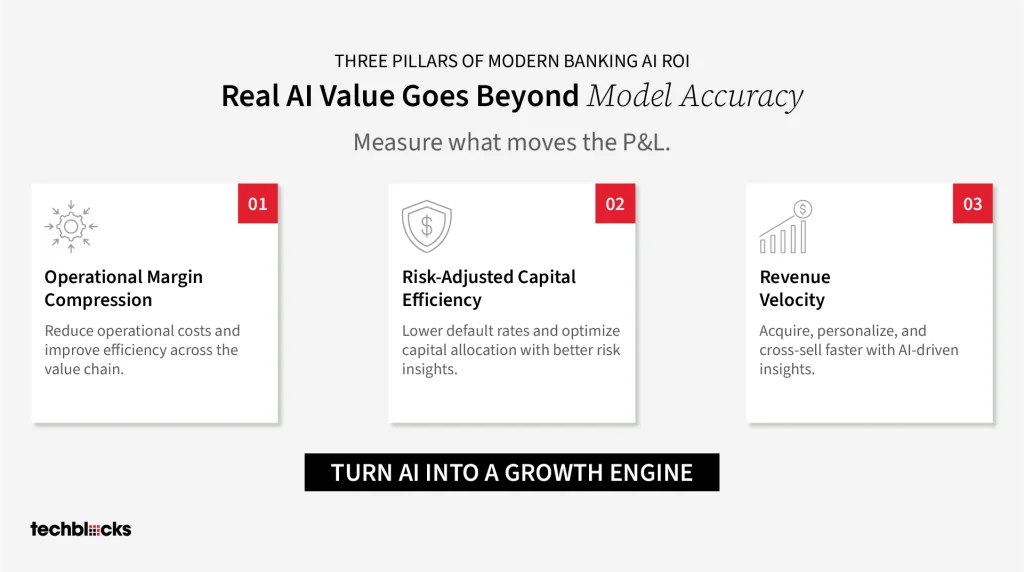
True artificial intelligence return on investment in financial services requires evaluating outcomes across three distinct balance sheet metrics. Moving past technical accuracy means measuring how automated systems directly impact the P&L through operational leverage, capital allocation, and revenue acceleration.
Pillar 1: Operational Margin Compression
Traditional efficiency initiatives in banking focus heavily on reducing headcount or compressing back-office labor costs. Modern AI ROI looks deeper, measuring how automated document processing, regulatory reporting, and credit underwriting reduce operational friction per transaction.
- By removing manual intervention from repetitive workflows, institutions scale transaction volume without a linear increase in operational expenditure.
- Processing cycle times drop from days to seconds, directly lowering the cost-to-income ratio across high-volume retail and commercial lines.
Pillar 2: Risk-Adjusted Capital Efficiency
Regulatory capital requirements dictate a bank’s lending capacity and overall profitability. Traditional credit models often rely on blunt historical parameters, forcing institutions to hold higher capital buffers against potential defaults.
- Real-time fraud detection and precise, AI-driven credit decisioning optimize provisioning buffers and lower risk-weighted assets (RWA).
- Optimizing capital allocation allows financial institutions to deploy more lending capital into the market without increasing systemic exposure or regulatory penalties.
Pillar 3: Revenue Velocity & Customer Value
Cost containment alone cannot drive sustainable banking growth. Advanced AI decision engines accelerate product time-to-market and elevate customer lifetime value (LTV) through hyper-personalized wealth management and automated cross-selling.
- Intelligent routing of financial products ensures offers reach clients at the exact moment of financial intent, expanding net interest margins (NIM).
- Accelerating product deployment cycles allows commercial banks to capture emerging market opportunities ahead of legacy competitors.
The TechBlocks Approach: Engineering AI for P&L Impact
Enterprises are bleeding capital because they treat artificial intelligence as a software experiment rather than an engineering transformation problem. Traditional vendors lock banks into endless headcount expansion, bloated retainers, and fragmented pilot queues where millions evaporate before a single algorithm touches production. That is precisely where enterprise ROI dies.
At TechBlocks, we reject the status quo. We refuse to sell hours, headcount, or endless proofs-of-concept that stall in technical purgatory. Instead, we rely on AiDE, our AI-native delivery engine, to rewrite the fundamental economics of software and AI delivery. By orchestrating the entire lifecycle, from automated requirement parsing and code generation to continuous compliance validation, we eliminate the manual friction that bloats traditional tech budgets.
Bridging Theory and Execution
Data science sandboxes traditionally operate in a vacuum, completely detached from core banking API gateways, security protocols, and legacy enterprise service buses. We eliminate this failure point through AiDE, embedding automated quality controls, continuous compliance guardrails, and deterministic testing pipelines directly across the Plan-Build-Test-Deploy lifecycle. This architecture translates complex business logic into production-ready code that interfaces cleanly with legacy mainframes without destabilizing live systems.
Outcome-Led Governance
Legacy IT partners profit from inefficiency by billing for developer headcounts and hours logged. We invert that model entirely. Because AiDE automates the heavy lifting of software engineering and regression testing, we decouple revenue from labor. We align delivery with hard, verifiable financial baselines rather than billable hours, governing end-to-end value streams through strict performance SLAs.
Modular Execution Units
Modernizing a financial institution does not require a catastrophic, rip-and-replace core system overhaul. Powered by AiDE, our cross-functional engineering pods deploy containerized microservices and secure event-driven architectures. This automated orchestration handles the complex API plumbing required to integrate advanced machine learning models into existing infrastructure, ensuring regulatory compliance and execution velocity move in absolute unison.
De-Risking Transformation Through Zero Lock-In Models (Revised)
Now that we know how precision engineering replaces legacy friction, this is where the key transformation comes into the picture.
Enterprise transformation usually stalls out of fear, and that anxiety is entirely rational. Traditional IT vendors exploit this hesitation, locking banks into rigid, multi-year contracts and massive upfront retainers long before any code makes it to production. They demand an organization-wide leap of faith, shifting all the financial risk onto the buyer while they profit from endless delays. That dynamic explains why digital roadmaps fail.
We break this trap by inverting the risk curve entirely, leveraging the velocity of AiDE to remove long-term lock-ins. Instead of holding your balance sheet hostage, our model proves its value before you ever commit to enterprise-wide scale.
The Pilot Pod Footprint
Transformation does not require an enterprise-wide gamble. We begin small and surgical, deploying a single, highly specialized cross-functional pod backed by AiDE to attack a high-friction engineering bottleneck in your current architecture.
The 6-to-8-Week Proof Window
Months of endless discovery are unnecessary. Within two months, our engineering unit establishes hard, verifiable baselines for release velocity, system stability, and code quality against your key performance metrics, operating at a fraction of traditional timelines.
Conditional Scaling
Broader structural expansion happens strictly after our metrics clear predefined benchmarks. Tying commercial agreements directly to demonstrated operational value rather than sales promises or headcount volume eliminates your financial exposure entirely, turning capability center migration into a predictable, milestone-driven evolution.
Conclusion
High model accuracy is merely a baseline technical requirement, not a business outcome. When financial institutions measure artificial intelligence through validation metrics while ignoring operational P&L realities, they remain trapped in pilot purgatory.
Solving this disconnect requires abandoning legacy IT engagement models that reward delay and headcount bloat. By pairing outcome-led governance with disciplined engineering, financial institutions eliminate technical debt and bridge the gap between sandbox theory and balance sheet growth.
When banks govern AI initiatives through rigorous, milestone-driven execution, artificial intelligence stops being an expensive IT line item. It becomes the primary engine for margin expansion, risk-adjusted capital efficiency, and sustainable banking growth.
Engineering Real Banking ROI
Ready to Measure AI by P&L Impact?
Stop funding endless pilots and start engineering predictable financial returns for your bank today.
CASE STUDY – RETAIL
Building a Successful Ecommerce Startup With A Real Estate
SmartCentres collaborated with TechBlocks to design Penguin Pickups’ business model, identifying the need for two distinct solutions.
Frequently Asked Questions
Initial ROI captures deployment velocity and immediate cost reduction, but sustainable value requires treating AI models as living infrastructure. True engineering accountability embeds automated monitoring for data drift, concept degradation, and continuous retraining pipelines directly into the production SLA, ensuring the model’s economic return doesn’t decay after the initial handoff.
The primary friction is cultural and structural silos between risk management, data science, and core engineering. When risk teams view AI through a purely compliance lens and engineering views it as a sandbox experiment, timelines stall. Successful execution requires a unified operating model where compliance guardrails are automated directly into the CI/CD pipeline from day one.
Core banking mainframes lack the native low-latency compute required for complex real-time inference. Modernization doesn’t require replacing the core; rather, it relies on deploying containerized microservices and event-driven streaming layers that sit adjacent to the mainframe, safely handling high-throughput scoring without destabilizing legacy ledger systems.
A successful proof window targets a high-friction, medium-complexity bottleneck, such as document processing for commercial lending underwriting or automated KYC verification. It must focus on a workflow where manual human intervention is currently driving up operational costs, allowing the pilot pod to clearly measure a drop in cycle time and resource expenditure.
Knowledge transfer often fails when documentation replaces active collaboration. Seamless transition happens when internal engineers are embedded directly inside the cross-functional execution pods from inception, utilizing shared automated toolchains and transparent code generation workflows so operational ownership transfers naturally upon deployment.