
Agentic AI is moving beyond code generation and into the broader software engineering lifecycle. Gartner reports that 77% of engineering leaders face challenges building AI capabilities into applications, while 71% face challenges using AI to augment software engineering workflows. At the same time, Gartner expects 90% of enterprise software engineers to use AI code assistants by 2028, up from less than 14% in early 2024.
The gap is no longer about whether enterprises will adopt AI. It is about whether their engineering operating models are ready for AI agents to become active participants in software delivery. As agents take on work across planning, development, testing, security, deployment, and operations, organizations need to rethink how engineering teams are structured, how systems are designed, how work is governed, and how delivery is measured.
In this article, we explore:
- How AI agents are changing software engineering teams and workflows
- Why architecture, platforms, and governance must evolve for AI-native engineering
- How engineering leaders can measure and manage AI-native software delivery
How Agentic AI Is Changing Software Engineering
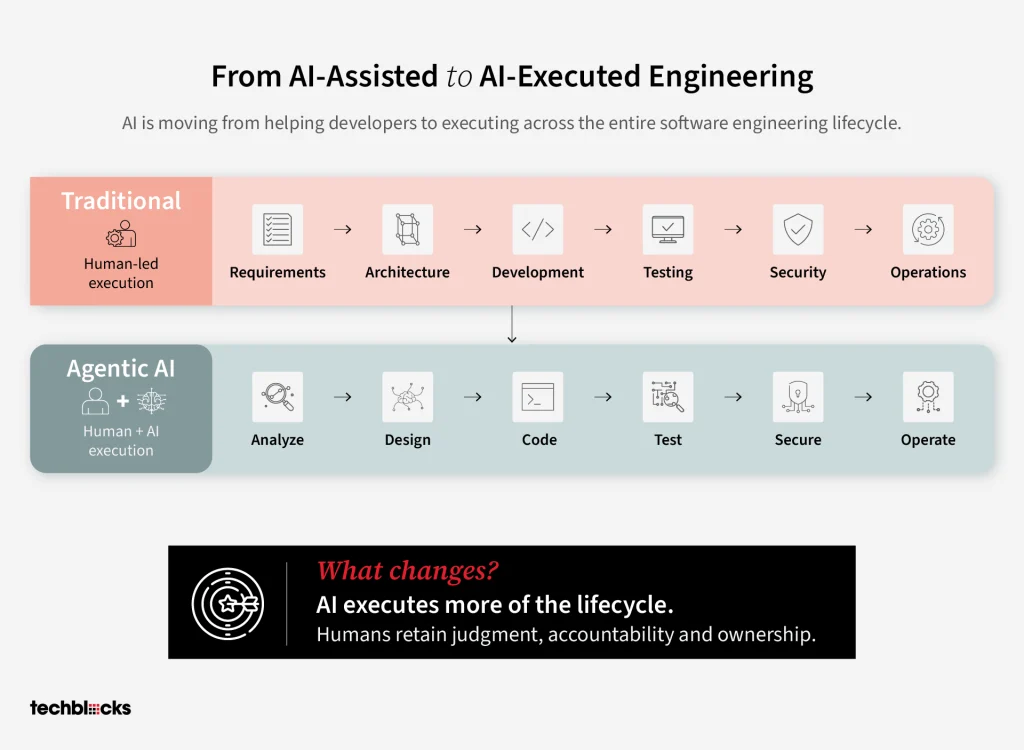
The first shift is from AI-assisted engineering to AI-executed engineering. Traditional AI coding tools primarily support an individual developer: generating code, suggesting completions, explaining errors, or creating tests. Agentic AI expands the scope. AI agents can interpret requirements, break work into tasks, modify code across multiple files, run tests, investigate failures, update documentation, and interact with engineering tools.
For enterprise engineering organizations, the change is less about adding another tool to the developer workstation and more about redesigning how engineering work moves through the SDLC.
From Developer Tools to Engineering Agents
An AI-native engineering model can assign different responsibilities to specialized agents across the development lifecycle:
| Engineering activity | Traditional model | Agentic AI model |
| Requirements | Product and engineering teams define stories | Agents analyze requirements, dependencies and acceptance criteria |
| Architecture | Architects and senior engineers design systems | Agents evaluate patterns, dependencies and architectural options under human direction |
| Development | Developers write and review code | Coding agents implement defined work within governed boundaries |
| Testing | QA engineers create and execute tests | Testing agents generate, execute and analyze tests continuously |
| Security | Security checks happen at defined gates | Security agents scan code, dependencies and configurations throughout delivery |
| Operations | Engineers investigate incidents manually | Agents analyze telemetry, identify anomalies and support remediation |
The human role does not disappear. Human engineers remain accountable for architecture, critical decisions, business context, risk and production ownership. AI agents extend execution capacity across the lifecycle while operating within defined controls.
Why the Software Engineering Workflow Must Change
Most enterprise engineering environments were designed around a human execution model: requirements move to developers, developers produce code, QA validates the output, security reviews the release, and operations manages production.
Agentic engineering introduces a different execution pattern. Multiple AI agents may work concurrently, generate large volumes of code and artifacts, interact with repositories and environments, and make recommendations or decisions at machine speed.
A software engineering operating model therefore needs to answer new questions:
- Which engineering decisions can an AI agent make independently?
- Which activities require human approval?
- How do agents access repositories, environments, data and development tools?
- How are AI-generated changes reviewed and tested?
- How do engineering teams coordinate work performed by multiple agents?
- How is code provenance tracked?
- How do security, compliance and quality controls operate across agent-driven workflows?
The operating model becomes the control system for human + AI engineering execution. This is where the conversation needs to move beyond AI adoption. Simply giving developers access to copilots or coding agents does not create an AI-native engineering organization. The organization needs the team structure, architecture, workflows, governance and measurement systems required to manage AI as an active participant in software delivery.
How AI Agents Are Changing Software Engineering Teams
Agentic AI changes more than how engineers write code. It changes how engineering teams divide work, collaborate, review decisions, and manage delivery.
A traditional software team is organized around human roles: product managers define requirements, architects make technical decisions, developers implement solutions, QA engineers validate them, and DevOps or SRE teams manage deployment and reliability. AI agents introduce a new execution layer across many of those responsibilities. The opportunity is not to replace existing roles with agents. It is to redesign the team around the combination of human judgment and machine execution.
From Role-Based Teams to Human-Agent Collaboration
AI agents can take on well-defined engineering activities while people retain ownership of decisions requiring context, judgment, and accountability.
For example:
- Product and engineering leaders define business outcomes, priorities, constraints, and acceptance criteria.
- Architects and senior engineers establish system boundaries, architecture patterns, technical standards, and critical design decisions.
- Coding agents implement defined changes, refactor code, and generate supporting artifacts.
- Testing agents create test cases, execute test suites, analyze failures, and identify coverage gaps.
- Security agents inspect code, dependencies, configurations, and vulnerabilities throughout development.
- Platform and operations agents assist with infrastructure, telemetry analysis, incident investigation, and operational workflows.
- Human engineers review critical outputs, resolve ambiguity, manage exceptions, and remain accountable for production systems.
The result is not simply a larger development team. It is a hybrid engineering system where work is distributed between people and specialized AI agents.
Engineering Teams Need an Orchestration Layer
Multiple agents operating independently can create as much complexity as they remove. An AI coding agent may modify code while a testing agent evaluates it, a security agent scans dependencies, and another agent analyzes an architectural dependency.
Without coordination, engineering leaders can lose visibility into:
- Who or what performed an engineering action
- Which agent produced a change
- What context informed the change
- Whether required quality and security checks were completed
- When human approval is required
- How work moves from one engineering stage to another
An AI-native engineering model therefore needs orchestration across agents, tools, repositories, environments, and human approvals.
The orchestration layer becomes especially important as organizations move from individual AI assistants toward multi-agent workflows. Work needs clear boundaries, defined handoffs, shared context, and enforceable controls.
The Engineering Manager’s Role Also Changes
Engineering management traditionally focuses on team capacity, delivery planning, technical execution, quality, and people development. With AI agents participating directly in delivery, managers also need visibility into how human and AI work interact.
Leadership needs to understand:
- Which engineering activities are being automated
- Where human review remains essential
- Which agents and tools are being used
- How AI-generated work moves through quality gates
- Where agent-driven workflows introduce security or operational risk
- Whether AI adoption is improving delivery performance rather than simply increasing engineering activity
This makes the operating model critical. AI agents can accelerate individual activities, but the engineering organization determines how safely and effectively those activities combine into production software.
The next layer is the technology foundation itself: AI agents work best when software architecture, interfaces, documentation, data, and engineering platforms provide structured context and predictable boundaries.
Why Software Architecture Matters for AI-Native Engineering
AI agents need clear boundaries, reliable context, and predictable interfaces to work effectively. Legacy architectures built around tightly coupled services, undocumented dependencies, and inconsistent APIs make agent-driven engineering harder to scale and govern.
For AI-native engineering, architecture should prioritize:
- Modular systems and clear service boundaries so agents can work within defined scopes
- Versioned APIs and contracts for predictable agent-to-system interactions
- Structured, accessible engineering context including documentation, dependencies, business rules, and data flows
- Built-in observability so engineers can track system behavior, agent actions, and quality
The goal is not to make every application “AI-native.” It is to create an engineering environment where AI agents can operate safely, consistently, and within defined architectural boundaries.
How to Govern AI Agents in Software Development
As AI agents move from recommendations to execution, governance becomes part of engineering architecture. Enterprises need controls over what agents can access, change, approve, and deploy.
A practical governance model should define:
- Access and permissions — which repositories, environments, data, and tools an agent can access
- Human approval — which decisions or production changes require engineering review
- Code provenance — what AI generated, modified, or influenced
- Security and quality gates — automated testing, vulnerability scanning, policy checks, and deployment controls
- Auditability — a traceable record of agent actions, decisions, and outputs
Governance should not become a manual approval layer around every AI action. Low-risk work can be automated; high-risk decisions should remain subject to stronger human oversight. The operating model needs governance built into the workflow rather than added after AI adoption.
How Engineering Leaders Should Measure AI-Native Software Development
Once AI agents become part of the engineering workflow, measurement needs to account for more than human activity. Traditional engineering metrics can still show release frequency, lead time, defects, and reliability, but AI introduces additional variables such as agent execution, AI-generated work, token consumption, and human intervention.
Engineering leaders therefore need a broader view of delivery performance:
| Measure | What it should reveal |
| AI execution | What agents are doing across the SDLC |
| Engineering performance | How delivery speed and quality are changing |
| AI and engineering cost | What delivery actually costs |
| Business outcomes | What the resulting software delivers for the business |
The emphasis should remain on outcomes, not AI activity. More agent executions or more AI-generated code do not automatically indicate better engineering performance. The operating model needs to connect AI contribution with engineering quality, delivery economics, and business results.
That visibility becomes the foundation for the final shift: redesigning the software engineering operating model around human and AI execution.
Agentic AI Is Reshaping Enterprise Software Engineering
Agentic AI is moving software engineering beyond a model built around human execution alone. The organizations prepared for the shift will be the ones willing to rethink how engineering work is organized, governed, supported, and measured.
The goal is not to automate engineering indiscriminately. It is to create an environment where AI can handle the right execution work while engineers retain ownership of architecture, judgment, quality, security, and business-critical decisions.
With the right operating model, enterprises can expect:
- Faster software delivery through AI-assisted execution across the development lifecycle
- Greater engineering scalability without relying solely on additional headcount
- Stronger quality and reliability through continuous testing, security, and observability
- Better engineering visibility into delivery performance, cost, quality, and outcomes
TechBlocks helps enterprises make this shift by bringing together AI-native engineering, modern architecture, platform engineering, DevSecOps, and engineering expertise to build software delivery models ready for the agentic era.
Ready to Rethink Your Software Engineering Model?
Build an AI-ready engineering organization designed for scalable, governed, measurable software delivery.
FAQs on Software Engineering Operating Model
Not necessarily. Enterprises can begin with defined agent responsibilities and gradually evolve team structures, workflows, and ownership as agent adoption expands.
Start with repeatable, well-bounded activities such as test generation, code analysis, documentation, refactoring, and security checks. Keep architecture, high-risk changes, and business-critical decisions under human ownership.
Multiple agents require orchestration, shared context, defined handoffs, access controls, and quality gates. Without coordination, parallel agent execution can introduce conflicting changes and reduce engineering visibility.
Yes, but the level of automation depends on architectural complexity. Clear APIs, modular services, documented dependencies, and accessible system context make existing environments considerably easier for agents to work with.
Measure AI activity alongside delivery speed, quality, reliability, engineering cost, and business outcomes. The goal is to establish whether AI-enabled engineering is producing better delivery performance, not simply more AI-generated work.