

How much does it actually cost an enterprise to produce a piece of software with AI?
The answer is no longer sitting neatly inside a developer-hour rate—or an AI invoice. Agentic workflows can consume tokens across repository analysis, reasoning, code generation, testing, debugging, and tool calls. Comparable agentic tasks can also produce dramatically different levels of token consumption depending on model choice, context, workflow design, and agent autonomy.
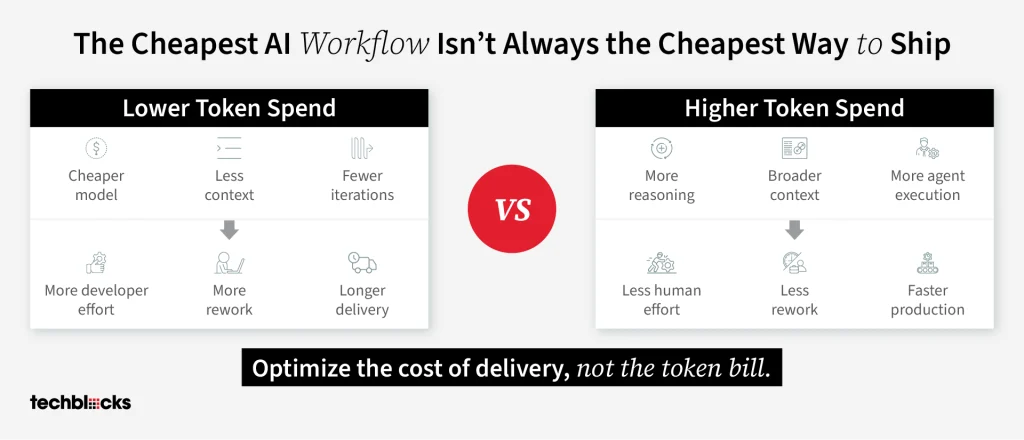
The bigger issue is what the token bill leaves out. A workflow using fewer tokens may require more developer intervention, additional remediation, or longer time to production. A workflow consuming more tokens may deliver the same capability faster with less human effort. The cheapest AI workflow is not necessarily the cheapest way to ship software.
For CIOs, CTOs, and engineering leaders, tokenomics is therefore becoming part of a larger question: What does it actually cost to deliver software, and how much of the cost is creating useful engineering output?
In this article, we explore:
- Where token consumption enters the software delivery lifecycle
- Why token efficiency can diverge from total delivery efficiency
- How enterprises can measure and govern AI-driven delivery economics
How Tokenomics Is Changing Software Delivery Costs
AI consumption is becoming part of the cost structure of software delivery. A single feature can trigger model calls across requirements analysis, repository exploration, architecture, code generation, testing, debugging, and remediation. An agent working across several services may retrieve repository context, trace dependencies, generate code, run tests, investigate failures, and revise its implementation before anything reaches production.
Every step can consume tokens. The cost therefore follows the work being performed, not simply the AI application or model an enterprise has purchased.
Where token consumption enters the SDLC
| Software delivery activity | What drives token consumption |
| Requirements analysis | Context retrieval, clarification, reasoning |
| Repository analysis | File discovery, dependency mapping, codebase context |
| Code generation | Context, generation, tool calls, iterations |
| Testing | Test generation, failure analysis, remediation |
| Debugging | Logs, traces, source analysis, repeated reasoning |
| Code review | Diff analysis, security analysis, suggested changes |
| Operations | Telemetry analysis, incident investigation, remediation |
The volume can vary significantly even when the business capability looks identical on a project plan. A tightly scoped change may require limited context and a few model interactions. A cross-service change can trigger extensive repository exploration, repeated testing, and multiple remediation loops.
Model selection also matters. So do context volume, reasoning depth, retrieval strategy, tool usage, retries, and the degree of agent autonomy. For engineering leaders, token consumption therefore becomes more than an infrastructure metric. It becomes a signal of how the delivery workflow is operating.
The question is no longer simply:
How much are we spending on AI?
It is:
How much AI consumption is required to produce a piece of software, and what else is happening alongside it?
The second question becomes critical because token consumption and total delivery cost do not always move in the same direction.
Token Efficiency Does Not Guarantee Lower Delivery Cost
Once token consumption becomes visible, the natural response is to reduce it. Teams can select lower-priced models, restrict context, limit agent iterations, route simpler tasks to smaller models, or place tighter controls around tool calls. Each choice can reduce inference spend.
None proves the software became cheaper to deliver. Consider two workflows producing the same feature:
| Workflow A: Higher AI Spend | Workflow B: Lower AI Spend | |
| Model strategy | Higher-capability model for implementation and reasoning | Lower-cost model for most tasks |
| Context | Broad repository context | Restricted context |
| Agent execution | More autonomous iterations | Limited iterations |
| Token consumption | Higher | Lower |
| Developer intervention | Lower | Higher |
| Testing / remediation | Fewer additional cycles | More correction cycles |
| Time to production | Shorter | Longer |
| Total delivery cost | Potentially lower | Potentially higher |
Workflow B looks better if leadership measures only the AI bill. Workflow A may produce the better economics once developer effort, remediation, and time to production enter the calculation.
The same trade-off appears across AI delivery decisions.
- Model choice: A smaller model may handle routine code efficiently, while a complex architectural change may require deeper reasoning. Using the cheapest model everywhere can lower token spend while increasing review and correction effort.
- Context strategy: Reducing context can lower input-token consumption, but insufficient context can cause missed dependencies, repeated retrieval, or rework.
- Agent autonomy: More autonomous execution can increase token consumption through additional reasoning and tool calls. It can also replace developer hours spent investigating, implementing, testing, or debugging.
The lesson is simple: token efficiency and delivery efficiency are related, but they are not the same metric.
Optimize the cost of completing the work
Unproductive AI consumption should absolutely be eliminated—redundant context, unnecessary retrieval, failed calls, inefficient agent loops, and poor model selection all deserve scrutiny. But the optimization target needs to be broader.
Software delivery economics = AI consumption + human effort + rework + infrastructure + quality costs + cost of delay
A workflow using more tokens can be economically superior if the additional computation reduces human intervention, rework, or time to production by enough to lower the overall cost.
For engineering leadership, the question therefore shifts from:
“How do we use fewer tokens?” to: “What does it cost to get this piece of software into production at the required speed and quality?”
Answering the question requires connecting AI consumption to the engineering work and delivery output it supports.
Enterprise Tokenomics Needs an Engineering Cost Model
An AI invoice can tell an enterprise how much it spent on inference. It cannot tell leadership what the spend produced. Suppose an engineering organization spends $50,000 on AI inference in a quarter. The number alone says very little. The spend could represent hundreds of production features, thousands of automated tests, extensive experimentation, or repeated agent activity around work eventually abandoned.
The same AI bill can represent very different delivery economics. The missing link is attribution.
From token spend to cost per delivered work
An enterprise tokenomics model should connect five layers: AI consumption → Engineering work → Delivery output → Quality → Business result
Consider a checkout enhancement:
- 18M input tokens across repository analysis and retrieval
- 4M output tokens for implementation and remediation
- 14 developer hours for review and modification
- 6 hours of automated and manual testing
- 2 remediation cycles
- 1 production release
- 0 critical defects after release
Now leadership has a much more useful picture.
Instead of asking:
“How much did we spend on AI?” the organization can ask: “What did it cost to deliver the checkout capability, and how much of the cost came from AI versus human engineering?”
Measure the work, not just the model
| Measurement layer | What to measure | Why it matters |
| AI consumption | Tokens, model mix, agent calls, tool calls | Shows where AI spend originates |
| Engineering effort | Developer time, review, intervention | Shows how AI changes human capacity |
| Delivery | Features, stories, releases, cycle time | Connects consumption to completed work |
| Quality | Defects, rework, reversions, change failure | Prevents lower cost from being mistaken for better delivery |
| Economics | Cost per delivered unit, release, capability | Creates a comparable delivery measure |
| Business value | Revenue impact, conversion, risk reduction, operational savings | Connects engineering economics to enterprise results |
The measurement also needs to follow the work beyond code generation. AI-generated code sitting in a branch has little economic value. Code requiring substantial developer correction carries a different cost from code reaching production with minimal intervention. Code later reverted or rewritten carries another cost altogether.
Production is where the economics become meaningful. Connecting AI consumption, human effort, delivery output, and quality gives engineering leaders a cost view tied to completed software rather than AI activity alone.
Tokenomics Becomes an Operating Model Problem
A cost view is useful only if leadership can act on it. Model selection, agent autonomy, context strategy, and human intervention can all influence delivery speed, quality, engineering capacity, and cost. Managing AI economics therefore becomes part of how software delivery itself is designed and governed.
A routine code change may need limited reasoning and little oversight. A complex modernization effort may justify broader repository context, deeper reasoning, multiple agent iterations, and stronger human review.
There is no universal token target. The right approach depends on the software being produced, the delivery constraints, and the economics of the workflow.
What Engineering Leaders Need to See
A useful tokenomics model should help leadership answer questions such as:
- Which models produce the lowest total delivery cost for specific engineering tasks?
- How much developer effort remains after AI generates the initial output?
- Which agent workflows create excessive retries or remediation?
- How much AI-generated code actually reaches production?
- What does each completed feature, release, or modernization increment cost?
Without those relationships, tokenomics remains a finance exercise. With them, AI consumption becomes one variable within the engineering operating model.
Turning AI Economics Into Delivery Decisions
The operating model needs a connected view of AI consumption, engineering effort, delivery, and cost.
TechBlocks AiDE, the AI-Native Delivery Engine, provides this view through AiDE Insights and the Delivery Ledger. AiDE Insights establishes a baseline across AI contribution, human effort, quality, cost, and delivery outcomes. The Delivery Ledger connects individual pieces of work with AI-assisted code, developer modifications, model usage, code survival, shipped work, rework, reversions, tokens, and cost per ticket.
The resulting view helps engineering leaders evaluate:
- Is additional AI spend creating additional delivery capacity?
- Which workflows reduce engineering effort without increasing rework?
- Where does human intervention remain significant?
- Which AI-assisted work actually survives into production?
- What does each delivered piece of engineering work cost?
The value is not in imposing a blanket token limit or choosing the cheapest model for every task. It is in making AI consumption accountable to delivery performance.
With the economics visible, organizations can make better decisions about model selection, agent autonomy, human oversight, and engineering capacity. Delivery Units and Engineering Outcomes can then provide the commercial structure for managing measurable work, quality, cost, and performance. Tokenomics is not simply about controlling AI spend. It is about understanding the economics of the delivery system producing software with AI.
Optimize the Cost of Delivery, Not the Token Bill
Model prices will change. Agent capabilities will expand. Engineering workflows will continue to evolve. The enterprise challenge is not predicting the next token price. It is understanding what the AI-enabled delivery system produces for the resources it consumes.
Token consumption becomes meaningful when connected to human effort, rework, quality, delivery speed, and completed software. The goal is not simply to use fewer tokens. The goal is to produce better software economics.
AiDE: AI-Native Delivery Engine
Ready to Turn AI Economics Into Delivery Advantage?
See how measurable AI consumption, engineering effort, and delivery performance can improve enterprise software economics.
Frequently Asked Questions
Compare AI consumption with production-ready output, developer intervention, cycle time, quality, and rework. Higher token spend is economically positive only when additional computation creates measurable delivery capacity or lowers the total cost of completing the work.
Token budgets can provide financial discipline, but token consumption should not become the primary productivity constraint. Engineering leaders should evaluate AI spend alongside delivered work, human effort, quality, and overall delivery cost.
Use a common delivery baseline rather than comparing raw token consumption or AI adoption. Measures such as cost per delivered unit, cycle time, developer intervention, rework, defect rates, and production survival provide a stronger basis for comparison.
Yes. A meaningful ROI assessment compares incremental AI costs with changes in engineering capacity, delivery speed, quality, rework, and business output. Establishing a baseline before scaling an agentic workflow makes the resulting impact easier to evaluate.
Establish attribution and delivery baselines first. Leadership should know what work agents perform, how much human intervention remains, what the work costs, and how successfully it reaches production before expanding agentic workflows across the SDLC.