Digital transformation runs on data. And nowhere is the data deluge more visible than in the world of the Internet of Things (IoT). The global IoT market, projected to reach over USD 4 trillion by 2032, is a clear indicator of the scale of data enterprises will need to manage.
With billions of sensors and devices constantly generating massive streams of data, leaders often seek ways to effectively collect this data from its source and transform it into a state where it can drive value. The decision boils down to two core patterns: ETL vs. ELT.
This article will break down the fundamental difference between ETL and ELT in the context of high-volume IoT workloads on GCP, empowering you to make the right architectural choice for your business.
What Is ETL and ELT in the Context of IoT?
To understand which pattern is superior for your needs, you must first have a clear grasp of their core definitions. The simple difference between ETL and ELT is the order in which the last two steps occur.

Difference Between ETL and ELT
| Criteria | ETL | ELT |
| Transformation timing | Before load | After load (in-warehouse) |
| Storage/processing | On external servers/workers | Primarily within GCP (BigQuery, Dataflow) |
| Data structure | Structured, schema-locked | Structured, semi-structured, unstructured |
| Governance | Rigid, regulatory-first | Flexible, central policy possible |
| Speed/scalability | Slower for IoT-scale; limited parallelism | Blazing fast; leverages cloud parallelism |
| Cost structure | Extra infra for staging/processing | Pay for what you analyze, not all infra |
| Data lake compatibility | Limited | Strong (native in GCP) |
When to Use ETL vs ELT for Enterprises on Google Cloud:
Choosing the right strategy is about matching the pattern to your specific business needs and data maturity.
Ideal Scenarios for ETL
The extract-transform-load approach still has a place, particularly for legacy systems or specific compliance needs.
- Strict data governance, needing regulatory compliance, or advanced privacy/PII stripping before data touches the cloud.
- Smaller, structured operational datasets where pre-cloud logic is business-critical.
Ideal Scenarios for ELT
ELT is the preferred choice for most modern, cloud-native IoT workloads.
- Large-scale, real-time sensor or device analytics where flexibility and speed outpace regulatory rigidity.
- Mixed data types and evolving schemas, such as in smart factories, fleet management, or global retail IoT reporting.
Impact on Enterprise Decision-Making
For leaders, the ETL vs ELT difference translates into agility. An ELT approach fosters a culture of rapid experimentation. Analysts can simply query the raw data in BigQuery, speeding up the time-to-insight and allowing the business to pivot faster.
Choosing the Right Data Integration Strategy for IoT Workloads
Making a strategic choice requires weighing several key factors unique to your organization.
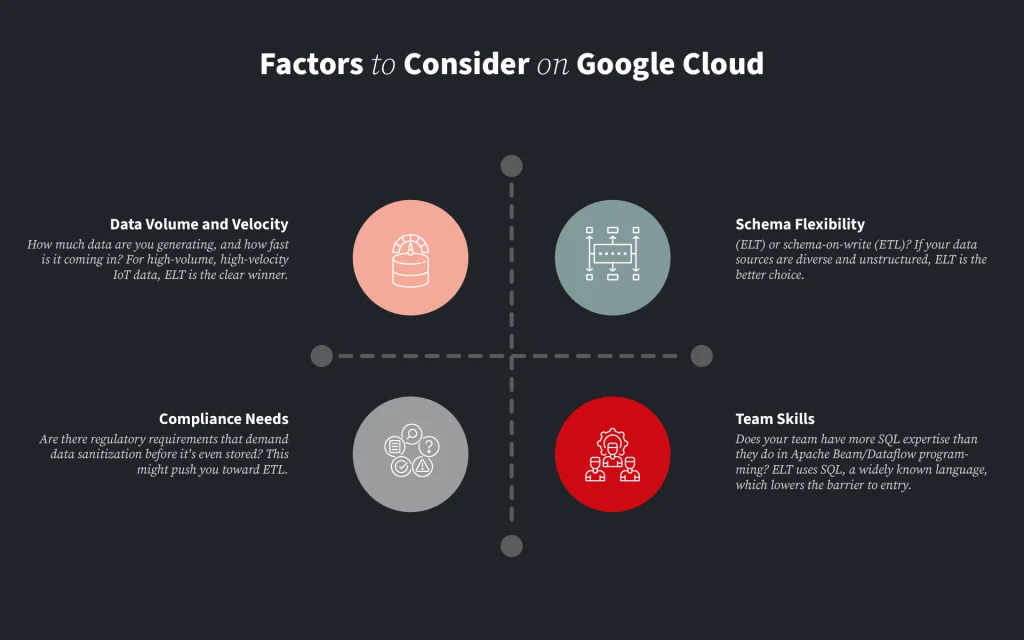
Balancing Cost and Performance
- ETL can frontload costs in infrastructure and operations.
- ELT gives cost granularity, where you just pay for transformation and query jobs (BigQuery, Dataflow), storing only the essentials long-term.
Future-Proofing with GCP
Emerging ML/AI demands, new analytics, and evolving IoT schemas mean adaptability is paramount. GCP is rapidly innovating, as ELT is becoming easier to retool, reprocess, and scale as enterprise needs evolve.
Conclusion
The debate of ETL vs. ELT for IoT workloads on Google Cloud is ultimately settled by the needs of the modern enterprise. This strategic architectural pattern is what enables firms to not just keep up with the data explosion but to leverage it as a competitive advantage.
Choosing the right data integration partner is as important as choosing the right strategy. With deep expertise in Google Cloud and thought leadership in data architecture, TechBlocks helps you navigate these critical decisions with cloud consulting services and build a data ecosystem that is ready for the future.
Get in touch with TechBlocks to build a data strategy that delivers measurable results.
FAQs on ETL vs ELT
High data volumes make ETL cumbersome and expensive; ELT excels in high-throughput, high-variety IoT scenarios enabled by GCP’s scalable architecture, ensuring that even petabyte-scale datasets remain actionable.
Yes, a staged migration is a practical and widely used approach. Enterprises can begin by running ETL and ELT pipelines in parallel for a specific data source.
Machine learning thrives on large, raw, diverse datasets, making ELT on GCP a strong fit. Pre-transforming with ETL may remove valuable signals, while ELT leverages BigQuery ML and Vertex AI natively.
Yes, hybrid pipelines deliver both secure preprocessing (ETL) and cloud-scale analytics agility (ELT), best leveraging GCP’s full suite.