

Every fiscal year, engineering leadership faces the same high-stakes ritual. The CTO steps into the boardroom to defend a multi-million-dollar R&D budget, only to be met with a predictable executive question from the CFO: “Where is the actual return on this capital?”
For years, the standard defense has relied on abstract internal metrics. Engineering teams point to rising velocity, increased deployment frequency, shrinking pull request turnaround times, or higher story-point output. But from the perspective of our engineering leaders at TechBlocks working alongside enterprise executives, this explanation rarely satisfies finance. To a CFO looking at bottom-line growth, telling them that code is shipping faster without knowing how it moves the commercial needle sounds less like progress and more like an expensive black hole.
The root of the tension is a fundamental language barrier. Traditional software engineering has long treated itself as a cost center measured by activity, while finance evaluates investments based on revenue, margin expansion, and tangible asset value.
As digital products become the core engine of enterprise revenue, this disconnect is no longer sustainable. Engineering leaders can no longer afford to treat software delivery as a closed loop isolated from financial outcomes. The critical challenge is building a bridge between the lines of code written by the team and the enterprise value realized by the business, transforming engineering from an opaque operational expense into a predictable, measurable growth driver.
Traditional Activity-Based Metrics Vs. Outcome-Based VSM Metrics
| Dimension | Traditional Activity-Based Approach | Outcome-Based VSM Approach |
| Primary Focus | Internal team velocity and code volume | End-to-end flow of commercial value |
| Key Metrics | Story points, lines of code, deployment frequency | Customer acquisition impact, retention, and margin expansion |
| Finance Alignment | Viewed as an opaque, escalating cost center | Measured as a predictable, transparent capital investment |
| Decision Making | Based on intuition and subjective engineering output | Based on unified telemetry, FinOps, and real-time data |
Why Traditional Metrics Fail to Measure R&D ROI
To understand why finance and engineering leadership constantly talk past each other, we have to look at the metrics engineering teams have historically used to justify their existence.
For decades, the industry relied on internal proxies of productivity: lines of code written, pull requests closed, story points burned, and deployment frequency. While these metrics are useful for managing day-to-day agile workflows and team velocity, they suffer from a fatal flaw when presented to the C-suite. They measure activity, not value.
In practice, this mismatch plays out constantly across enterprise environments. A team can double its deployment frequency and shatter internal velocity records, yet the business can simultaneously experience flat revenue, high customer churn, and stagnant margins. Shipping features faster is a hollow victory if those features fail to drive user adoption, optimize internal operational efficiency, or protect market share.
The core limitation of traditional engineering metrics is that they exist in a vacuum, completely disconnected from financial ledgers. They tell leadership how hard the engine is working, but they provide zero visibility into whether the vehicle is actually heading toward a profitable destination. Until engineering leaders stop treating activity metrics as a substitute for business outcomes, R&D budgets will continue to be viewed by the boardroom as an act of faith rather than a measurable capital investment.
Tying Code to Revenue: The Shift Toward Value Stream Management (VSM)
Bridging the gap between engineering output and financial returns requires moving away from isolated team-level metrics and embracing a holistic framework. Leading enterprises are solving this disconnect by adopting Value Stream Management (VSM).
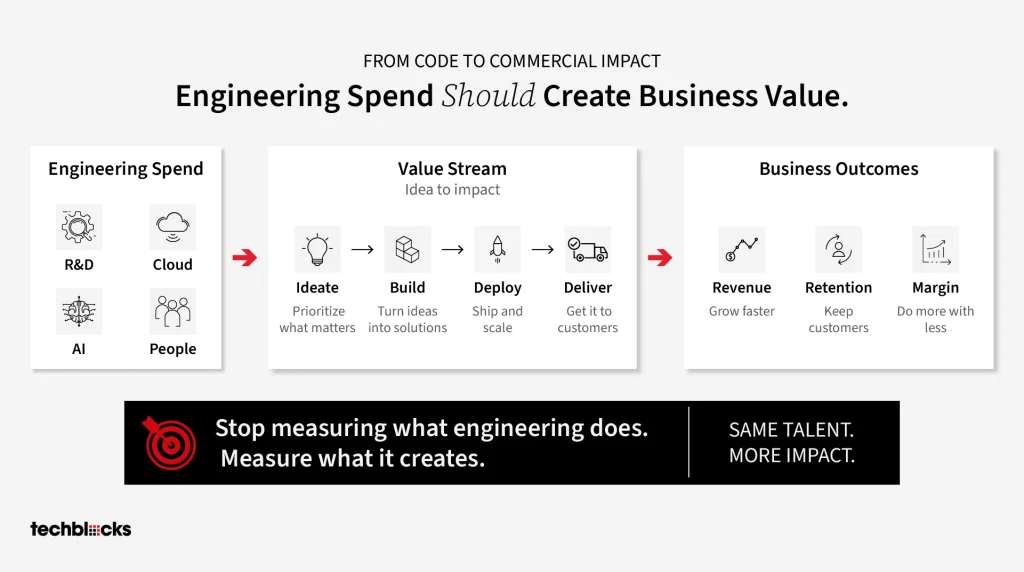
Value Stream Management shifts the engineering paradigm from tracking how much work gets done to measuring how efficiently that work flows through the pipeline to create tangible business value. Instead of viewing software delivery as a series of disconnected coding sprints, VSM maps the entire journey, from initial product ideation and resource allocation down to customer deployment and revenue realization.
When engineering and finance teams look at a unified value stream, the conversation changes entirely:
- Connecting Effort to Outcomes: Leadership can trace a specific feature or modernization project directly to the key performance indicators (KPIs) it influences, whether that is lowering customer acquisition costs, improving retention, or accelerating time-to-market.
- Eliminating Bottlenecks in Real-Time: VSM surfaces operational friction points, such as bloated compliance gates or legacy testing bottlenecks, allowing teams to optimize workflow velocity where it actually matters for the bottom line.
- Transparent Capital Allocation: Finance teams gain clear visibility into which product lines or digital initiatives are generating high commercial returns, turning R&D budgeting from a guessing game into a data-driven investment strategy.
By anchoring software delivery to clear value streams, engineering leaders stop defending abstract story points and start speaking the universal language of the boardroom: measurable growth.
Overcoming the Data Silos Between Engineering and Finance
Even with a framework like Value Stream Management in place, bridging the gap between software delivery and financial returns remains a formidable challenge because of how enterprises are structured. For years, engineering teams and finance departments have operated in completely separate silos, speaking entirely different languages.
Finance tracks ledgers, capitalized R&D, amortization schedules, and operating expenses. Engineering tracks sprints, technical debt, pull requests, and cloud infrastructure consumption. Because these two domains rarely share a unified data layer, the conversation between the CTO and the CFO inevitably devolves into friction. Finance sees an escalating cost center that needs trimming, while engineering sees an underfunded innovation engine choked by arbitrary budget cuts.
Breaking down these data silos requires more than just scheduling cross-functional meetings. It requires establishing a shared operational vocabulary and unified tooling:
- Integrating Cost with Code: Organizations must connect cloud infrastructure and AI token expenses directly to specific product teams and feature releases, rather than treating them as unallocated corporate overhead.
- Reclassifying R&D Investments: Working alongside finance to map software initiatives to clear capital or operational buckets ensures that modernization and product development efforts are accurately evaluated as revenue-generating assets.
- Translating Technical Debt into Business Risk: When communicating with the boardroom, engineering leaders must frame technical debt not as an abstract code cleanup task, but as a direct threat to delivery speed, security posture, and future margin expansion.
When data flows seamlessly between engineering operations and financial ledgers, the cultural barrier dissolves, turning the relationship between the CTO and CFO from an adversarial negotiation into a strategic partnership.
Delivering Measurable Value with TechBlocks
Closing the gap between engineering spend and commercial outcomes cannot be solved by another internal committee or abstract reporting dashboard. It requires a fundamental shift in how software execution is engineered from the ground up. When internal teams are locked in perpetual maintenance cycles and walled off from financial ledgers, bridging that chasm demands specialized execution capacity.
At TechBlocks, we partner directly with enterprise CTOs and engineering leaders to dismantle the cost-center mindset and transform R&D into a predictable, revenue-generating engine through deep architectural and operational integration:
We begin by instrumenting your entire software delivery pipeline through engineering-first Value Stream Mapping. Rather than just auditing codebases, we re-architect legacy workflows so every sprint directly correlates with downstream revenue and operational margins. Simultaneously, we bridge the data chasm between engineering telemetry and corporate finance by fusing cloud expenditure, AI token consumption, and feature delivery metrics into a single, transparent financial ledger.
To turn these frameworks into execution velocity, we bypass internal hiring bottlenecks and turf wars by embedding elite, cross-functional engineering pods directly inside your organization. These teams accelerate time-to-market while guaranteeing high-yield commercial delivery across your entire digital portfolio.
Stop defending software spend as an act of faith. Partner with TechBlocks to embed true accountability and commercial visibility into your engineering lifecycle.
Engineering Value, Driving Growth
Turn R&D Into a Predictable Revenue Engine
Schedule an architectural briefing with our leadership team to map your engineering spend directly to measurable business outcomes.
Frequently Asked Questions
While Scrum and Agile manage team-level task execution and sprint cadence, they are fundamentally insular, measuring internal output rather than business results. Value Stream Management operates at a macro architecture level, tracking the continuous flow of an idea from ideation across the entire delivery pipeline down to real-world revenue generation and margin impact.
Successful linkage requires implementing FinOps practices that combine cloud cost allocation tagging with modular domain-driven architectures. By mapping microservices and AI workloads directly to product feature teams rather than unallocated enterprise pools, finance can accurately categorize expenses as revenue-generating capital investments.
Instead of framing technical debt as code refactoring or developer preference, leaders must quantify it in financial risk metrics. This involves illustrating how legacy bottlenecks directly delay time-to-market for revenue-generating capabilities, inflate cloud compute costs through inefficient resource usage, and increase security exposure.
Key indicators include a lack of cross-functional visibility into product profitability, board-level discussions dominated by velocity or story points rather than customer impact, and recurring friction where engineering budget requests are treated as arbitrary expenses rather than ROI-driven capital investments.
Embedded pods bypass internal hiring constraints and organizational silos by introducing specialized engineering and product talent that are aligned with outcome-based delivery models from day one. They work alongside legacy teams to modernize workflows, implement VSM toolchains, and prove immediate commercial impact.