
When a Fortune 500 engineering organization tries to scale generative AI using legacy software governance playbooks, the system breaks in predictable ways.
Central IT steps in with a mandate to secure the enterprise, locking down model endpoints, routing every vector database through rigid security review boards, and demanding months-long compliance sign-offs before a single prompt goes to production. The result is immediate gridlock. Product squads, supply chain pods, and marketing engineers facing intense pressure to ship localized intelligence, bypass internal infrastructure entirely. They spin up rogue LLM API keys on corporate credit cards, wire up unvetted external vector stores, and build an unmanaged shadow architecture that flies completely below the Chief Information Security Officer’s radar.
Organizations are trapped in a false binary. Complete centralization turns enterprise IT into a high-cost innovation bottleneck, starving business units of the speed they need to compete. Complete decentralization turns the cloud estate into a fragmented, non-compliant disaster zone of data leakage, unmasked PII, and runaway token consumption.
As artificial intelligence moves from isolated experimental wrappers to foundational enterprise infrastructure, the old operating models are entirely obsolete. Technology leaders can no longer choose between absolute control and unbridled chaos.
The structural challenge is drawing the boundary: what elements of the AI stack demand absolute, non-negotiable centralization at the core, and what must be fiercely decentralized to the frontlines to keep engineering velocity alive?
Why Traditional IT Operating Models Fail at AI Scale
To understand why legacy governance structures break down under artificial intelligence, we have to look at how software development used to work versus how AI actually operates.
For the last two decades, enterprise IT relied on a predictable, top-down command-and-control model. Applications were monolithic or cleanly tiered services built on deterministic code. Central IT owned the infrastructure, managed the release cycles, and enforced strict gatekeeping to ensure system stability, security, and compliance. Changes were slow, deliberate, and thoroughly tested before hitting production.
Artificial intelligence shatters this entire paradigm because it is fundamentally non-deterministic and consumption-driven.
The Mismatch of Deterministic Governance
Traditional IT governance is designed to manage fixed assets, codebases, database schemas, and static server allocations. AI, by contrast, relies on a fluid stack of probabilistic model weights, multi-model gateways, vector embeddings, and dynamic context windows.
When a central IT department tries to govern AI using the same multi-month ticket queues and rigid architecture review boards used for traditional enterprise software, they create an immediate operational mismatch. An engineering pod iterating on a localized Retrieval-Augmented Generation (RAG) pipeline cannot wait six weeks for a security committee to approve a prompt template adjustment or a minor model swap. Market feedback loops demand days, not quarters.
The Cost of Over-Centralization vs. Unchecked Chaos
When organizations force AI through a legacy centralized bottleneck, the enterprise pays a heavy tax in lost momentum. Product teams grow frustrated, talent seeks out more agile environments, and the business misses market windows while competitors move ahead.
Yet, the alternative, letting business units completely self-govern is equally catastrophic. Without centralized orchestration, organizations suffer from severe structural drift:
- Duplicate Engineering Effort: Multiple business units independently build redundant data ingestion pipelines, custom vector stores, and messy LLM wrappers without sharing institutional learnings.
- Invisible Security Blind Spots: Uncoordinated teams inadvertently expose proprietary intellectual property to external APIs or fail to sanitize Personally Identifiable Information (PII) before passing it to foundation models.
- Runaway Token Economics: Unlike fixed SaaS seat licenses, generative AI consumption scales dynamically. A single unoptimized batch script or recursive prompt loop can quietly rack up thousands of dollars in cloud GPU and API costs.
Legacy operating models fail because they force a false choice between total stagnation and total exposure. Engineering leaders cannot manage AI by locking it down or letting it run wild; they must fundamentally redesign the perimeter.
What Enterprises Must Centralize: Foundation Architecture, FinOps, and Security Guardrails
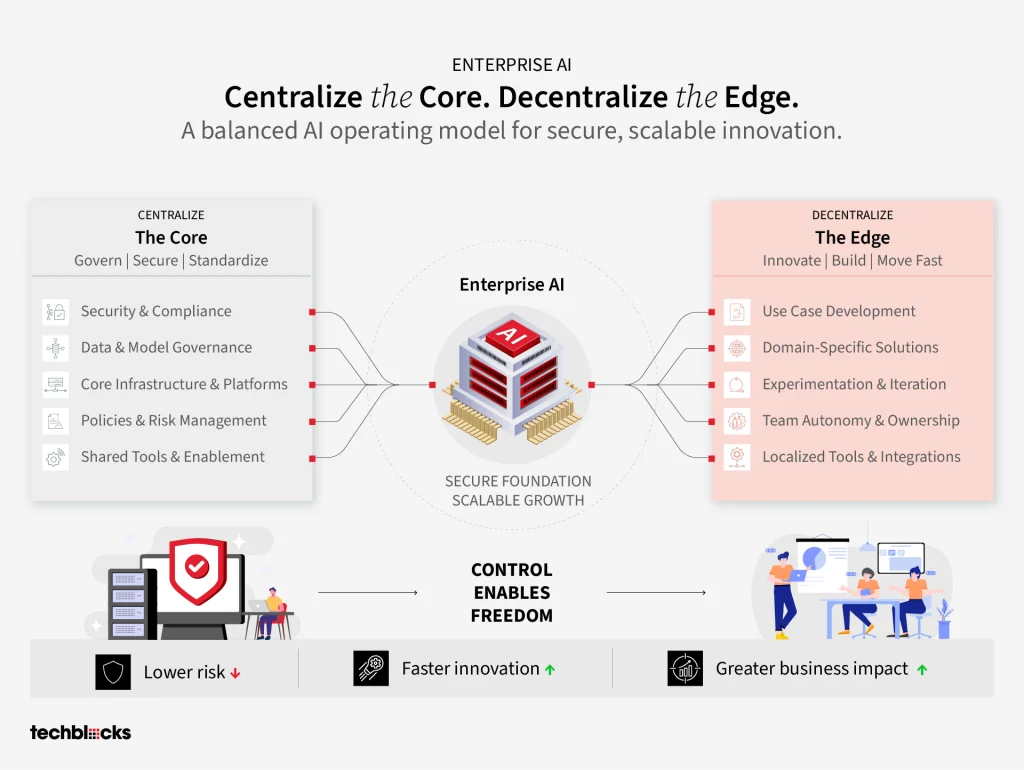
If unbridled decentralization invites security breaches and financial chaos, the opposite approach, letting individual business units build their entire AI stacks from scratch, is equally unsustainable. When scaling artificial intelligence across an enterprise, leadership must draw a firm, non-negotiable perimeter around three core pillars that belong strictly under central platform and security ownership.
1. The Unified Multi-Model Gateway and Infrastructure Core
Allowing individual product squads or business units to provision their own raw API keys, contract independently with foundation model providers, or deploy disparate model runtimes creates an immediate architectural blind spot.
- The Centralized Mandate: Platform engineering must establish a centralized multi-model gateway. This serves as the single abstraction layer and secure proxy for every LLM call, embedding, and inference request across the enterprise.
- Why It Matters: A centralized gateway decouples business applications from underlying model dependencies. It allows architecture teams to swap, upgrade, or route traffic between different foundation models (e.g., shifting from a third-party API to an internally hosted open-weights model) without requiring downstream application rewrites, while standardizing rate-limiting, load balancing, and fallback execution.
2. Data Governance, PII Masking, and Compliance Perimeters
The most severe risk of enterprise AI is not application failure, it is data leakage. When localized engineering pods wire unstructured internal datasets into external models without strict data hygiene, proprietary source code, financial records, and unmasked customer PII risk becoming part of third-party training data.
- The Centralized Mandate: Security and data governance teams must own the data pipeline guardrails. This includes implementing automated PII scrubbing, dynamic tokenization, data residency enforcement, and strict Role-Based Access Control (RBAC) before data ever reaches a model prompt or vector store.
- Why It Matters: Regulatory compliance frameworks (such as SOC2, HIPAA, and regional AI regulations) demand auditable data lineage. Decentralized business units cannot be expected to build and maintain enterprise-grade security perimeters on their own without creating massive compliance gaps.
3. Centralized FinOps and Token Consumption Governance
Unlike traditional enterprise software characterized by fixed annual SaaS seat licenses, generative AI consumption is elastic, dynamic, and notoriously unpredictable. A single unoptimized RAG architecture, an inefficient embedding script, or a recursive agentic loop can quietly generate thousands of dollars in cloud GPU and API token costs overnight.
- The Centralized Mandate: Financial operations (FinOps) integrated with central platform engineering must monitor, allocate, throttle, and forecast token consumption and compute spend across all business units.
- Why It Matters: Centralized cost tracking prevents sudden budget shock. It allows enterprise finance teams to attribute cloud AI expenditure accurately to the specific business units driving commercial return, rather than absorbing it as an unmanaged corporate overhead.
Locking down these foundational elements at the core ensures that security, cost control, and architectural integrity remain uncompromised. But a secure foundation is only valuable if the business can actually build on top of it. That requires looking at the exact inverse: where control must be relinquished to the frontlines.
Architecting the Hybrid Hub-and-Spoke Model
Knowing what to centralize and what to decentralize is a conceptual victory, but the real test is execution. The traditional enterprise org chart is completely ill-equipped to bridge the chasm between central IT governance and fast-moving edge product squads.
This is where the hub-and-spoke operating model becomes non-negotiable.
In this structure, our central hub owned by core platform and security engineering, manages the non-negotiable guardrails: the multi-model gateway, automated PII scrubbing, regulatory data perimeters, and FinOps token monitoring. Meanwhile, the spokes consist of cross-functional product and domain pods embedded directly within business units, free to iterate on localized RAG pipelines, prompt workflows, and user-facing features without hitting a bureaucratic wall.
However, designing an organizational chart on a whiteboard is the easy part. The friction point for most enterprises is a lack of specialized engineering bandwidth to actually stand up the secure core while accelerating delivery at the edge.
Bridging that gap requires more than internal rearranging; it demands dedicated execution capacity. At TechBlocks, we deploy specialized, cross-functional engineering pods designed to solve this exact architectural tension. By embedding experts who understand both multi-model core infrastructure and rapid edge application delivery, we help enterprises bypass internal turf wars between IT and business units, turning AI governance from a permanent bottleneck into a true competitive advantage.
Conclusion: Moving Past the Binary
The debate over whether to centralize or decentralize artificial intelligence is built on a false premise. Enterprises cannot afford the stagnation of a command-and-control IT bottleneck, nor can they survive the unmanaged security risks and financial shocks of runaway shadow AI.
As generative AI solidifies its place as core enterprise infrastructure, the path forward requires a deliberate architecture: locking down foundational security, multi-model gateways, and FinOps at the central core, while empowering cross-functional frontlines to rapidly innovate at the edge.
Achieving this balance is rarely easy with internal resources alone. It demands rigorous architectural foresight and dedicated execution capacity. At TechBlocks, we help engineering leaders bridge the chasm between core governance and edge velocity through our core capabilities:
- Rapid Core Provisioning: We rapidly deploy and configure secure multi-model gateways and automated PII data pipelines so your foundational infrastructure is locked down from day one.
- Cross-Functional Edge Pods: We embed specialized engineering pods directly inside your business units to build, test, and scale domain-specific RAG workflows at market speed.
- FinOps & Governance Integration: We establish automated token tracking and compliance frameworks that eliminate budget shock and give leadership total visibility across the AI estate.
For enterprises looking to eliminate shadow AI without compromising speed, we are here to help you architect and scale with confidence.
AI & ML SOLUTIONS
Scale Enterprise AI Securely Without Sacrificing Innovation Velocity
Scale Enterprise AI Securely Without Sacrificing Innovation Velocity Partner with TechBlocks to architect your hub-and-spoke operating model and bridge core governance with frontline execution.

FAQs
You cannot stop shadow AI by locking down permissions or issuing strict policy memos; developers and business units will simply find workarounds. The solution is to provide a secure, self-service alternative. By establishing a centralized multi-model gateway and pre-approved developer sandboxes, IT gives teams a fast, compliant way to build without having to resort to corporate credit cards and external, unvetted endpoints.
AI spending requires a hybrid financial model. Central IT and FinOps must own the foundational infrastructure costs—such as core multi-model gateway licensing, cluster management, and baseline security guardrails. However, variable token consumption and domain-specific RAG scaling costs should be attributed directly to the business units driving those specific workflows and commercial use cases.
When an enterprise forces all AI initiatives through a single, top-down central IT committee, innovation grinds to a halt. Product squads and business units face multi-month ticket queues just to test a prompt adjustment or connect a new data source. This creates severe friction, drives top engineering talent away, and causes the business to miss critical market windows while competitors move faster.
In a hub-and-spoke model, the CTO shifts away from being an operational gatekeeper who approves every individual tool or script. Instead, they transition into a platform architect and enabler. Their focus moves toward defining the core infrastructure, establishing security guardrails, and curating reusable technical building blocks that empower autonomous edge teams to ship safely and at scale.
First, perform an infrastructure audit to map out existing shadow AI deployments, unmanaged API keys, and scattered vector databases. Second, establish a centralized multi-model gateway to regain visibility and secure data flows. Finally, partner with specialized engineering teams like our cross-functional pods at TechBlocks, to help build out the core architecture while rapidly accelerating domain-specific edge use cases.