

Key Takeaways
- Real-time financial AI initiatives fail primarily due to fragmented legacy architectures and batch processing latency rather than algorithmic limitations.
- Unifying low-latency streaming feature stores with immutable historical lakehouses eliminates training-serving skew and enables audit-ready compliance replay.
- Financial institutions should modernize around the core using Change Data Capture and event streaming fabrics instead of executing high-risk rip-and-replace overhauls.
- In-flight schema validation, automated data lineage, and real-time observability provide the foundational governance required to deploy production-grade AI safely.
- Event-driven platforms deliver measurable balance-sheet value by collapsing decision latency across real-time fraud interception, intraday risk, and regulatory compliance triage.
Global financial institutions are aggressively adopting AI to detect fraud, automate underwriting, and optimize capital allocation. Yet a structural gap chokes these initiatives in production. While 70% of financial institutions still run core banking, trading, and risk systems on legacy mainframes or monolithic architectures, only 22.6% of financial leaders believe their organizations are prepared to capture AI value at enterprise scale.
The operational disconnect is an architectural barrier. Modern ML models and neural networks require high-frequency, multi-dimensional context windows to evaluate risk and execution decisions. Yet enterprise financial systems keep data locked inside isolated silos, disparate schemas, and asynchronous T+1 pipelines. When live transaction streams cannot access continuous customer telemetry, predictive models are starved of context, forcing high-stakes operations to rely on batch-processed historical extracts.
Bridging this gap requires understanding how real-time AI applies to financial workflows. AI is only as effective as the financial data platform underneath. Deploying advanced models without modernizing infrastructure demands that financial enterprises identify the structural bottlenecks paralyzing current architectures. Once the bottlenecks are understood, enterprises can define a modern, AI-ready data platform architecture around measurable business and operational requirements.
Why Financial Data Architecture Is Becoming an AI Bottleneck
Deploying enterprise AI requires a continuous, high-fidelity data supply chain. In most financial institutions, however, the underlying data architecture was engineered for historical record-keeping and scheduled reporting, not for continuous, low-latency model inference. When advanced machine learning algorithms consume inputs from outdated infrastructure, the architecture itself becomes the primary bottleneck.
Fragmented Data and Legacy Systems Limit AI Readiness
Enterprise financial data is rarely centralized. It is distributed across decoupled core banking engines, payment rails, trading desks, credit risk marts, and customer CRM systems. The primary impediment to AI readiness is not data volume, but structural inconsistency across operational boundaries:
- Conflicting Schemas and Identifiers: A single entity may exist under an account number in core banking, a legal entity identifier (LEI) in commercial lending, and a distinct CIF number in wealth management, without a canonical key to resolve them
- Decoupled Ownership and Governance: Independent business units enforce isolated access controls and divergent schemas, preventing automated data integration across divisional boundaries
- Asynchronous Refresh Cycles: Transactional ledgers update on different cadences, leaving analytical engines with conflicting, out-of-sync states of the same financial reality
Without unified data management and automated entity resolution, AI applications receive fragmented feature sets. Starved of an authoritative, synchronized view of the customer, transaction, or market event, predictive models produce degraded risk scores, trigger false alerts, or fail to recognize complex multi-channel patterns.
Batch Data Creates Too Much Decision Latency
Traditional data architectures rely on batch Extract, Transform, Load (ETL) pipelines designed to populate central data warehouses on an hourly, daily, or T+1 schedule. While periodic updates remain adequate for retrospective reporting and historical trend analysis, they introduce fatal decision latency for operational AI.
In mission-critical workflows such as fraud detection, payment screening, and intraday risk mitigation, the decision window is measured in milliseconds. A batch pipeline that updates overnight creates an operational blind spot. When a live payment-screening model evaluates a suspicious transaction, it cannot detect an active account takeover. Especially if recent login anomalies and transfer telemetry remain trapped in an unexecuted batch queue. So by the time the warehouse updates, the funds have cleared. It turns what should have been a real-time interception into an expensive post-mortem investigation.
What a Real-Time Financial Data Platform Needs?
Before selecting specific technologies, businesses must define what the platform must deliver. A modern financial data platform is not an isolated tool. It is a connected operational system that transforms raw, distributed activity into governed, contextualized intelligence.
From Data Capture to Contextualized, Trusted Data
Raw financial events carry little analytical value on their own. For example, an isolated credit card swipe reveals only an account ID, an amount, and a timestamp. But to determine risk, an AI model needs multi-dimensional context.
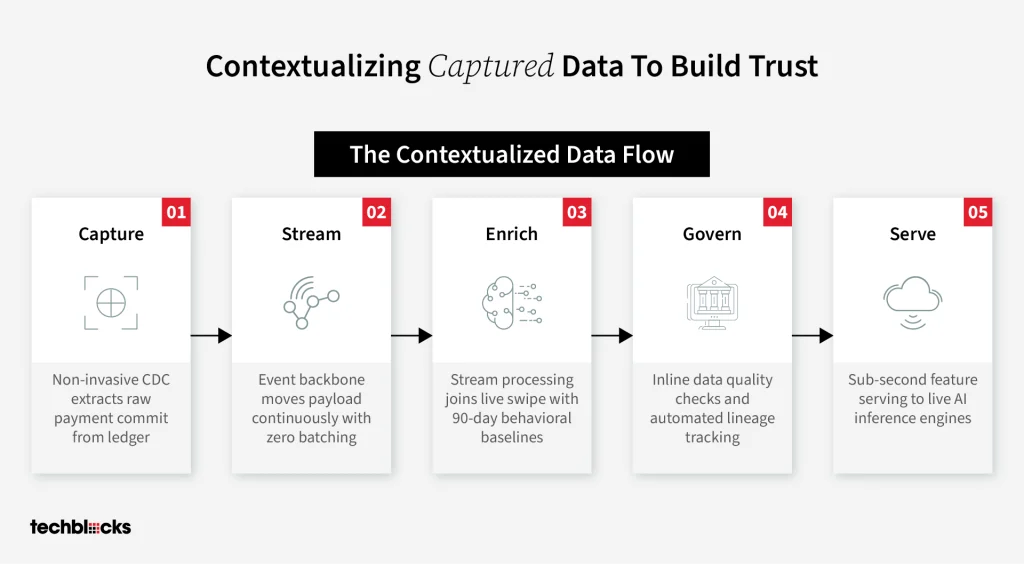
Transforming a raw event into a reliable decision input requires a continuous five-stage pipeline:
- Capture (CDC and APIs): Change Data Capture (CDC) reads transaction logs directly from operational ledgers the instant an entry commits. This extracts changes asynchronously without placing query locks on core banking engines.
- Stream (Event Backbone): The event backbone receives the raw payload and transports it continuously across the enterprise without batching delays.
- Process & Enrich (Stream Transformation): Stream processors calculate rolling aggregates in flight, such as 10-minute transaction velocity. The system joins the live event with customer profile telemetry, device risk ratings, and historical baseline patterns.
- Govern (Observability and Lineage): Active financial data governance validates schema contracts and monitors financial data quality in flight. Every transformation generates verifiable lineage records for regulatory auditability.
- Store and Serve (Dual-Path Delivery): The platform routes the enriched feature vector to low-latency in-memory stores for live inference, while writing an immutable copy to long-term storage.
Real-Time and Historical Data Must Work Together
A resilient AI-friendly data platform cannot force a trade-off between streaming feeds and historical storage. High-precision financial AI requires both operating in tandem, combining the current streaming set with stored historical context and depth. Real-time streaming captures current state, including the active transaction, immediate geolocation shifts, and short-term behavioral spikes. Historical storage provides a critical baseline of depth, including months of spending trends, seasonal variance, and cross-channel settlement records.
Note: Historical data remains equally vital downstream. Data science teams need long-term event stores to train new model architectures, backtest risk parameters, and conduct forensic compliance replays. Unifying streaming pipelines with immutable historical storage creates a single source of truth. It prevents training-serving skew and ensures offline training datasets match the live features evaluated in real-time production data analytics.
Reference Architecture for a Scalable Financial Data Platform
Building an enterprise financial data platform requires an end-to-end architectural blueprint. It decouples operational sources from analytical consumers while enforcing strict governance at every stage.
How Data Moves Through the Architecture?
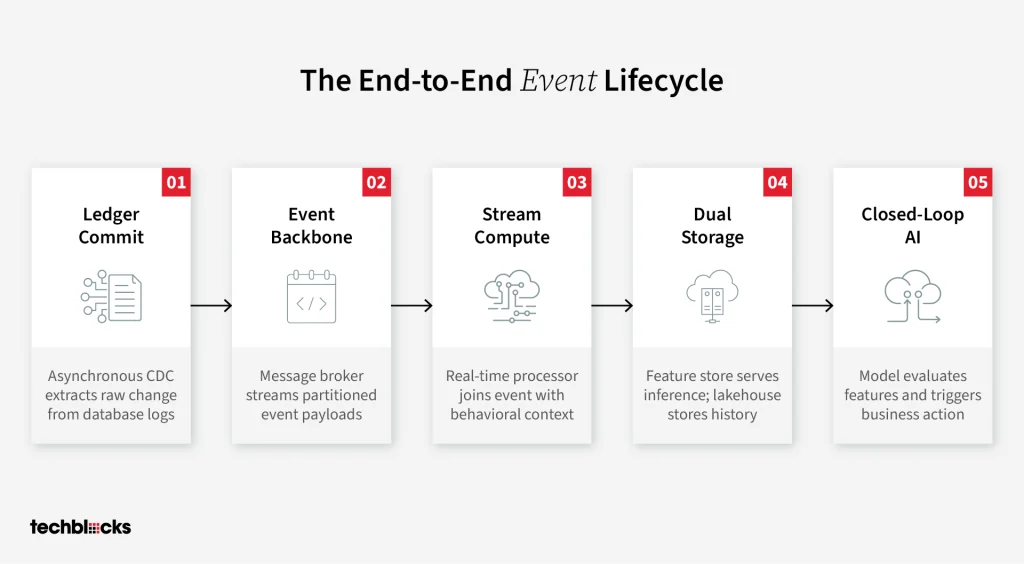
A modern data platform, built for AI, standardizes how data flows from origin to automated operational action. Rather than building bespoke point-to-point connections, every financial event moves through an integrated eight-step pipeline:
1. Event Generation: An operational event occurs, such as a ledger transaction, payment authorization request, or market quote update.
2. Non-Invasive Ingestion: Change Data Capture (CDC) or API gateways capture state changes asynchronously from database logs without locking operational tables.
3. Streaming Backbone: Distributed event streaming layers (such as Apache Kafka) ingest and buffer the raw events into partitioned, ordered topics.
4. Stream Processing & Enrichment: Stream processing engines (such as Apache Flink) validate schemas, execute sliding-window aggregations, and join transaction telemetry with customer profiles.
5. Dual-Path Persistence: The platform writes enriched event records into an immutable historical lakehouse (such as Apache Iceberg or Delta Lake) for continuous model training and regulatory replays.
6. Low-Latency Feature Serving: Synchronized, in-memory feature stores (such as Redis or Aerospike) expose real-time features with sub-second lookup latency.
7. Model Inference: Runtime inference engines (such as ONNX Runtime or Triton) score the enriched feature payload against live risk models.
8. Automated Action: The resulting intelligence triggers an immediate business action, clearing the payment, stepping up authentication, or adjusting intraday risk exposure.
With each stage, the pipeline ensures that the data-event lifecycle remains end-to-end, avoid any data leakage or wastage.
Designing for Scale, Reliability, and Governance
Deploying financial analytics platform workloads into production requires meeting non-negotiable enterprise constraints. Each architectural characteristic solves a specific operational challenge:
- High Throughput and Elastic Scale: Market spikes and peak processing windows generate extreme event surges. Decoupling ingestion from processing allows the architecture to scale horizontally without dropping messages or degrading latency.
- Deterministic Low Latency: Millisecond-level inference windows require predictable execution paths. Pre-computing sliding aggregates in the streaming layer eliminates heavy runtime queries during live transaction scoring.
- Fault Tolerance and State Recovery: Financial operations demand strict consistency. Stream processing runtimes must support exactly-once processing semantics to prevent duplicate transaction entries or missing state during node restarts.
- Financial Data Quality and Schema Contracts: Stricter validation at the ingestion boundary protects downstream models. Schema registries reject malformed records before bad inputs pollute production financial data analytics.
- Lineage and Auditability: Regulatory mandates require transparent provenance. Active financial data governance tracks data transformations from source ledger to model feature, ensuring full compliance replay capabilities.
- Continuous Observability: Pipeline telemetry tracks data freshness, schema mutations, and ingestion lag in real time, alerting engineers to upstream drift before it causes downstream model degradation.
Moving data continuously from ingestion to inference is only the baseline requirement. In regulated financial environments, speed without structural resilience creates immediate operational exposure.
Architectural traits like high throughput, deterministic latency, fault tolerance, verifiable lineage, and real-time observability are not passive IT checkboxes. They are the active operational guarantees that prevent transaction failures during volatility spikes, satisfy strict regulatory scrutiny, and provide the systemic trust required for autonomous AI models to evaluate live financial risk.
How to Modernize Legacy Financial Data for AI?
Modernizing financial data for AI does not require ripping out the mainframe. Financial institutions can retain mission-critical core systems while building an agile, high-throughput data architecture around them.
Modernize Around the Core, Not Instead of the Core
Attempting a multi-year ‘rip-and-replace’ of core banking or mainframe applications creates immense operational risk and stalls AI initiatives indefinitely. Instead, institutions should adopt a pattern of non-invasive data extraction, progressively unlocking legacy data stores without burdening the transactional core.
The architecture flows through four clear stages:
- Change Data Capture (CDC): Attach low-impact listeners (such as Debezium or IBM InfoSphere DataStage) directly to legacy databases or transaction logs (DB2, Oracle, VSAM). CDC reads log files in real time without placing query load on the underlying transactional engines.
- APIs: Wrap existing transactional services in clean, well-governed REST or gRPC endpoints to expose stateful data and allow bi-directional context fetching when models need deeper historical attributes.
- Event Streaming: Feed CDC logs into distributed event streaming platforms. Transactions, transfers, and ledger entries become real-time streams of append-only events.
- Modern Data Layer: Sink event streams into cloud data platforms, real-time feature stores, and vector databases. This decoupled layer serves pre-processed features directly to machine learning pipelines and real-time inference endpoints.
Building the Foundation Around High-Value AI Workloads
Attempting to build an enterprise-wide data platform for AI risk detection models, all at once, often stalls in prolonged architectural planning. Modernization delivers value fastest when engineering teams anchor initial pipelines to a single high-impact operational workload.
Effective rollouts prioritize workloads that satisfy four specific criteria:
- Clear Business Stakes: Real-time data freshness directly dictates the quality of the operational outcome.
- Bounded Data Boundaries: The required data inputs reside across specific, identifiable source systems.
- Material Decision Impact: Machine learning inference measurably improves operational precision or decision speed.
- Quantifiable Balance-Sheet Return: The outcome creates direct financial savings or revenue expansion.
Real-time fraud detection provides an ideal starting point. The causal link between data freshness, model scoring, and direct loss reduction is immediate and measurable, and is seen across three phases:
- Real-Time Fraud Detection: Establishing non-invasive CDC and real-time feature serving.
- Intraday Risk Management: Expanding stream processing fabrics to handle dynamic market volatility and exposure limits in flight.
- AML & Compliance Screening: Unifying multi-source state and historical profiles across disparate ledgers for automated triage.
Once extraction pipelines, feature stores, and governance controls are proven in fraud detection, engineering teams extend the same infrastructure to adjacent workloads. The data foundation expands organically to support intraday liquidity risk, anti-money laundering (AML) screening, and algorithmic portfolio operations.
Therefore, modernizing financial data is not a monolithic migration project. It is a progressively expanding data foundation that powers increasingly sophisticated AI workloads over time.
Turning the Data Platform Into Real-Time Financial Intelligence
Streaming data delivers zero business value in isolation. The true measure of an event-driven architecture is its ability to turn continuously updated telemetry into faster, higher-precision operational decisions.
From Real-Time Data to AI-Driven Decisions
When modern financial data solutions unify real-time event streams with historical depth, artificial intelligence shifts from retrospective analysis to active intervention. The architecture powers continuous decision loops across core enterprise workloads:
- Real-time fraud interception: A live payment swipe triggers immediate contextual stream enrichment and sub-second feature retrieval, allowing machine learning models to score the transaction and execute automated authorizations or step-up authentication within milliseconds.
- Dynamic intraday risk management: Ingests high-frequency market quote shifts to continuously update portfolio states, calculating real-time value-at-risk metrics to automatically adjust collateral and enforce exposure limits.
- Continuous anti-money laundering and compliance triage: Incoming payment executions initiate automated entity resolution across historical profiles and external watchlists, scoring behavioral anomalies to streamline case triage and generate audit-ready regulatory filings.
In each scenario, real-time context enables machine learning models to act during the active decision window rather than after losses have already cleared.
How TechBlocks Can Help?
Building a production-grade data platform for AI usage requires an architectural strategy that bridges legacy transactional systems with real-time intelligence. TechBlocks partners with capital markets, banking, and fintech leaders to help build that strategy by modernizing their data estates through focused financial data solutions like:
- Data Strategy & Phased Roadmaps: Aligning architecture, tooling, and engineering teams to concrete business outcomes. We design progressive modernization blueprints that unlock legacy core data around existing systems rather than forcing high-risk migrations.
- Event-Native Data Pipelines & ETL: Deploying high-throughput streaming fabrics powered by log-based Change Data Capture (CDC) and Kafka-compatible streams. We implement Kappa-style single code paths with replayable logs and idempotent writes to unify real-time feature serving and historical model training.
- Stream Governance & Observability: Enforcing active financial data governance directly on event streams. Our teams embed schema registries, column-level lineage, PII discovery, and policy-as-code to ensure every feature is auditable and every metric traceable.
- Advanced Analytics & Model Serving: Productionizing real-time inference pipelines with automated drift alerts and continuous monitoring. We connect live feature stores directly to decision channels, turning continuously updated telemetry into measurable balance-sheet value.
TechBlocks in Action: Post-Merger Integration at $44B Scale
After a $44 billion merger with IHS Markit, a leading financial information and analytics provider needed to integrate 300+ applications and digital platforms. Legacy QA processes couldn’t scale, causing quality inconsistencies and release delays.
TechBlocks delivered:
- AI-driven Assessment Framework integrated with the client’s KAFE framework for rapid test case generation and automated regression testing
- Continuous monitoring across 300+ platforms with efficient bug tracking
- 36-person specialized QA team for functional and performance testing on critical applications
- Structured 5-day QA approval cycle for new features, cutting release delays
Outcome: Scaled quality across 300+ platforms while reducing manual effort, supporting faster releases and higher platform stability for real-time financial dashboards.
Transitioning to real-time intelligence is not a one-time migration or risky core replacement. It’s an incremental evolution that modernizes data flows around existing ledgers to establish a trusted, event-driven foundation. By unifying low-latency features serving with audit-ready historical governance, winning financial institutions establish the operational maturity required to scale AI-native financial services.
Blueprint a scalable, governed, and event-native financial data architecture with TechBlocks.
Schedule a discovery call today!
FAQs on Financial Data Platform
Real-time AI models require continuous behavioral context to evaluate in-flight events accurately. Relying on stale batch data creates training-serving skew, elevating false-positive declines, missing coordinated fraud attacks, and delaying risk mitigation until after transactions clear.
Institutions modernize safely by building around the core rather than executing disruptive rip-and-replace migrations. Implementing Change Data Capture (CDC) and event streaming layers extracts state changes directly from database logs without destabilizing mission-critical transaction engines.
An AI-ready platform requires a dual-path architecture combining low-latency feature serving with an immutable historical lakehouse. This pairing eliminates feature skew, enforces active data governance, and provides unified context for both real-time inference and offline model retraining.