

AI is changing how quickly software can be built. According to DORA’s latest research, 90% of technology professionals use AI at work, and more than 80% report productivity gains from it. But faster development does not automatically make the entire delivery process faster.
There is still a lot between writing code and getting a reliable change into production. Architecture dependencies, testing, infrastructure, security checks, approvals, and production issues can all slow things down. As development gets faster, these bottlenecks become easier to see.
This article looks at:
- Where software delivery slows down even when development speeds up
- How architecture, quality, infrastructure, governance, and operations affect the pace of delivery
- How AI can be built into the delivery process so faster engineering translates into faster, more reliable releases
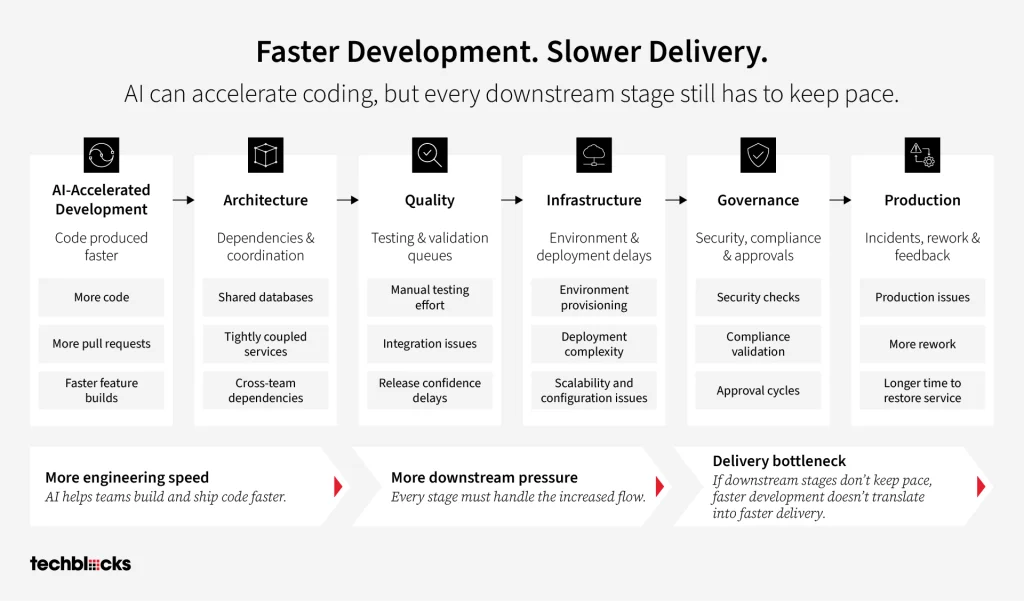
Faster Development Doesn’t Mean Faster Delivery
It is easy to see when development is getting faster. Teams may be completing work sooner, creating more pull requests, or deploying more frequently. But none of that tells us what happens to the software once it leaves a developer’s hands.
A change can move quickly through development and still spend hours or days waiting for testing, security checks, another team’s dependency, an approval, or a production environment. It can also reach production quickly and create more rework or incidents than before.
That is why delivery speed cannot be measured by development activity alone.
DORA’s four delivery metrics: deployment frequency, lead time for changes, change failure rate, and time to restore service, look at both sides of that equation. The first two show how quickly changes move through delivery. The latter two show what happens when those changes reach production.
Taken together, they reveal something a simple productivity metric cannot: whether a team is actually moving software through the system faster, or simply producing more work inside one part of it.
AI makes this increasingly important. When developers can produce code faster, every other part of the delivery process has to handle that increased flow. If it cannot, the constraint moves downstream.
And architecture is often one of the first places that happens.
Architecture Can Become the Bottleneck
A developer can finish a change without the organization being ready to release it. The problem often isn’t the code itself. It is everything the change touches.
| Architectural constraint | What it can slow down |
| Shared databases | Schema changes and coordinated releases |
| Tightly coupled services | Changes that require multiple teams to update systems together |
| Fragile integrations | Integration testing and release confidence |
| Shared application components | Independent development and deployment |
| Unversioned APIs | Changes that can break dependent applications |
| Cross-team dependencies | Reviews, testing, and release coordination |
When several of these constraints exist together, a small change can turn into a multi-team release. Development may take a few hours, while coordination takes considerably longer.
The goal isn’t more microservices
Breaking a system into more services doesn’t automatically solve the problem. It can introduce more APIs, infrastructure, monitoring, and operational dependencies.
What matters is whether the architecture gives teams enough independence to make and release changes without creating unnecessary coordination.
That can involve:
- Modular architecture to isolate areas of change
- Clear API boundaries so teams can work against stable interfaces
- Versioned contracts to reduce the risk of breaking dependent systems
- Event-driven integration where asynchronous communication makes sense
- Clear ownership boundaries so teams know which components they can change and release
The result should be a simpler path from change → validation → release, not simply a more distributed architecture. And once teams can move changes independently, another constraint becomes visible: how quickly can those changes be validated?
When Development Speed Outruns Quality
The faster software changes, the harder it becomes to rely on testing as a final step before release.
AI-assisted development makes this shift more visible. Code can be generated, modified, and refactored quickly, while the change may still affect APIs, database logic, dependencies, security controls, and existing functionality. The testing effort doesn’t disappear simply because the coding effort becomes smaller.
A stronger quality process follows the change throughout its lifecycle:
Code → Unit Testing → Integration Testing → Security Testing → Regression Testing → Release Validation → Production Feedback
Each layer answers a different question:
- Unit testing: Does the individual component behave as expected?
- Integration and contract testing: Do connected components continue to work together?
- Security testing: Has the change introduced a vulnerability or weakened an existing control?
- Regression testing: Has existing functionality remained intact?
- Performance testing: Can the system handle the expected workload?
- Production validation: Does the software behave as expected under real conditions?
The depth of validation should also reflect the risk of the change. A configuration update and a change to a core transaction service should not follow identical testing paths.
Automation can shorten these cycles, but automation alone does not guarantee faster validation. Slow regression suites, flaky tests, unstable test environments, and poor test data can create new queues inside the delivery pipeline. The objective is straightforward: increase the speed of validation while maintaining the level of confidence required for release.
Next, we need to look beyond the code and testing environment. A change can pass every test and still face delays when development, staging, and production environments behave differently.
When the Environment Slows the Release
Passing a test does not mean a change will behave the same way in production. Development, testing, staging, and production can differ in configuration, infrastructure, dependencies, permissions, network conditions, or data. A change may work perfectly in one environment and still require investigation before it can be released into another. The result is often a familiar pattern: Code is ready → Testing is complete → Environment isn’t ready → Release waits
Environment differences can come from relatively small things:
- Different configuration values
- Different versions of dependencies
- Manually changed infrastructure
- Missing services or permissions
- Production-only integrations
- Inconsistent test data
- Differences in scale and workload
Infrastructure as Code and automated environment provisioning can reduce much of this variation. Version-controlled infrastructure, repeatable configuration, automated setup, and standardized deployment processes make environments easier to reproduce and maintain. The bigger shift is operational: an environment should be treated as part of the software delivery process, not as something teams prepare after development is finished.
When environments are reproducible and deployment paths are automated, fewer changes have to stop for environment-related investigation or manual setup. But technical readiness isn’t the only thing that can hold up a release. Security, compliance, and organizational approvals can create another queue between a validated change and production.
When Governance Becomes Part of the Queue
A release can be technically ready and still wait for a person to approve it. Security reviews, compliance checks, change approvals, and audit requirements all have a place in enterprise software delivery. The problem starts when every change follows the same manual path, regardless of its risk.
A simple release might move through:
Developer → Reviewer → Security → QA → Change Approval → Operations → Production
Every handoff adds time. More importantly, the queue grows when the same checks have to be repeated manually for every release.
A better approach is to automate controls that can be evaluated consistently and reserve human decisions for situations that genuinely require judgment.
| Manual control | Automated or embedded approach |
| Repeated security checks | Automated security scanning |
| Manual compliance verification | Policy-as-code |
| Release evidence gathered after the fact | Continuous audit trails |
| Identical approval for every change | Risk-based release gates |
| Manual configuration checks | Automated validation |
| Repeated evidence collection | Automatically generated evidence |
Human oversight still has a role, particularly for high-risk changes, architectural decisions, security exceptions, and business-critical releases. The objective is to remove unnecessary waiting without removing control.
With the right controls embedded into the delivery workflow, governance can become part of the process rather than a separate queue sitting between development and production. The release is finally in production. The next question is whether anyone can quickly tell what happened after it got there.
Deployment Is Not the Finish Line
A release reaching production only marks the beginning of real-world validation. Production traffic introduces conditions that development and testing environments cannot fully reproduce. Load patterns change, users behave differently, integrations respond in unexpected ways, and infrastructure can perform differently at scale. Teams need visibility across the application and the environment to catch these changes quickly. That means combining:
- Application logs and metrics
- Distributed traces
- Service-level objectives and error budgets
- Infrastructure and performance data
- Incident and recovery data
- User and product telemetry
- Release health and rollback signals
The real value comes from closing the feedback loop. A recurring production error should influence test coverage. A performance problem should feed into engineering and architecture decisions. A failed release should reveal where validation or deployment controls need improvement.
A deployment metric tells you how often software reaches production. Production signals tell you what happened after it got there. Both are necessary to understand delivery performance.
As release cycles become shorter, the feedback cycle needs to become shorter as well. Teams need to move quickly from production signals to diagnosis, remediation, and the next engineering change. AI can accelerate many of those activities. The larger challenge is coordinating them across the software lifecycle so faster engineering does not simply create more work for testing, operations, security, or engineering teams.
AI Is Changing the Unit of Software Delivery
For years, software delivery was organized around people and their time. A project had a team. The team had developers, testers, architects, DevOps engineers, and managers. Work was broken into stories, assigned to people, estimated in hours or points, and tracked through a backlog. Delivery performance was largely understood through team capacity, effort, throughput, and release metrics.
AI makes parts of the old model harder to measure. A developer may spend an hour producing code that previously took a day. An AI agent may analyze a large codebase, generate a set of tests, or investigate a production issue without appearing as a member of the engineering team. A developer may then spend more time reviewing, modifying, or validating AI-generated work.
The question becomes less about how many hours went into the work and more about what happened to the work after AI entered the process. Consider a software story:
| Traditional delivery view | AI-native delivery view |
| Who worked on the story? | How much work was performed by people and AI? |
| How many hours were spent? | How much engineering effort was required? |
| How many points were completed? | What was actually delivered? |
| How much code was produced? | How much of the code survived review and production? |
| How many releases were made? | What reached production successfully? |
| What did the team cost? | What did engineering, AI, model, and infrastructure usage cost? |
| Was the sprint completed? | Did the delivered capability create the intended outcome? |
The change isn’t just about productivity measurement. It affects how engineering work gets planned, governed, priced, and improved.
A delivery organization needs to know where AI is helping, where humans are still doing the heavy lifting, where rework is increasing, how much AI usage costs, and whether faster execution is producing better software.
AiDE, TechBlocks’ AI-Native Delivery Engine, is built around this shift. It connects user stories, engineering effort, AI usage, code changes, quality, token spend, cost, shipped work, production survival, and business outcomes across the delivery lifecycle.
The result is a different way of looking at software delivery: not simply measuring how much work a team completes, but understanding how people and AI together turn engineering capacity into production outcomes.
What an AI-Native Delivery Model Looks Like
An AI-native delivery model doesn’t mean putting an AI tool into every stage of software development. The bigger change is how the stages work together. Planning needs context from previous delivery work. Architecture needs visibility into existing dependencies. Engineering needs access to approved patterns and standards. Testing needs to understand what changed. Deployment needs evidence from quality and security checks. Production data needs to feed back into planning and engineering.
The lifecycle starts looking more connected: Plan → Design → Architect → Build → Test → Deploy → Optimize
AI can participate across each stage, but the role changes from one stage to another.
| Stage | AI contribution | Human control |
| Plan | Analyze requirements, refine stories, identify dependencies | Prioritization and business decisions |
| Design | Generate options, evaluate patterns, document decisions | Product and experience decisions |
| Architect | Map dependencies, assess architecture, identify modernization paths | Architecture approval and trade-offs |
| Build | Generate code, refactor, document, explain existing code | Engineering review and ownership |
| Test | Generate tests, analyze defects, expand coverage | Quality standards and risk decisions |
| Deploy | Prepare releases, validate conditions, automate deployment tasks | Release accountability |
| Optimize | Analyze telemetry, investigate issues, recommend improvements | Production decisions and remediation |
The important part is the connection between stages. A requirement should not disappear once development begins. Architecture decisions should remain available to engineers. Test results should influence release decisions. Production incidents should feed back into testing and development. AI usage and engineering effort should remain visible alongside delivery results.
AiDE follows the same lifecycle across its AI-native delivery model, with agents supporting product delivery, architecture, design, engineering, QA and reliability, DevOps/SRE, and governance and security.
Human involvement also remains deliberate. AiDE places human control points across requirements, design, architecture, code, testing, deployment, cost, and AI safety rather than treating automation as a replacement for engineering judgment. The result is a delivery process where AI can handle more of the repeatable work while people remain responsible for decisions involving architecture, risk, quality, security, and business outcomes.
ENGINEERING BEYOND THE CODE
Turn Faster Engineering Into More Reliable Software Delivery
Modernize software engineering with AI, automation, and delivery practices built for speed, quality, and scale.

Move From Effort-Based Delivery to Outcome-Based Delivery
AI changes the economics of software development. When a developer can complete in a few hours what previously took much longer, measuring delivery through hours, headcount, or even the volume of engineering work becomes less meaningful. Paying for more effort no longer tells you whether more value was created.
The same applies to productivity metrics. Closing more tickets or generating more code can show increased activity without showing whether customers received better software, whether a business capability reached production, or whether the engineering investment produced a worthwhile return.
The focus needs to move toward outcomes.
Instead of asking:
- How many hours did the team spend?
- How many developers worked on the project?
- How many tickets were completed?
- How much code was produced?
the conversation becomes:
- What capability reached production?
- How quickly did it reach customers?
- Did it work reliably?
- How much rework was required?
- What did delivery cost?
- What business result came from it?
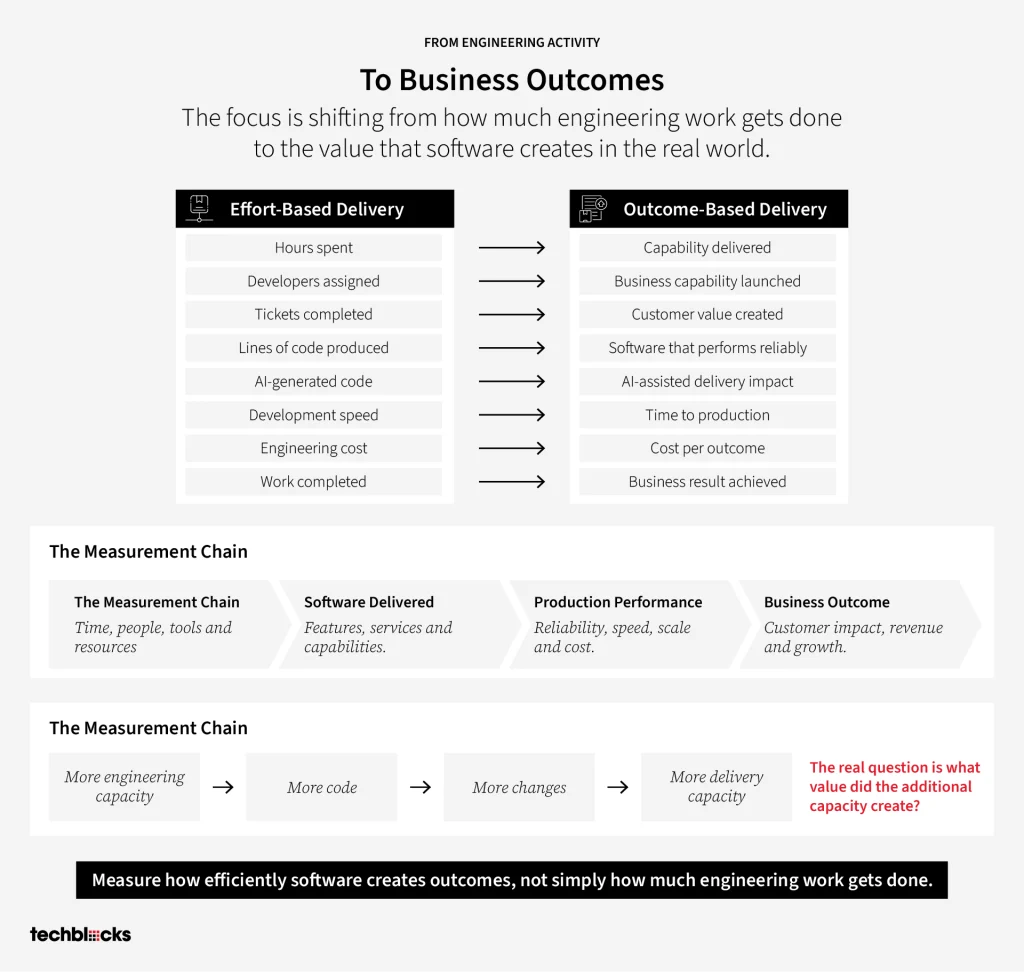
Outcome-based delivery does not mean abandoning engineering metrics. Cycle time, deployment frequency, change failure rate, recovery time, defects, rework, engineering effort, and AI usage still matter. They explain how efficiently the outcome was produced.
The important change is where the measurement ends.
A delivery team should be able to connect engineering effort → software delivered → production performance → business outcome.
For example, reducing cycle time is an engineering improvement. Reducing the time required to launch a revenue-generating capability is a business outcome. Increasing AI-assisted code generation is an engineering productivity signal. Reducing the effort and cost required to deliver a customer-facing capability is a stronger measure of the value created.
Outcome-based delivery also changes how AI itself should be evaluated. The question isn’t simply whether developers are using AI or how much code AI generates. The more meaningful questions are whether AI reduces delivery effort, improves quality, increases sustainable throughput, lowers rework, reduces cost, or helps teams deliver capabilities that matter to the business.
AI gives software organizations more engineering capacity. Outcome-based delivery provides a way to decide where that capacity should create value.
What Changes When Delivery Becomes AI-Native
The biggest change isn’t adding AI to individual engineering tasks. It is changing how the delivery system operates around those tasks.
Work can move between people and AI based on the type of decision involved. Repeatable execution can be automated. Engineers can focus on architecture, trade-offs, risk, and complex problems. Quality and security controls can run as part of the workflow rather than waiting at the end. Production signals can continuously influence what gets built next.
The operating model starts to look less like a sequence of handoffs and more like a connected delivery system.
Plan → Build → Validate → Release → Operate → Learn
Each stage produces information for the next one. AI can participate across the lifecycle, while people retain control over decisions requiring context and accountability.
The result is not simply faster software development. It is a delivery system designed to make use of the additional engineering capacity AI creates.
Conclusion: Faster Development Is Not Faster Delivery
AI has changed how quickly software can be developed. Code can be produced faster, tests can be automated, and engineers can spend less time on repetitive work.
But software still has to move through architecture, quality, security, deployment, and production before it creates value. Improving one part of the process does not automatically improve the whole.
The next stage of software delivery is about connecting these parts. AI should help teams move work forward, automation should remove unnecessary delays, and production feedback should continuously improve what gets built next. Most importantly, engineering performance needs to be connected to the outcomes the software is expected to deliver.
Faster development creates more capacity. A better delivery model turns that capacity into business value
A NEW WAY TO ENGINEER
Turn Faster Engineering Into Faster Delivery
Build an AI-ready software delivery model that connects engineering speed, quality, automation, and business outcomes.
Frequently Asked Questions
Faster development can increase the volume of work entering testing, security, deployment, and operations. If those stages cannot keep pace, delivery slows even when engineering output increases.
AI can accelerate coding, testing, code analysis, and other engineering tasks. Organizations also need to account for review, validation, governance, production monitoring, and rework as AI increases the pace of change.
Tightly coupled systems can make small changes dependent on multiple teams, services, or shared components. Modular architecture, clear API boundaries, and independent ownership can reduce unnecessary coordination.
Delivery should be evaluated using measures such as cycle time, deployment frequency, change failure rate, recovery time, rework, quality, engineering cost, and ultimately the business outcomes produced by the software.
An AI-native delivery model integrates AI across planning, architecture, engineering, testing, deployment, and operations while retaining human oversight for decisions involving risk, quality, security, and business priorities.