

Poor data quality is often treated as a technical problem: an incorrect customer record, a missing field, a failed pipeline, or an inconsistent value. The cost comes from everything the organization has to do because the data cannot be trusted.
A customer record with conflicting information can require teams to reconcile multiple systems before an order or service request is processed. A failed transformation can force engineers to investigate and repair a pipeline. Conflicting financial figures can send analysts back through source systems before a forecast or report can be approved. Each incident consumes time, engineering capacity, and operational resources, and recurring incidents turn those costs into a permanent part of running the business.
IBM’s research found that 43% of chief operating officers identify data quality as their most significant data priority. More than a quarter of organizations estimate annual losses of more than $5 million from poor data quality, while 7% report losses of $25 million or more.
The cost becomes harder to contain when the same data feeds multiple systems. A defect introduced in a source application can pass through integrations, transformations, warehouses, analytics, operational applications, and AI workflows. By the time someone finds the error, several teams may already be working around it.
Poor data quality is therefore not simply a question of whether a record is accurate. It is the cost of the work required to detect, investigate, correct, and contain unreliable information. The longer a defect persists and the farther it travels, the more systems, teams, and business processes can become involved.
The real challenge is to identify where that work is being created, quantify its recurring cost, and change the systems and controls responsible for producing the problem.
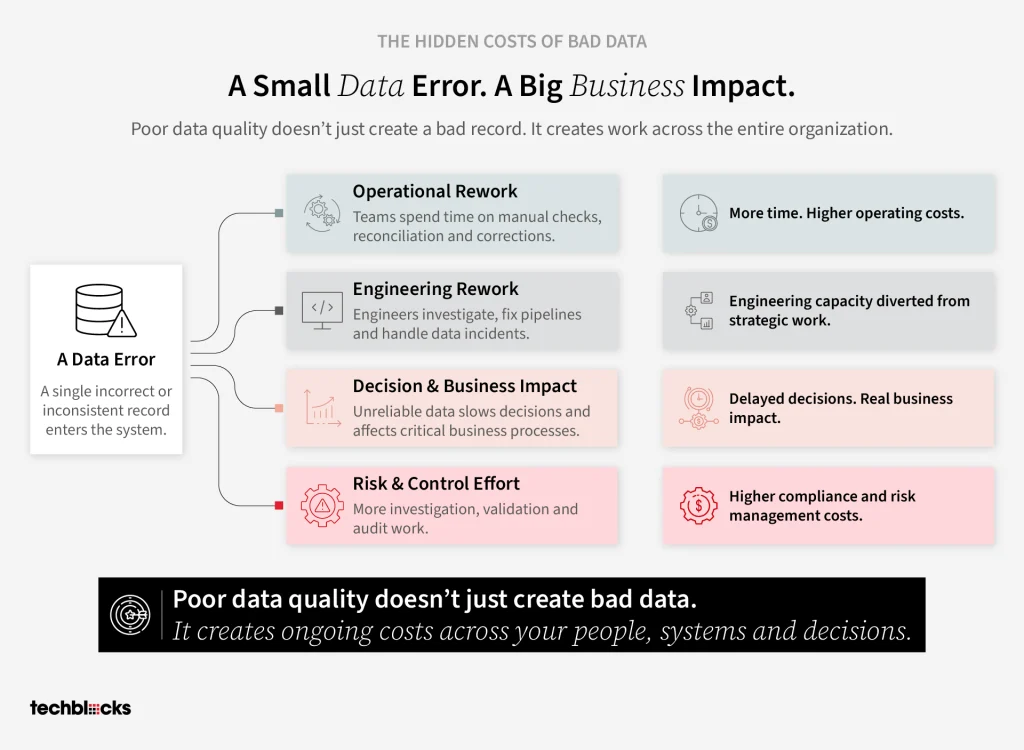
Where Poor Data Quality Creates Enterprise Costs
Poor data quality becomes expensive when people and systems have to compensate for information they cannot trust. An incorrect customer record can require reconciliation across systems. A failed transformation can create exceptions for operations teams. Conflicting financial figures can force analysts to verify reports before a forecast is approved. The underlying defect may be small, but the work required to investigate, correct, validate, and work around it can spread across functions. The cost appears in four main areas:
Operational Rework
When data cannot be trusted, employees compensate with manual checks, reconciliation, and correction. Teams compare records across systems, validate exceptions individually, or maintain spreadsheets to bridge gaps between sources. A correction that takes minutes becomes recurring overhead when the same issue continues to appear.
Engineering Rework
Data-quality problems also consume technical capacity. Engineers may spend time repairing pipelines, handling failed transformations, reconciling source-system changes, investigating data incidents, or correcting downstream defects. The cost is not limited to the hours spent fixing the problem. Recurring data-quality work also takes engineering capacity away from platform modernization, automation, product development, and other planned work.
Decision and Business Impact
Unreliable data can slow decisions and affect the processes built on top of it. Finance may need to reconcile figures before approving a forecast. Operations may verify inventory data before acting. An incorrect address can disrupt fulfillment, while inconsistent product or pricing information can affect transactions, merchandising, recommendations, or sales reporting. The data problem becomes a business-process problem when unreliable information reaches a decision or transaction.
Risk and Control Effort
Poor data quality can increase the effort required to maintain reporting, controls, and auditability. When records are incomplete or inconsistent, teams may need additional investigation to establish what the data represents, where it originated, and whether a reported result can be supported. Unclear lineage or ownership can turn a straightforward question, where did this number come from? into a manual investigation.
Why Poor Data Quality Becomes More Expensive Across the Enterprise
A data-quality problem rarely stays where it starts. A customer record can enter through a CRM, move into a warehouse, feed a customer-data platform, appear in an analytics dashboard, and eventually influence a campaign or service interaction. If the original record is incomplete or incorrect, downstream systems can reproduce the error, trigger exceptions, or require additional validation.
The problem becomes harder when different systems maintain their own versions of the same information. Acquisitions, legacy applications, SaaS platforms, regional databases, and departmental tools can use different definitions, formats, identifiers, and update cycles. A customer might be identified by email in one system, account number in another, and a CRM identifier in a third. One system may show an account as active while another carries an older status.
Resolving those differences can require identity matching, transformation logic, reconciliation, or manual intervention. The further data travels, the more systems and processes an organization may have to examine when something goes wrong.
More consumers also mean more opportunities for a quality problem to affect the business. The same data may support operational applications, financial reporting, analytics, customer-facing processes, AI workflows, and regulatory reporting. A problem discovered in a dashboard may have originated several transformations upstream, requiring engineers to trace the data back to its source before the issue can be corrected.
Legacy systems add another complication. Older applications can remain important upstream sources even after the surrounding data environment has modernized. Undocumented transformations, inconsistent schemas, and limited validation make those sources harder to control. Replacing the application may not be practical, so organizations add reconciliation and transformation layers around it. Over time, those layers can accumulate alongside pipelines, business rules, exceptions, and manual controls.
A handful of bad records can be handled manually. Millions of records moving continuously through interconnected systems cannot. Even a small exception rate can therefore create substantial recurring work: more exceptions to review, more downstream systems to check, and more engineering effort to trace and correct failures.
How to Calculate the Cost of Poor Data Quality
Once the work created by poor data quality is visible, the next step is to quantify it. Start with each recurring data-quality problem and track the work required to correct it: remediation, engineering rework, operational handling, compensating technology, and measurable business impact.
| Cost | What to measure |
| Correction | Remediation, reconciliation, and manual validation hours |
| Engineering | Engineering hours spent on incidents, pipelines, transformations, and source changes |
| Operations | Exception handling, manual reviews, and other business-user effort |
| Technology | Infrastructure and tooling added to compensate for unreliable data |
| Business impact | Affected transactions, customers, revenue, forecasting, or other measurable consequences |
Measure Recurring Correction Work
Start with the most visible cost: fixing the data. Measure the number of incidents, records requiring remediation, exceptions requiring manual review, and time spent investigating or correcting each problem.
Remediation cost = remediation hours × fully loaded hourly labor cost
Separate one-time cleanup from recurring remediation. A migration may create a temporary correction cost. A customer master-data problem generating 5,000 exceptions every month represents an ongoing operating expense. Recurring remediation also points to problems upstream. If the same exceptions continue returning, the source data, process, or architecture may still be generating the defect.
Quantify Engineering and Operational Rework
Engineering and business teams often absorb data-quality costs through work that never appears as a dedicated “data quality” expense.
- For engineering, measure time spent investigating failed pipelines, repairing transformations, handling schema changes, reconciling source-system differences, and resolving downstream defects.
Engineering cost = data-related rework hours × fully loaded engineering cost
- For operations, measure time spent reconciling figures, investigating exceptions, manually verifying information, and resolving data-related process failures.
Operational cost = data-related exception-handling hours × fully loaded hourly labor cost
Transaction volume can make a small exception rate expensive. An organization processing 10 million transactions annually with a 1% exception rate generates 100,000 exceptions. At 10 minutes of manual handling per exception, the workload exceeds 16,600 hours.
Account for Technology and Business Impact
Some costs appear as infrastructure rather than labor. Duplicate pipelines, reconciliation layers, additional processing, manual quality controls, and monitoring can all exist because upstream data cannot be trusted. Measure the technology specifically added to compensate for recurring quality problems.
Business impact should be measured separately from operating costs where possible. Incorrect inventory data may contribute to stockouts or excess inventory. Inaccurate customer data can affect fulfillment. Inconsistent product information can affect transactions or merchandising. Delayed financial data can slow forecasting and planning.
Not every consequence can be reliably converted into dollars. In those cases, use a defensible operational measure such as affected orders, affected customers, delayed transactions, or analyst hours.
The resulting cost should then be broken down by data domain, source system, business process, and incident type. A recurring problem costing $2 million annually in remediation and downstream effort, for example, gives leadership a measurable baseline against which to evaluate investment in validation, lineage, observability, or pipeline architecture.
Why Fixing Bad Data Doesn’t Stop the Cost
Cleaning bad data can remove the immediate problem without removing the cause. A team may correct records in a warehouse while the source application continues generating the same errors. Engineers may repair a failed pipeline while the underlying source or transformation remains unchanged. Analysts may reconcile conflicting reports each month without resolving why the figures diverge.
The result is a recurring cycle: Defect → detection → correction → recurrence
The cycle becomes expensive when correction replaces prevention.
- Technical validation can also miss problems that are valid from a system perspective but wrong for the business. A field can be populated, correctly formatted, and within an accepted range while violating a business rule or conflicting with another value. Quality controls therefore have to account for how data is used, not only whether the data satisfies a schema.
- Monitoring has a similar limitation. An alert can identify a failed pipeline, missing records, or an unexpected change in a dataset, but an alert alone does not establish where the problem originated or which downstream processes depend on the affected data. Without lineage and dependency visibility, engineers still have to trace the data through multiple transformations to establish the source and scope of the incident.
The underlying issue is therefore not a lack of cleanup or monitoring. Quality controls are often applied after unreliable data has already entered the environment. Preventing recurring cost requires moving those controls closer to where data is created and processed.
Build Data Quality Into the Data Platform
If recurring cleanup is the cost of allowing bad data to travel, the platform has to intervene before the problem spreads.
Quality controls should operate across the data flow, starting where information enters the platform. Ingestion controls can validate schemas, required fields, data contracts, and defined business rules before data moves into downstream pipelines. Once data is moving, observability can monitor freshness, completeness, volume, distribution, and schema changes so abnormal behavior is detected before it reaches a report or operational process.
When a quality issue is detected, teams also need to know where it originated and what depends on the affected data. Lineage connects data back to its source and forward through datasets, transformations, and business processes. Engineers can then investigate the source and scope of an incident without checking every downstream system independently.
Controls should also reflect the consequence of failure. Data supporting financial reporting, regulatory requirements, inventory decisions, or critical operations warrants stronger controls than low-risk exploratory data. Applying identical requirements across every dataset can add cost without addressing the areas where unreliable data creates meaningful business impact.
The response to a quality failure can then become part of the platform. Depending on the failure, the system can route the issue to the appropriate owner, trigger an investigation, apply an automated correction, or prevent affected data from progressing further.
Validate → Observe → Trace → Respond
Data Platform Engineering provides the architecture, pipelines, observability, lineage, and automation behind those controls. DataOps provides the operating discipline for managing data reliably across the environment. The objective is not another data-quality layer sitting on top of the platform. Quality becomes part of how critical data is produced, moved, monitored, and consumed.
Conclusion
Poor data quality becomes an operating cost when the same defects repeatedly create remediation, engineering rework, manual intervention, and downstream disruption.
Cleaning records or repairing pipelines can resolve individual incidents. It does not address the systems, integrations, transformations, or processes generating the defects. Sustainable improvement requires quality controls closer to the source, clear ownership, and enough observability and lineage to detect, trace, and contain problems before they spread.
For enterprises operating across fragmented systems, legacy platforms, and increasingly complex analytics and AI environments, data quality ultimately becomes a data platform engineering problem. The architecture has to make reliable data easier to produce, monitor, trace, and maintain.
TechBlocks brings Data Platform Engineering and DataOps together to modernize the data foundation behind critical business processes. From pipeline engineering and platform modernization to observability, lineage, governance, and automation, the focus is on reducing the recurring work created by unreliable data and building an environment teams can depend on.
Stop Paying for the Same Data Problem Twice
Identify where poor data quality is creating recurring operational and engineering cost, and build the controls to prevent it from happening again.
FAQs on Cost of Poor Data Quality
Poor data quality includes inaccurate, incomplete, inconsistent, outdated, or incorrectly formatted information. The specific quality requirements depend on how the data is used, for example, financial reporting may require high accuracy and completeness, while operational systems may place greater importance on freshness and availability.
Unreliable data can delay decisions when teams have to verify or reconcile conflicting information before acting. It can also affect the processes built on the data, including fulfillment, inventory management, customer service, financial planning, and reporting.
Data quality concerns whether data is accurate, complete, consistent, timely, and fit for its intended use. Data governance establishes the ownership, standards, policies, and accountability used to manage that data. Governance supports data quality, but quality problems can also originate in applications, integrations, pipelines, and transformations.
Useful metrics depend on the data and business process, but common measures include accuracy, completeness, consistency, freshness, validity, exception rates, and remediation volume. Enterprises should also track the operational and engineering effort created by quality failures to understand their cost.
Prevention requires controls closer to where data is created and processed. Validation, observability, lineage, data contracts, business rules, automated remediation, and clear ownership can help detect problems earlier, trace them to their source, and prevent affected data from moving further through the environment.