

What if the application creating the biggest technical headache isn’t the application your business needs to modernize first?
Enterprise application portfolios make the decision difficult because technical urgency and business urgency rarely point to the same systems. An aging core platform may be stable enough to retain, while a newer application can constrain revenue growth, slow product releases, or force costly work across multiple systems. Technical debt can signal trouble without revealing business impact. High infrastructure spend can justify scrutiny without making modernization the best answer. Dependency complexity can elevate an application’s priority—or make it a poor candidate for the first wave.
Getting the decision wrong has consequences beyond one application. Modernization capital, engineering capacity, and transformation momentum can be committed before the enterprise has established where intervention will create the greatest value. A sound portfolio assessment therefore needs to connect each application’s condition with the business capability it supports, the cost and risk of retaining it, the dependencies surrounding it, and the practicality of changing it.
In the sections ahead, we will examine:
- How to identify the legacy applications creating the greatest business constraints
- How business value, cost, technical risk, dependencies, and feasibility should influence modernization priority
- How to translate those priorities into modernization waves and select the right path for each application
How to Prioritize Legacy Applications for Modernization
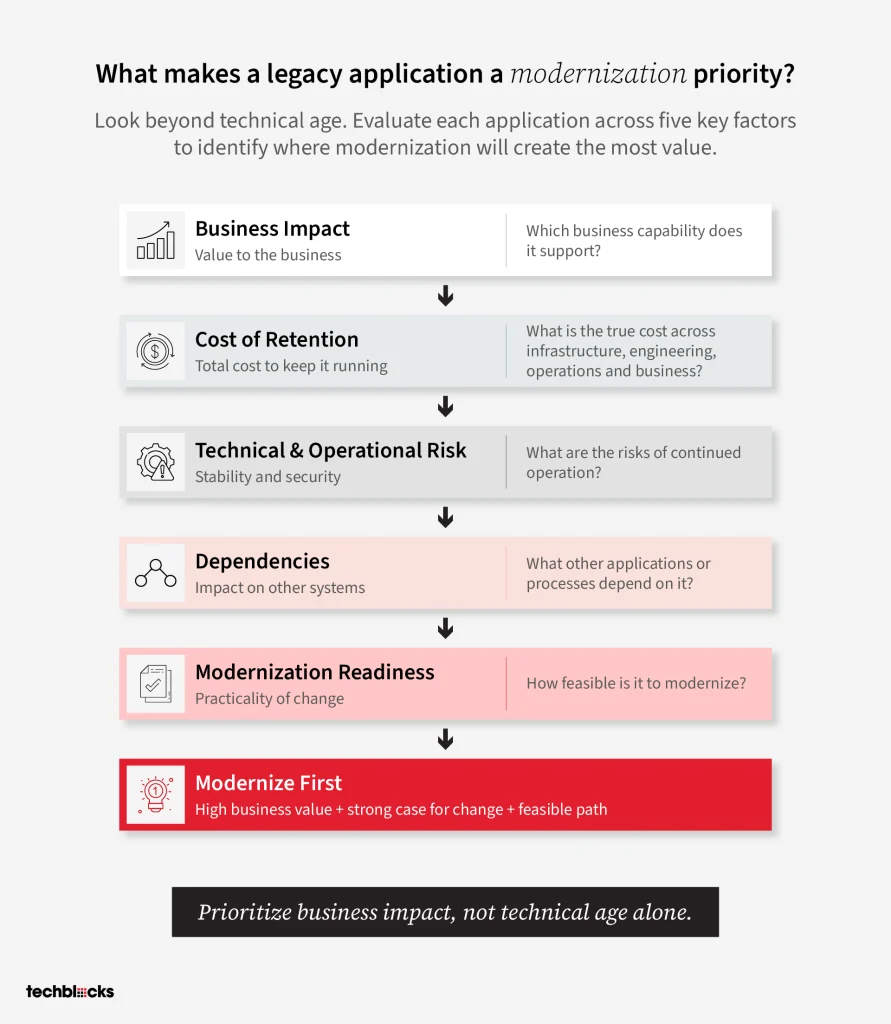
Modernization prioritization starts with understanding which applications create the greatest constraints on the business. Technical age, technical debt, infrastructure cost, and architectural complexity can indicate problems, but none necessarily determines where modernization should begin.
An older internal system may support a stable, low-change process with limited strategic importance. A newer customer or revenue platform may create a much larger constraint by slowing releases, limiting new capabilities, or requiring costly work across other systems. The key distinction is between technical condition and business impact. A stronger assessment starts by connecting each application to the business capability it supports and asking five questions:
| Assessment area | What to establish |
| Business criticality | Which business capability depends on the application? |
| Revenue & customer impact | What commercial or customer consequences follow from limited application capability? |
| Change demand | How frequently does the business need to modify or extend the application? |
| Strategic relevance | Does the application support a capability the enterprise intends to grow or differentiate? |
| Business constraint | What initiatives become harder, slower, or more expensive because of the current architecture? |
The priority should therefore reflect the business constraint created by the current application, not simply the severity of its technical problems. An application becomes a strong modernization candidate when its limitations materially restrict an important business capability and the organization has a clear reason to change it.
Assess the Cost and Risk of Your Legacy Application Portfolio
Once business priority is established, the next question is what the enterprise is paying to keep the current application in place. For legacy systems, the cost rarely appears in a single budget line. Finance sees infrastructure and licensing. Engineering sees maintenance work. Operations sees incidents and manual intervention. Security sees unsupported components and remediation. Product teams see release delays and constrained functionality.
Each function sees a different part of the application’s cost.
That fragmentation can distort modernization decisions. An application may appear inexpensive when assessed only through annual run costs, while engineering spends significant capacity keeping it operational. Product teams may absorb the larger consequence through delayed releases or constrained capabilities. Security and operations may carry additional risk without it appearing in the application’s technology budget.
A portfolio assessment should bring those costs together:
| Cost category | What to examine |
| Run cost | Infrastructure, licenses, support, and maintenance |
| Change cost | Engineering effort, testing, release preparation, and integration work |
| Risk cost | Incidents, unsupported technology, security exposure, and recovery complexity |
| Business cost | Delayed releases, constrained capabilities, lost engineering capacity, and deferred initiatives |
The modernization decision should compare the full cost of retention with the investment required to change the application. Technical debt alone is not enough to justify modernization. The case becomes stronger when maintenance burden, operational risk, business constraints, and future requirements combine to make the current architecture increasingly expensive to retain.
The question is not simply what the application costs to run. It is what the enterprise continues to pay—in money, capacity, risk, and lost opportunity, by keeping the current architecture.
Map Application Dependencies Before Modernization
When an application sits at the center of several business processes, modernizing the application alone can create more risk than value.
An order-management platform, for example, may connect pricing, inventory, payments, fulfillment, customer data, reporting, and external partners. Replacing the core application without understanding those relationships can disrupt downstream processes, require coordinated changes across multiple systems, or turn one modernization initiative into an unexpectedly large transformation program.
Before selecting an application for an early modernization wave, the dependency picture needs to answer four questions:
- What does the application depend on?
Databases, APIs, shared services, infrastructure, external platforms, and data feeds. - What depends on the application?
Customer channels, operational workflows, downstream applications, reporting, and business processes. - Where does change propagate?
Shared databases, tightly coupled integrations, synchronous calls, batch processes, duplicated data, and manual handoffs can all increase modernization complexity. - Which business capabilities are connected?
A dependency becomes far more significant when it crosses critical capabilities such as order management, pricing, payments, fulfillment, or customer service.
The exercise can produce a very different modernization sequence. A high-value application with manageable dependencies may be ready for an early wave. Another high-value system may require foundational architecture work first. A relatively low-value application can become strategically important when several priority systems depend on it.
The application portfolio needs to be understood as an interconnected business system before individual applications are assigned modernization priority.
Build the Business Case for Legacy Application Modernization
Once business impact, cost, risk, and dependencies are visible, the modernization case has to survive an investment conversation. Technology teams often present modernization through architecture: outdated frameworks, unsupported components, brittle integrations, or limited scalability. Senior leadership needs a broader equation. How much capital will modernization require? What operating cost can be removed? Which business capabilities become easier to change? What risk can be reduced? What new revenue, efficiency, or customer capability can the investment enable?
The strongest business cases connect the application to measurable consequences rather than promising a generic “modern platform.”
For example:
A legacy application may support a high-value business process but require significant manual intervention every month. Modernization expenditure then needs to be weighed against the operational effort removed, engineering capacity released, incident exposure reduced, and business changes accelerated.
Another application may have severe technical limitations but little strategic relevance. Retirement could produce a better return than rebuilding it.
The investment decision should account for:
- Modernization investment — architecture, engineering, migration, testing, data, and integration work
- Cost of retention — ongoing maintenance, infrastructure, support, and specialist skills
- Risk exposure — security, compliance, resilience, and operational failure
- Business value released — faster change, new capabilities, improved customer experience, and revenue enablement
- Portfolio impact — dependencies or shared capabilities unlocked for subsequent modernization
The result is a business case grounded in the economics of change versus the economics of retention. An application does not become a modernization priority simply because it is expensive or technically outdated. The investment becomes easier to justify when changing the application can release meaningful business value, reduce material risk, or remove constraints affecting subsequent transformation.
The business case should ultimately answer a straightforward leadership question: What does the enterprise gain by changing this application now, and what does it continue to lose by keeping the current architecture?
Choose the Right Modernization Strategy: Rehost, Replatform, Refactor, Rebuild, Retire, or Retain
Not every application selected for modernization needs the same treatment.
- Rebuilding everything is rarely a modernization strategy. It can turn a portfolio problem into a series of large, expensive transformation projects.
- Rehosting can provide a faster path away from aging infrastructure, but moving an unchanged application to the cloud does little to address architectural constraints.
- Replatforming can improve the operating environment with less disruption. Refactoring can improve maintainability and scalability, while rebuilding may make more sense when the existing application no longer supports the business capability effectively. In other cases, retirement is the highest-value decision.
The 6R framework gives portfolio teams a way to make those choices deliberately:
| Strategy | When it may make sense |
| Rehost | Move the application with minimal changes when the immediate priority is leaving aging infrastructure. |
| Replatform | Move to a more suitable platform while making targeted application changes. |
| Refactor | Improve the existing architecture incrementally when the application remains valuable and can evolve without a full rewrite. |
| Rebuild | Create a new implementation when the existing design can no longer economically support future requirements. |
| Retire | Remove the application when its business capability is no longer required or can be replaced elsewhere. |
| Retain | Keep the application when intervention would create less value than continuing to operate it. |
The important decision isn’t simply selecting an R. The modernization path needs to reflect the application’s business role, current constraints, future requirements, and the level of change the organization can realistically support. The right strategy may therefore range from minimal intervention to complete replacement, or no modernization at all. Choosing deliberately prevents the modernization program from treating every legacy application as a rebuild project.
Build a Legacy Application Modernization Roadmap
Prioritizing applications is only the first step. The next challenge is deciding which applications to modernize first, what needs to happen before each initiative, and how much transformation the organization can execute at once.
An application may rank highly in the portfolio but still be a poor candidate for the next modernization wave. A critical dependency may need to be addressed first. A shared platform capability may need to be established before several applications can move. A major business initiative may also create a specific timing requirement. The roadmap needs to account for such factors rather than simply moving applications down a ranked list.
Business timing can elevate one application over another. Dependency removal can make a lower-priority system worth addressing earlier. Architecture readiness can determine whether a high-value candidate is genuinely executable. An early modernization wave may also need to establish a shared capability required by several later initiatives.
A roadmap should make four decisions visible:
- Investment timing: Which applications move now, later, or not at all?
- Prerequisites: Which data, integration, platform, or architectural changes need to happen first?
- Expected outcome: What business value should each modernization wave release?
- Decision points: When should leadership reassess the portfolio before committing further capital?
The roadmap should also remain open to reprioritization. Business strategies change. Application usage changes. Dependencies evolve. New risks emerge. A five-year plan built around today’s application priorities can become irrelevant long before the final wave begins.
For complex estates, the roadmap should connect modernization waves to business capabilities, SLAs, and P&L impact, giving leadership a clear view of what is changing, why it is changing now, and what the organization should gain from each wave.
Conclusion: Modernize the Applications With the Highest Business Impact
Legacy modernization doesn’t require transforming every aging system. Some applications warrant immediate investment because the current architecture is restricting an important business capability. Others can wait, move through a lighter modernization path, or leave the modernization portfolio entirely.
The quality of the program ultimately depends on how well leadership distinguishes between applications worth changing, applications worth sequencing later, and applications worth leaving alone. The strongest modernization programs create measurable improvements beyond technology: faster delivery, greater operational agility, lower manual effort, and a stronger foundation for future business growth.
TechBlocks has helped enterprises achieve those outcomes through modernization programs, including 70% greater delivery agility for a global B2B travel logistics leader, 35% higher agent productivity for a global pharma and clinic network, and 50% lower manual effort for a global automaker.
If your application portfolio has more modernization candidates than your organization can realistically tackle, the next step is not another application inventory. It is identifying where modernization can create the greatest business impact, which applications should move first, and what path each one should take.
Make Your Next Modernization Investment Count
Identify the applications where transformation can deliver measurable business and operational impact.
FAQs on legacy application portfolio
Assess business criticality alongside application architecture, technical debt, change frequency, operating cost, dependencies, security exposure, and future requirements. A technically outdated application with low business demand may warrant retirement, while a strategically important system may justify refactoring or rebuilding.
Map upstream and downstream applications, APIs, databases, shared services, data flows, and integration points before committing a system to a modernization wave. Dependency centrality can make a lower-priority application an important prerequisite for modernizing higher-value systems.
Refactoring can make sense when the existing application still represents a valuable business capability and its underlying architecture can be incrementally improved. Rebuilding becomes more compelling when business requirements have moved substantially beyond the existing design or accumulated architectural constraints make incremental change uneconomical.
Build the business case around both modernization cost and cost of retention. Include infrastructure and licensing, engineering maintenance, specialist skills, operational incidents, security remediation, release friction, and the business value associated with faster change or newly enabled capabilities.
Combine business priority with dependency readiness, architectural prerequisites, delivery capacity, modernization effort, risk, and expected value. Each wave should have a defined scope, investment requirement, dependency plan, and measurable business or operational outcome rather than simply grouping applications by technology stack.